
Guess the Fairy Tale: A Quiz for Favourite Children's Stories
A quick 8-question quiz about well-loved children's fairy tales that checks whether you understand why the characters act as they do — not just whether you remember their names.
How This Quiz Works
In this quiz you'll test how well you really understand your favourite fairy tales. We won't just ask who said what — you'll think about why the characters behave the way they do, and what might have happened if they'd chosen differently. Take your time answering, then read the explanation afterwards to learn something new: every question tells you why the right answer is right and why the other three don't work.
The Quiz: 8 Questions About Favourite Fairy Tales
Guess the Fairy Tale
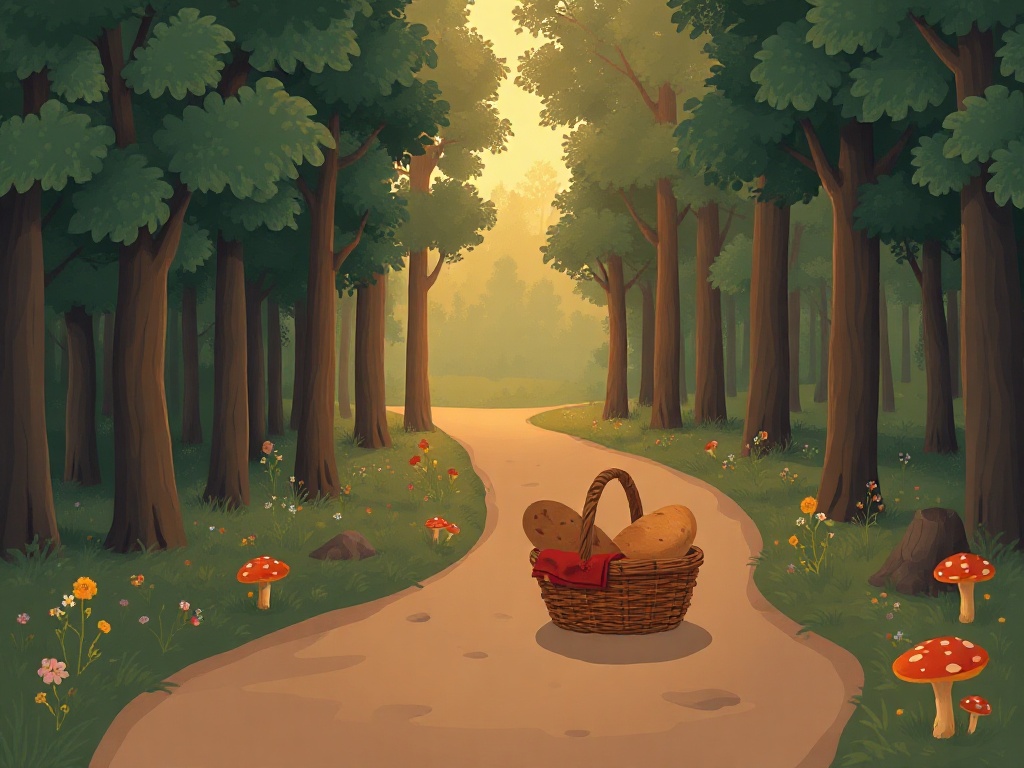
1. In "Little Red Riding Hood", the girl sets off through the forest. Why does her mother warn her not to stray from the path?
- Because she might meet strangers in the forest and get lost
- Because the path is the quickest way to Grandmother's house
- Because her mother wants the cake to arrive while it is still warm
- Because the woodcutters are working deeper in the forest and must not be disturbed
Answer and explanation
Because she might meet strangers in the forest and get lost
Her mother is worried about her safety, not about how long the journey takes. That is exactly what happens: the moment Red Riding Hood leaves the path to pick flowers, the wolf gets his chance. The other answers are all about speed or convenience — the quickest route, a warm cake, undisturbed woodcutters — and none of them explains why leaving the path turns out to be dangerous rather than merely slow.
2. The Three Little Pigs build houses of straw, sticks and bricks. Which of these would have made the straw house safe as well?
- Building it from a heavy material whose parts are firmly joined together
- Making the straw walls twice as thick as before
- Building it last, once the pigs had more practice
- Adding a second door so the pigs could run out faster
Answer and explanation
Building it from a heavy material whose parts are firmly joined together
Strength comes from the material and from careful building, not from thickness, timing or an extra way out. Bricks are heavy and mortared together, so the wolf's breath cannot shift them. Twice as much straw is still straw and still light enough to blow away; building later doesn't change what the walls are made of; and a second door only helps you run away — it doesn't keep the house standing.
3. In "The Enormous Turnip", even the little mouse joins in at the end. What does this ending teach us?
- That even the smallest help matters when everyone pulls together
- That the strongest puller should always take hold first
- That the old man should have waited until the turnip stopped growing
- That the work would have been easier with a smaller turnip
Answer and explanation
That even the smallest help matters when everyone pulls together
The mouse alone couldn't have done it — but added to everyone else's effort, it makes all the difference. That is the whole point of the story. The order of the pullers isn't what solves the problem, waiting longer would only have made the turnip bigger, and wishing for a smaller turnip avoids the task instead of showing how it was finally done.
4. Pinocchio tells a lie and his nose grows. What is the growing nose in the story?
- A visible sign of something Pinocchio is trying to hide
- A spell the Blue Fairy renews every morning
- A sign that he is slowly turning into a real boy
- A warning that someone else in the room is lying
Answer and explanation
A visible sign of something Pinocchio is trying to hide
The growing nose is the story's way of showing that a lie is revealed sooner or later. It reacts to Pinocchio's own words, not to a daily spell and not to anyone else's dishonesty. And it is the opposite of becoming a real boy: Pinocchio earns that by telling the truth and caring for others, not by lying.
5. The other birds avoid the Ugly Duckling. Which sentence best explains why everything changes in the end?
- He grows up and turns out to be a swan — he was simply different, not ugly
- He finally learns to behave the way the ducks expect him to
- The other birds feel sorry for him and take him back
- He proves himself by becoming the fastest swimmer on the pond
Answer and explanation
He grows up and turns out to be a swan — he was simply different, not ugly
Being different isn't a flaw — sometimes others simply don't know what you'll grow up to become. Nothing about the duckling's behaviour changes: he doesn't learn duck manners, he isn't forgiven by the farmyard, and he wins no contest. He simply grows into the bird he always was, and the swans recognise him at once.
6. In "The Wolf and the Seven Little Goats", the wolf whitens his paw and changes his voice. What does this tell us about the kids?
- That they checked by voice and by paw, so the wolf had to fool both
- That they opened the door to anyone who knocked politely
- That they had been told to wait for a password from their mother
- That they recognised their mother by her smell rather than her voice
Answer and explanation
That they checked by voice and by paw, so the wolf had to fool both
The little goats were careful — that's why the wolf had to trick every single one of their checks. If they had opened up for any polite knock, the wolf would not have needed chalk for his voice and flour for his paw. There is no password in the story, and it is the sight of the white paw under the door, not a smell, that finally convinces them.
7. Imagine Hansel and Gretel had scattered breadcrumbs on their very first trip into the forest, instead of pebbles. What would most likely have happened?
- The birds would have pecked up the crumbs and the children still wouldn't have found their way home
- The trail would have shown up better than the pebbles, because bread is white
- The children would have been found sooner, because the birds would have led searchers to them
- Nothing would have changed, since the children already knew the way home
Answer and explanation
The birds would have pecked up the crumbs and the children still wouldn't have found their way home
Pebbles stay in place, but food disappears — that's why the choice of marker was so important. This is exactly what happens on the second trip in the real story. How white the crumbs look doesn't matter once they have been eaten, birds gathering in the forest attract no searchers, and the children clearly did not know the way home — that is why they needed a trail at all.
8. Looking back at all the tales in this quiz: which character wins through patient, steady effort rather than a quick shortcut?
- The third little pig, who takes the time to build with bricks
- The wolf, who looks for the fastest way into the goats' house
- Pinocchio, who tries to talk his way out of trouble
- The little mouse, who takes hold of the turnip at the very last moment
Answer and explanation
The third little pig, who takes the time to build with bricks
Fairy-tale characters win through patience and persistence, not through quick or dishonest shortcuts — the brick house takes the longest to build and is the only one still standing at the end. The wolf and Pinocchio are the shortcut-takers here: one looks for the fastest way in, the other tries to lie his way out, and neither succeeds. The mouse does help, but its lesson is about everyone pulling together in one final moment, not about long, patient work.