
My Child Won't Fall Asleep Alone in Their Room: A Parent's Guide With a Bedtime Story and Two Evening Steps
Written for parents and carers (adult reading in the parenting and family section, not a children's article): a story about Mia and the night lamp to read aloud, plus a gentle two-step evening plan for children aged 5-7 who cry or call out once they are left alone in their room. The check-in step is a familiar technique - often called graduated check-ins, 'camping out' or controlled comforting - and there are no promises of a miracle overnight fix.
It's half past eight. The blanket is pulled up to the chin, the lamp is on, the story has been read twice. You head for the door, and from the bed comes the same sentence as last night: "Stay a little longer." If you leave now, you'll probably hear crying in a few minutes. If you stay, you may well be the one who falls asleep - not your child.
This piece is written for the adults in the room - parents and carers of children between 5 and 7, kids who can already tell you what scares them, but don't yet know how to calm themselves down. It belongs in the parenting and family section rather than the children's one: it is general family reading for grown-ups, not material for children to read on their own. Inside you'll find a story to read aloud to your child and two concrete steps to try over the next two weeks - one of them a long-established sleep technique, the other a small homemade tool you can put together this afternoon.
Why a night lamp rarely solves the problem
The first thing many of us buy is a lamp. Then a stuffed animal, then glow-in-the-dark stars on the ceiling. And still the child calls out ten minutes later. The reason is often simple: they aren't watching the dark - they're watching the door. The fear keeping them awake is usually described as separation anxiety - the worry that you'll vanish while their eyes are closed. That's why a lamp helps most with the child who is genuinely startled by shadows on the wall. For others, it ends up being just one more thing in the room that isn't mum.
The opposite approach doesn't work either. If you lie down next to your child until they fall asleep, they fall asleep with you there - and at two in the morning, when they wake for a few seconds, you're gone, and the condition under which they fell asleep is broken. That's one common explanation for the midnight visits to your bedroom.

A story about Mia and the lamp that counts
Read it slowly. Pause where your child nods along - that's their story.
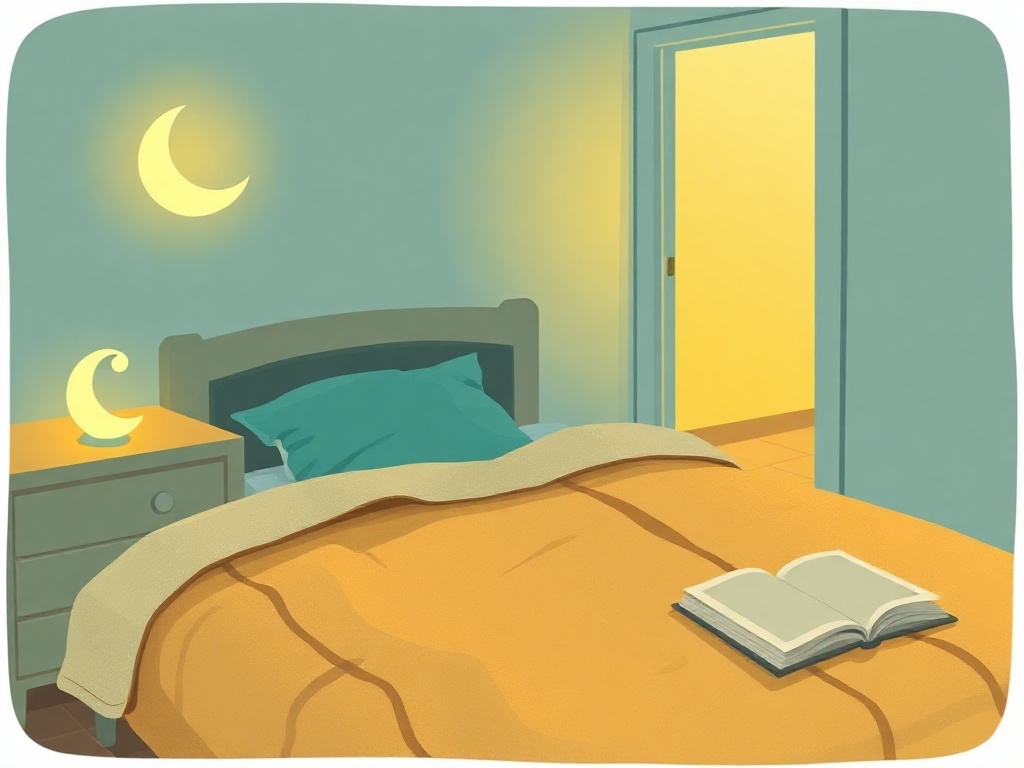
Mia had a room with a yellow wall, a bed by the window, and a lamp shaped like the moon. Mia loved her room - during the day. In the evening the room somehow grew bigger, and the door somehow grew further away.
One evening, when Mum went out, Mia asked the moon: "Are you staying?"
"I'm staying," said the moon. "I've got nothing else on."
"What about Mum?"
"Mum's in the kitchen. Want me to show you how to check, without getting up?"
Mia nodded.
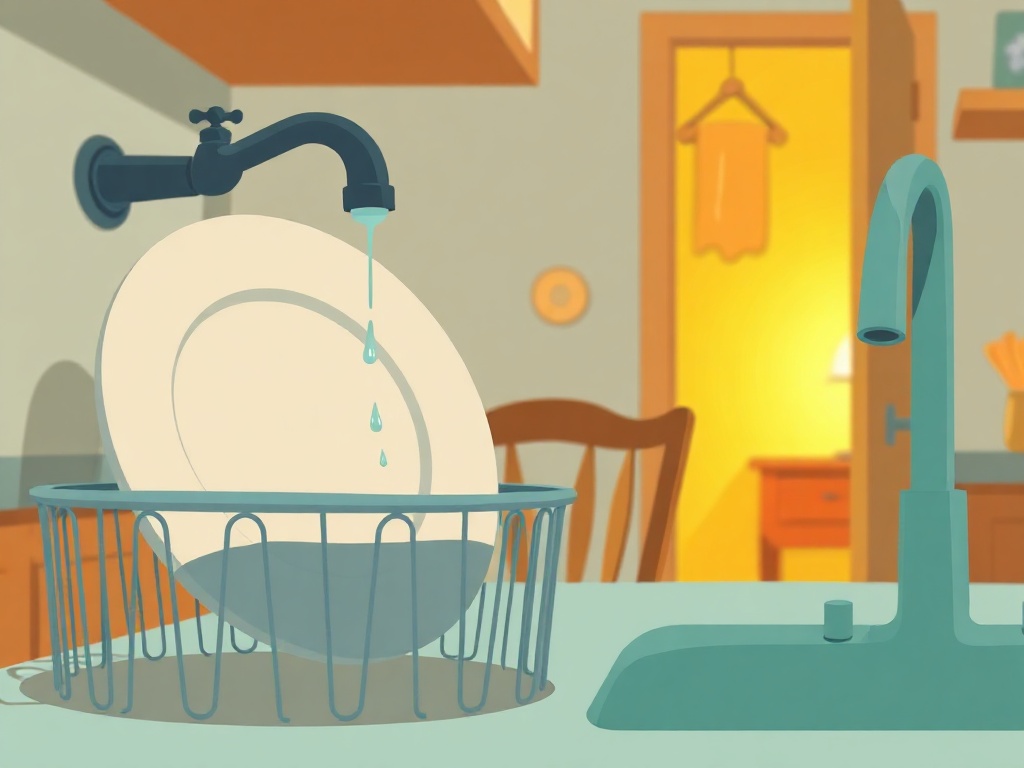
"Count with me," said the moon. "One - do you hear the plate? Two - do you hear the tap? Three - do you hear the chair? That means Mum's there."
Mia counted. The plate was there. The tap was there. The chair creaked.
"What if I don't hear anything?"
"Then call out once. Mum comes, rests a hand on your back, and leaves again. That's her job - to keep coming back."
Mia called out once. Mum came, rested a hand on her back and said: "I'm here. I'm going out, and I'll come by again."
And she did - once, then once more, and by the third time round, Mia was already asleep with a hand tucked under her cheek.
In the morning Mia asked the moon: "When did I fall asleep?"
"Between the second and third time she came by," said the moon. "Every night it's a little sooner."
The two steps that can change the evening
The idea is simple: your child needs proof that you'll come back - without you staying. So the return visits are kept short, predictable, and are spaced further apart over time. This is not a new invention: parenting and sleep literature has described it for years under names like graduated check-ins, 'camping out' or controlled comforting. What follows is simply one concrete way to run it at home, with a small box of answers added on top.
The check-in you promise in advance
All you need is a clock in the kitchen and one sentence said before you leave: "I'm going out, I'll come back in two minutes." You come back, rest a hand on your child's back, say the same three words - "I'm here, sleep" - and leave again without sitting down. The second time, come back after five minutes; the third, after ten. The whole routine takes roughly a quarter of an hour a night and suits children aged 5-7. Many parents count it a success once their child falls asleep before the third check-in on most evenings of the week. This kind of gradual, predictable return is the same technique described in the NHS advice pages on children's sleep problems and in the American Academy of Pediatrics' parent guidance on bedtime routines, where it appears as graduated check-ins or controlled comforting.
The box of nighttime answers
Grab a shoebox or a zip-lock bag, six slips of paper, and some coloured pencils; stick on a family photo if you like. For about 20 minutes in the afternoon - not at bedtime - draw one question your child asks at night on each slip: "Where are you?", "Is the door locked?", "Will you come back?". On the back, write the answer in one short phrase, and let your child learn it by heart. At night the box sits by the bed, and instead of calling out, your child pulls out a slip. Best suited to ages 5-7, with an adult preparing it together with the child. You'll notice it's working when, every now and then, your child says in the morning: "I pulled out the door one, and then I fell asleep."
The most common mistake: sneaking out while your child isn't looking
Many parents wait for their child to turn toward the wall, then slip out quietly. It works - once. After that the child starts fighting sleep, because they've noticed that the moment they close their eyes, you disappear. From there come the requests for more water, one more story, one more trip to the toilet. That's usually not being difficult - it's an attempt to keep you in sight.
The other common mistake is bargaining: "If you fall asleep on your own, I'll buy you something tomorrow." A small toy really does work - for one night. By the third night, though, a child wants something bigger, and you can find yourself haggling over price at nine in the evening instead of switching off the lamp. A reward addresses motivation - but here the difficulty is not motivation, it's security.
- Try not to promise "I'll stay until you fall asleep" if you plan to leave sooner - children check.
- Try not to ask "what are you afraid of?" right before bed; the question stirs up the image. Ask in the afternoon instead.
- Try not to change the rules every night - predictability is half the effect.
- If the other parent does things differently, agree on the approach before dinner, not in the hallway outside the bedroom.
"I'm here. I'm going out, and I'll come by again." - three sentences that can do more than half an hour of sitting on the edge of the bed.
What to expect in the first two weeks
The first two or three nights are often louder, not quieter - your child is testing whether the new rule really holds. If you stick to the same sentences and the same order, many families find that by the end of the first week the gaps between calling out grow longer. Many parents treat the change as lasting once their child falls asleep alone on most nights of the week. Every child moves at their own pace, so take these timings as a rough guide rather than a rule. Keep in mind the start of the school year too: in mid-September, once school and nursery kick off again, evenings often wobble for a few days. That doesn't mean you're back at square one.
One more thing rarely mentioned: bedtime itself matters just as much as everything else. A child who goes to bed very late can be overtired, and an overtired child cries more easily and falls asleep less easily. If dinner and bath time keep dragging on, shift the whole routine 20 minutes earlier for a week and see whether it makes a difference.
When it's worth talking to a doctor
This article is general parenting information written for adults, based on everyday family experience and on publicly available parent guidance about children's sleep - for example the NHS pages on sleep problems in children and the bedtime-routine advice published by the American Academy of Pediatrics. It is not medical advice, and it cannot replace an examination or the guidance of your own doctor. If your child's nights regularly look distressing to you, if their sleep or breathing seems unusual, or if the fear appears suddenly for no reason you can see, then it's worth a calm conversation with your paediatrician rather than another bedtime story. Whenever something about your child's sleep worries you, speak to a health professional first. In many other cases, this is simply a habit, and habits change through repetition.