
What You Can Actually See From a City Balcony in August
You don't need an observatory to show your child something real. From an ordinary city balcony in August, there are about a dozen things worth looking at — as long as you know what they are and where to look.
An August evening, 9:30 pm, a fifth-floor balcony. Your child looks up, watches for ten seconds, and says: "There's nothing. Just two dots." And they're completely right — that's exactly what you see in the first ten seconds. The problem isn't the buildings across the street; it's that the eyes haven't adjusted yet, and nobody's told them which of the two dots is a planet.
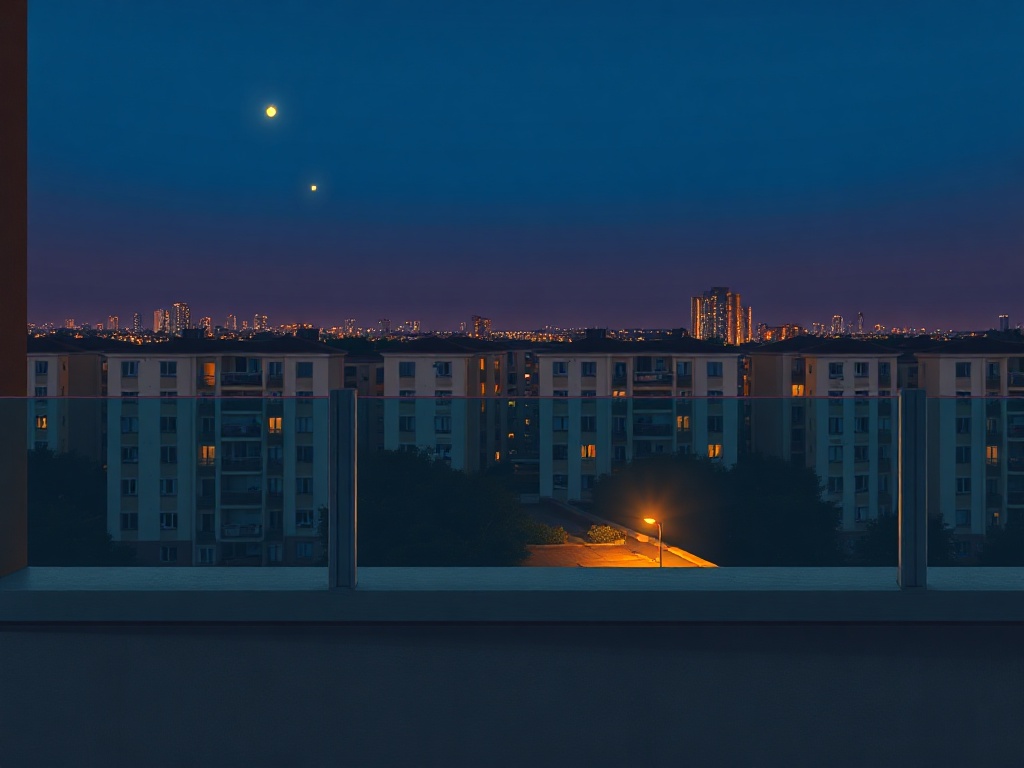
This is written for parents of children between 8 and 10 — the age when a child can already read names, remember directions, and stay put for twenty minutes without getting bored.
Why "you can't see stars in the city" is only half true
Light from streetlamps and shop windows really does brighten the sky and drown out faint stars. But brightness works like volume: quiet things get lost, loud things cut through the noise. Planets, the brightest stars, and the Moon are the "loud" objects. They're visible even from a balcony wedged between two buildings, or above a floodlit car park.
So don't set out on the first night to find constellations made of eighteen stars. Set out to find three or four points of light your child can point to and name. The difference between "I can't see anything" and "there's Vega" is one named object.
Realistic goals for August
- The Moon — the easiest one. It's sometimes visible even before school in the morning, depending on its phase, which usually surprises kids.
- The Summer Triangle: Vega, Deneb, and Altair. Three bright stars high overhead that hold up against city lights. If your child remembers only these three, the evening was worth it.
- A bright planet low on the horizon. Planets don't twinkle, but stars do — that's the most reliable way for a child to tell them apart on their own.
- The International Space Station. It looks like a very bright plane with no blinking lights, moves silently, and crosses the sky in a few minutes.
- The Perseids — the meteor shower that peaks around 12 August. From the city you'll only catch the brightest ones, but "only the brightest ones" is still something worth watching for.
One word of warning about expectations: the photos you see online are taken with long exposure and special equipment. The naked eye will never see a sky like that — not from a balcony, not from a mountaintop. Say this up front so there's no disappointment later.
Twenty minutes in the dark
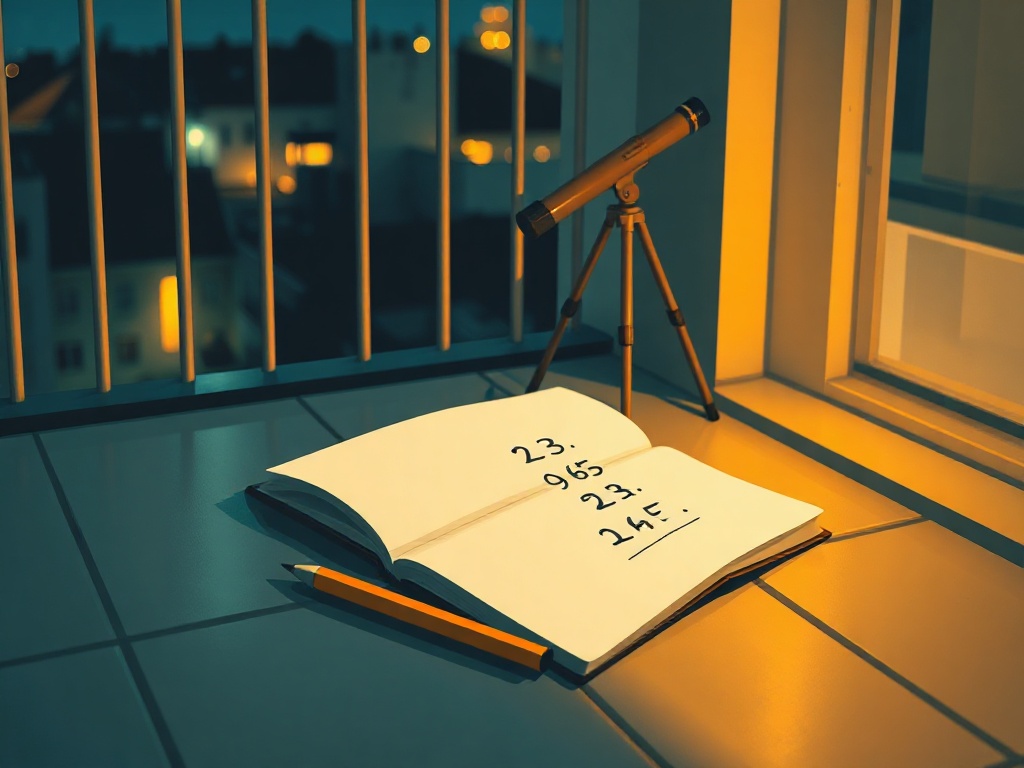
Turn off the light in the room facing the balcony, and bring only two things outside with you — a small notebook and a pencil (the phone stays inside; the screen ruins everything in seconds). For the first five minutes, don't look for anything specific: just sit and let your eyes adjust. At the five-minute mark, your child counts how many dots they can see and writes the number down, then does the same at ten minutes and again at twenty. The activity takes 20 minutes, suits 8-10-year-olds, and almost always ends with numbers like 6, then 14, then 25. Call it a success if your child says on their own that they can see more than before — that's the moment they realise the sky hasn't changed, their eyes have.
How your child can spot a planet on their own
There's one simple test, and it works from any balcony. Stars are so far away that their light arrives as a thin thread, and the air makes it wobble — which is why they twinkle and sometimes seem to change colour. Planets are closer, shine as a small steady disc, and hold still.
Give your child the line ahead of time, so they've got something to say: "That one's flickering, so it's a star. That one's holding steady — it's a planet." Kids this age love having a ready-made line that makes them sound confident.
Balcony map
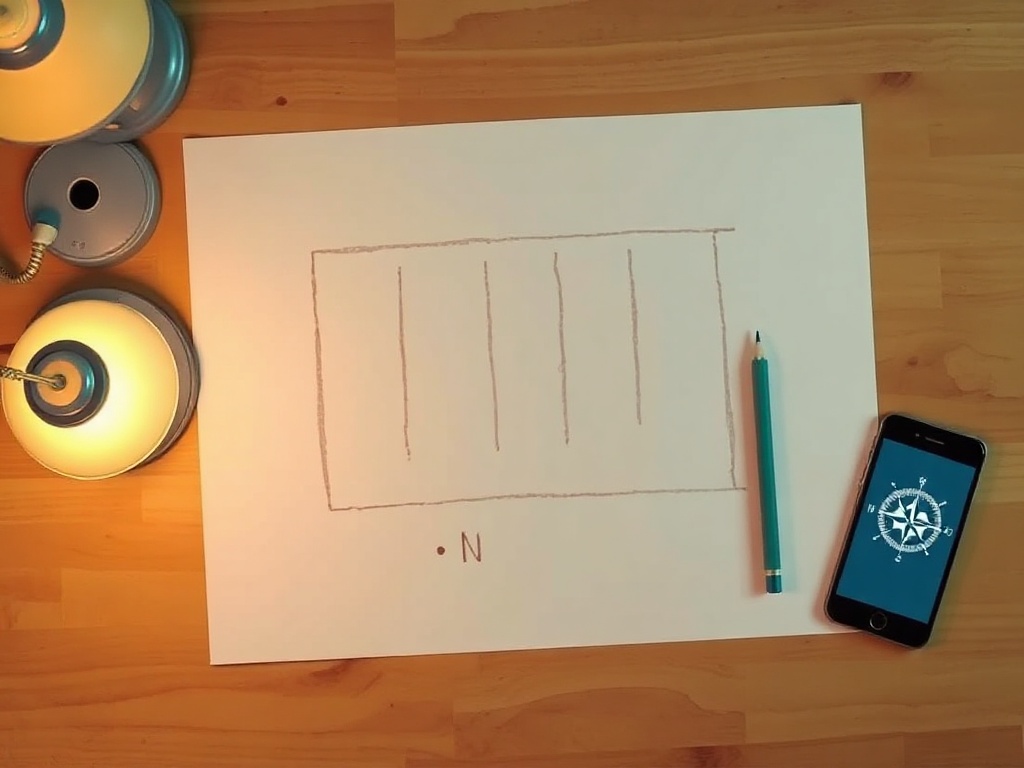
You'll need a sheet of A4 paper, a pencil, and the compass app on your phone (used just once, at the start — then the phone goes back inside). Draw a rectangle to represent the railing, and mark which way is north. Then, at the same time each evening — say 9:30 pm — your child marks a dot where they see the brightest light and writes the date next to it. It takes about 10 minutes an evening, works best with 9-10-year-olds since it takes a few days of patience. You'll know it's worked when, after four or five evenings, one of the dots has clearly shifted position relative to its neighbours on the page — your child has just discovered, on their own, the difference between a planet and a star, without anyone telling them.
A common mistake: starting with a telescope
Many parents' first instinct is to buy a cheap telescope "to start off with." Here's what actually happens: the telescope has a tiny field of view, wobbles on its flimsy tripod, and flips the image upside down. The child can't find anything in it, loses interest within fifteen minutes, and the thing ends up in a cupboard. Not because the child wasn't interested — but because you handed them the hardest tool first.
The reverse order works better. Start with the naked eye and naming a few bright objects. Then, if the interest lasts a month or two, bring out whatever binoculars you already have at home — with those, the Moon looks astonishing, and you can even spot Jupiter's moons as a tiny row of dots. And only at the very end, if your child is still asking on their own, does it become telescope time.
A second common mistake: stargazing with a phone lit up in hand. It takes about twenty minutes for eyes to adjust to the dark, and one flash of screen light sends that back to almost zero. If you genuinely need a screen, turn the brightness all the way down and switch to red/night mode if your phone has one.
"We're not looking for lots of stars. We're looking for three whose names we know."
What to say when your child asks something you don't know
They will ask. Usually "how far away is it" or "what's out there." The most useful answer isn't a made-up fact — it's: "I don't know. Let's write the question down and check tomorrow." The notebook from the first activity does exactly that job — dot counts on one page, questions on the other.
If you'd like somewhere to check those answers, local science centres and school observatories often hold public evenings, and admission is usually a few euros — typically €1 to €3 for a child. Call ahead, though, since these get cancelled if it's cloudy.
When exactly to go outside
In August it gets dark late — true darkness doesn't arrive until after 9 pm. For a child starting school again in mid-September, that's late, so the first week of the summer holidays is a better time for this than the last. Twenty to thirty minutes is plenty. If you go out "for an hour and a half, to do it properly," your child won't want to go out again next time.
One more small but important thing: pick the balcony that faces away from the brightest streetlamp, position yourself so the building opposite blocks it from view, and don't look upward from a spot where light shines straight into your eyes. Half the trick is simply where you stand.