
"Where Does the Electricity in the Outlet Come From?" — How to Answer a 7-9 Year Old Honestly (A UK Parent's Guide)
"Don't touch it, it'll shock you" stops the question but explains nothing. Here's how to trace electricity's path from a North Sea wind farm to the lamp in your hallway — and turn the socket rule into something understood, not something feared.
Your eight-year-old pulls the charger out of the socket, turns around, and asks: "But is there electricity inside the wall even when nothing's plugged in?" You're holding a plate and answer on autopilot: "There is, don't touch it!" The question is closed. Except the child is left with a hazy picture — something dangerous and invisible lives in the wall, and it's not something you talk about.
The problem with that answer isn't that it's harsh. The problem is that it doesn't work. Fear protects a child while they're little and someone stands beside them. Then comes the age when they switch on the hair dryer alone, pull a plug with wet hands, and tuck the phone cable behind the bed. At that point "it's scary" no longer helps — "I know why" does.
Where electricity really comes from — the 7-9 year old version
Tell it as a journey, not a definition. Electricity isn't "made" in the socket. It arrives there after a long trip.
Somewhere far away — at a power station, or on a wind farm out in the North Sea — something big is spinning. It might be a turbine pushed by water; it might be a wind turbine's blades, turning slowly enough that you can count them from the car; it might be steam from heated water. That spinning drives a generator, and the generator pushes tiny particles in wires to move. We call that movement electricity. From there it travels along thick cables, past the pylons that march across the fields beside the motorway, into a local substation — that humming grey box behind a fence with a yellow lightning-bolt sign your child has walked past a hundred times — then into the street, into the building, up through the walls to the consumer unit (the box of switches in the hall cupboard), and out at the socket in the room. The socket is simply the end of the journey. Like a tap — water isn't born in the tap, it arrives there.
And the single most important sentence, worth saying in exactly these words: electricity always looks for a path downward, toward the ground. If it finds a path through metal or water, it takes it. If it finds a path through a person, it takes that too. That's why it's dangerous — not because electricity is evil, but because it can't tell a wire from a finger. Worth adding one number, because children this age like numbers: the battery in a torch pushes with about 1.5 volts, and a UK socket pushes with 230 — roughly a hundred and fifty times harder.
Three things a child should know by heart
- Nothing goes into the socket holes except a plug. Not a hairpin, not a pencil, not a finger — even though the holes look just about finger-sized.
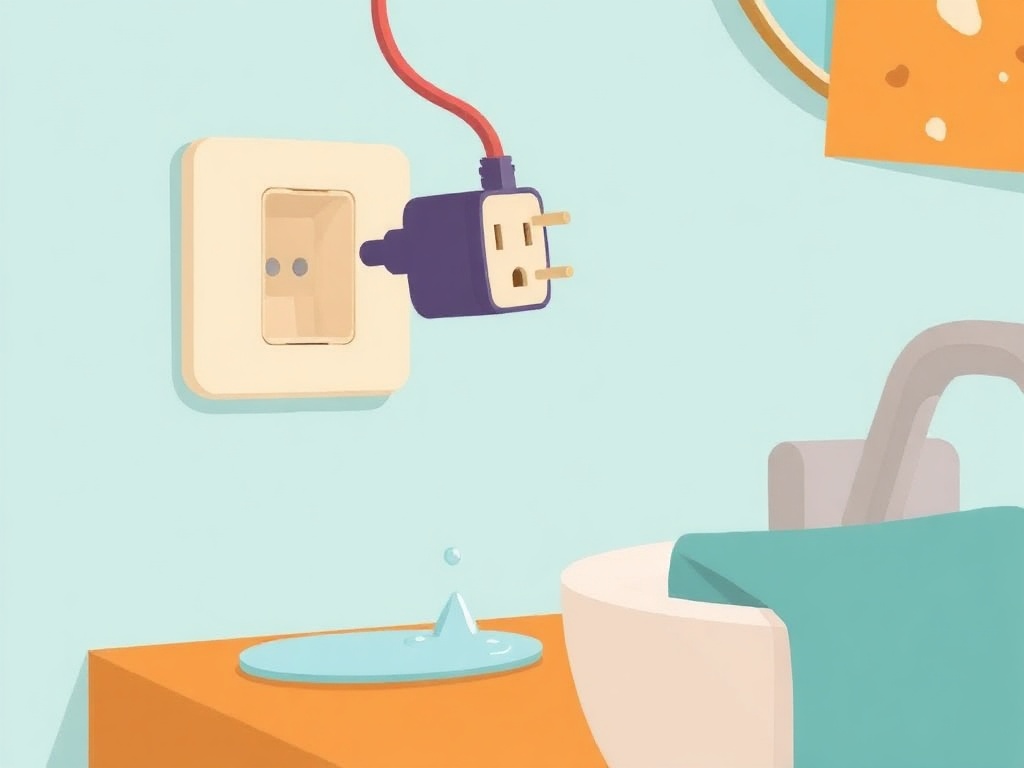
- Wet hands and electricity never mix. So don't touch a socket with hands damp from the bathroom, don't pull a plug with wet fingers, and don't use a phone while it's charging in the bath.
- Hold the plug by the plastic body, not the cord. Pulling on the cord slowly exposes the wires inside.
Here it's worth showing rather than telling, because a UK plug explains itself. Hand your child a BS 1363 plug — the standard square three-pin one on every kettle and lamp in the house — and ask them to spot which pin is different. The top one is longer. Get them to push just that pin gently into the top hole of a switched-off socket: the two little doors over the bottom holes click open. That's the shutter, and the long earth pin is the only key it accepts, which is exactly why a hairpin in the bottom holes gets nowhere. Then say the other half out loud: a hairpin in the *top* hole opens those doors too, so the shutter is extra protection, not a reason to drop the rule. Older sockets in an old flat, in a garage, or at Granny's house may have no shutters at all.
The Path of Electricity — from Wind to Lamp, Made of Paper
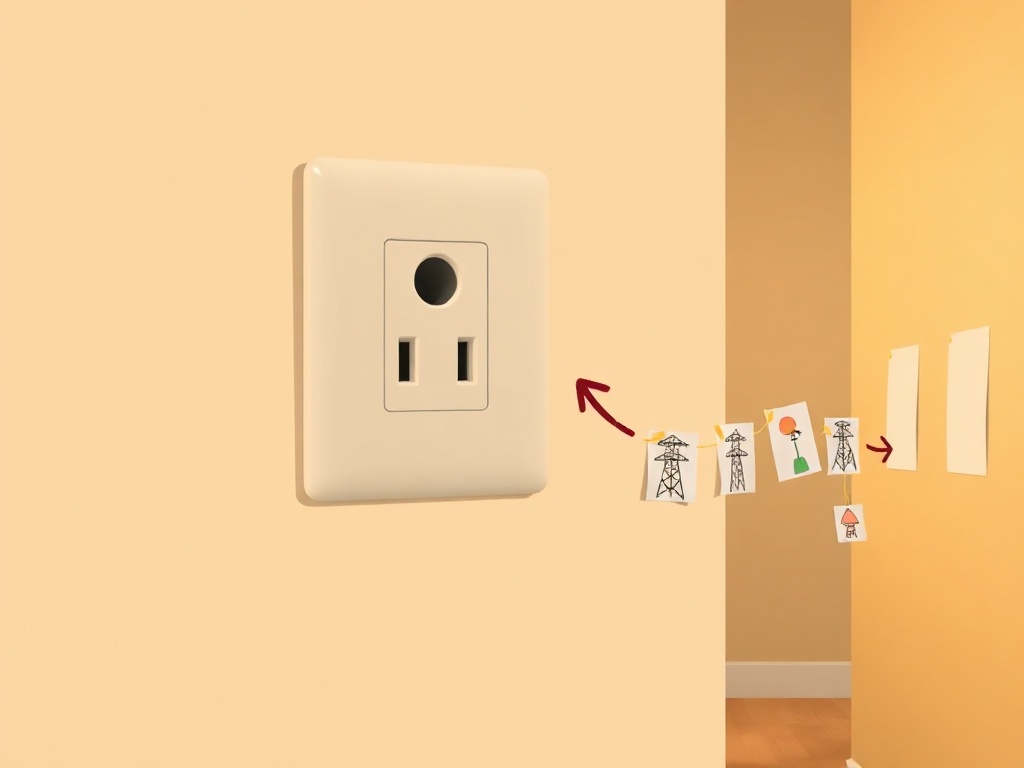
You'll need six sheets of A4 paper or card, a thick marker, and a bit of tape to stick them along the hallway. Set aside about 25 minutes; best suited for children aged 7 to 9. On each sheet, the child draws one stage: wind or water, a spinning turbine, a generator, tall pylons with wires, the substation and the consumer unit in the hall, a socket, and a lamp. Stick them in a row along the wall, and have the child walk past them narrating the journey aloud — they are the electricity. Then shuffle the sheets and let them put the sequence back together. One extra round that makes it stick: stand at the lamp and walk the route backwards, saying "and where did I come from?" at each sheet — children who can only recite it forwards usually stall at the pylons, and that's the stage worth going over again. The task is done when the child can order the stages correctly without help, in either direction, and answer "where does the path end?" with "at the lamp, when it lights up."
What Lets Electricity Through and What Doesn't — Sorting on the Kitchen Table
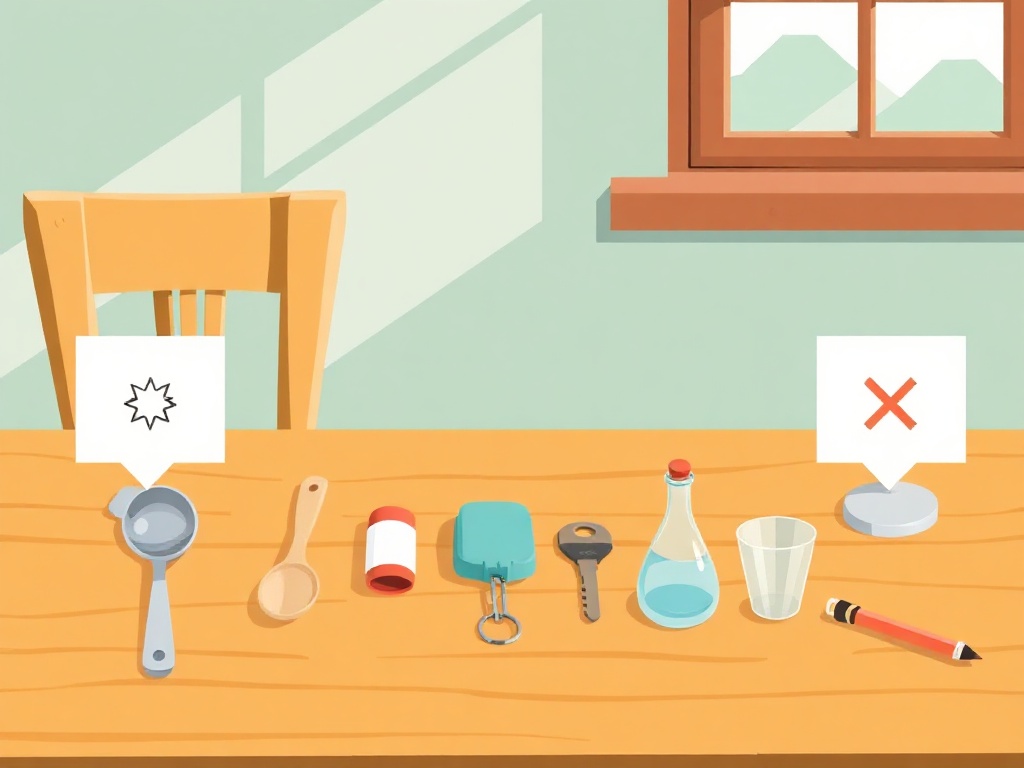
Gather about ten household items: a spoon, a wooden spoon, an eraser, a paperclip, a scrap of fabric, a key, a plastic bottle cap, a pencil, a glass cup, a 1p coin. Give the child two paper labels — "lets it through" and "doesn't" — and let them sort the items by guessing. It takes about 15 minutes and suits ages 7-9. If you have a children's battery-and-bulb kit, test a few items for real; if not, talk through the answers together — metal and water let it through, wood, plastic, glass, and fabric don't. Then run the round that isn't in the usual sorting game, and it's the one they remember: take one item that has already been filed under "doesn't" — a dry kitchen sponge, or a wooden lolly stick — soak it in water, and test it again with the same 1.5V battery and bulb. The bulb glows faintly where a moment ago it didn't. Stir a teaspoon of salt into a glass of water and touch both wires into it, and it glows brighter still. The point lands by itself: an object can change sides just by getting wet, which is why the rule isn't "don't touch metal" but "not with wet hands, ever." Consider it a success when the child states the rule themselves: "metal things let electricity through, and wet things do too, so I don't push metal things into the socket and I don't touch it with wet hands." No experiments with the mains socket itself — only with a battery, or just in conversation.
The most common mistake: "Electricity is very dangerous, don't even ask"
It sounds like firmness, but it's really a lid on curiosity. The child doesn't stop being curious — they just stop asking you. And next time they want to find something out, they'll run their own experiment while you're in the other room.
A second version of the same mistake is exaggeration. "You'll burst into flames," "you'll die on the spot," delivered wide-eyed. Some children this age can sense the story is overblown and start disbelieving everything you say — including the true part. Others get so frightened they're afraid to switch on the night light.
What actually works is a calm tone and specifics. Here's how that sounds in practice, in a real kitchen, with the plate still in your hand:
— Is there electricity in the wall even when nothing's plugged in?
— Yes, all the time. It's waiting in there, like water waiting behind a closed tap.
— Then why doesn't it come out?
— Because it has nowhere to go. It only moves if something joins the two holes — the plug does that, on purpose. A finger would do it by accident.
— And what would happen?
— The electricity in this socket is about a hundred and fifty times stronger than the one in your torch battery. If it goes through your hand it hurts a lot and it burns you, and your muscles squeeze so tight you can't let go. That's why only a plug goes in there.
— Okay. And if I put the plug in with one finger on the metal bit?
— Same problem. That's why we hold plugs by the plastic. Want to check how you're holding yours?
One sentence for the reason, one for the rule, and a question back at the end so the conversation stays open. No theatrics.
A rule a child can explain in their own words lasts far longer than a rule they've merely heard.
How to answer when you don't know
At this age the questions get uncomfortably precise: "Why don't birds on the power lines die?", "Does electricity ever run out?", "Why is the electricity bill so big if electricity is invisible?" It's fine not to know the answer straight away. Just don't make one up.
Say: "I don't know, let's find out together" — and actually look it up that same day, or the sentence loses its value. As for the birds, the answer happens to be lovely: they perch on only one wire, and electricity has no reason to pass through them because they're not touching anything else — not the ground, not a second wire. If that one's already been used up, there's a better version to point at from the car window: look at where the wires meet the pylon, at those stacks of grey discs strung like beads. Those are the insulators, and they're the reason the electricity stays in the wire instead of running down the metal legs into the field. Count the discs in a stack — the more there are, the harder the electricity in that line is pushing, which is why the pylons on the big cross-country lines carry longer strings than the little poles down the lane. A child who has counted them once looks at pylons differently forever.
A conversation about the bill that actually works
Connect the invisible to something the child understands — money. Show them the electricity bill and tell them how many pounds it came to this month. Point at the word "units" or "kWh" and explain it plainly: that's how electricity is counted, the way milk is counted in pints, and each unit costs a few pence. Then together find the appliances that use the most: the kettle, the tumble dryer, the immersion heater, the oven. Give them one concrete task for a week — switch off the light in their room whenever they leave for more than a few minutes. If you have a smart meter, let them read the number in the hall before and after boiling the kettle; the jump is instant and it delights them. At this age, children love tracking a result, and the next bill is exactly that. Don't promise the difference will be huge; promise you'll look at it together.
To make it even more tangible, compare it to something from their own pocket: a saving of around £2-3 is roughly what the little things they buy for themselves cost. That way "saving electricity" stops being abstract grown-up muttering.
What should stick after this conversation
- The child can narrate electricity's journey through four or five stops, in their own words.
- They know why the socket is dangerous, not just that it is.
- They can tell materials electricity passes through apart from ones it doesn't — and that water changes the answer.
- They ask you when something's unclear, instead of trying it out alone.
This isn't a lesson taught once and done. Come back to it when the power goes out in the street, when you spot engineers up a pylon, when the trip switch in the consumer unit goes and the hall lights die, or when your child first notices wind turbine blades from the car window. That's when the explanation lands on something seen, and it stays.