
Your Child Can Count to 100 — But Do They Understand Numbers? 6 Quick Checks for Parents
Counting to 100 isn't proof of understanding the base-ten system. Here are concrete questions and two games that let you find out in 15 minutes whether your child truly sees tens — or is just reciting.
A seven-year-old rattles off "eighty-nine" without a stumble, counts all the way to a hundred, and turns around with a grin. The parent asks: "What number is one more than 89?" Silence. Then: "Eighty-ten." This isn't a careless slip. It's the moment it becomes clear the child is reciting a string of words, not actually working with numbers.
In Year 1 and Year 2, counting to 100 is treated as a kind of finish line. Reach it, and you're considered ready. But the sequence of number-words is learned the same way a nursery rhyme or a song is learned — by ear and by rhythm. The base-ten system is something else entirely: understanding that 47 means four full tens plus seven more units, and that those four tens are forty separate things gathered into groups.

Who this is for
I'm writing for children aged 6 to 8 — from Reception right through the end of Year 2. It's exactly in this two- to three-year window that numbers either stay words or become quantities. If your child is older and still counts on their fingers for 30 + 20, the checks below still work — you'll just spot the gap faster.
Six questions that reveal the truth in five minutes
This isn't a test, and the questions shouldn't be fired off one after another like an interrogation. Drop them in at breakfast, in the car, while queuing at the shop. If your child trips on three out of six, the gap is in understanding tens, not in counting.
- "Count on from 87." A child who's only memorised the sequence often restarts silently from the beginning or stalls at 90.
- "What number comes before 70?" Counting backwards isn't learned like a song, so this instantly exposes the weak spot.
- "Count in tens: 10, 20, 30..." Then the harder version: "Now count on from 14 in tens." If 24, 34, 44 don't come, the ten hasn't been grasped as a unit.
- "How many tens are in 56?" The answer "five" is a good sign. The answer "fifty-six" means the number still isn't being broken down.
- "If I have 30 and take away 10, how many are left?" — asked with no objects in sight.
- "Which is bigger — 19 or 91?" followed immediately by "Why?" The explanation matters more than the answer.
Why English number words hide the problem
English has its own trap here. The teens — eleven, twelve, thirteen — don't obviously echo "one" and "two" the way, say, "sixteen" echoes "six", and children happily learn them as a block of separate names. That's exactly what misleads a parent: a child can say "seventeen" flawlessly and still think of it as just the name of one particular thing in a sequence, the way "Tuesday" is the name of a day. The check is simple: put 17 buttons on the table and ask your child to arrange them so it's instantly obvious there are seventeen. If they make one group of ten plus seven loose ones, they understand. If they line them up neatly one by one, they're still at the counting stage.
The egg-carton game
The ten you can actually see
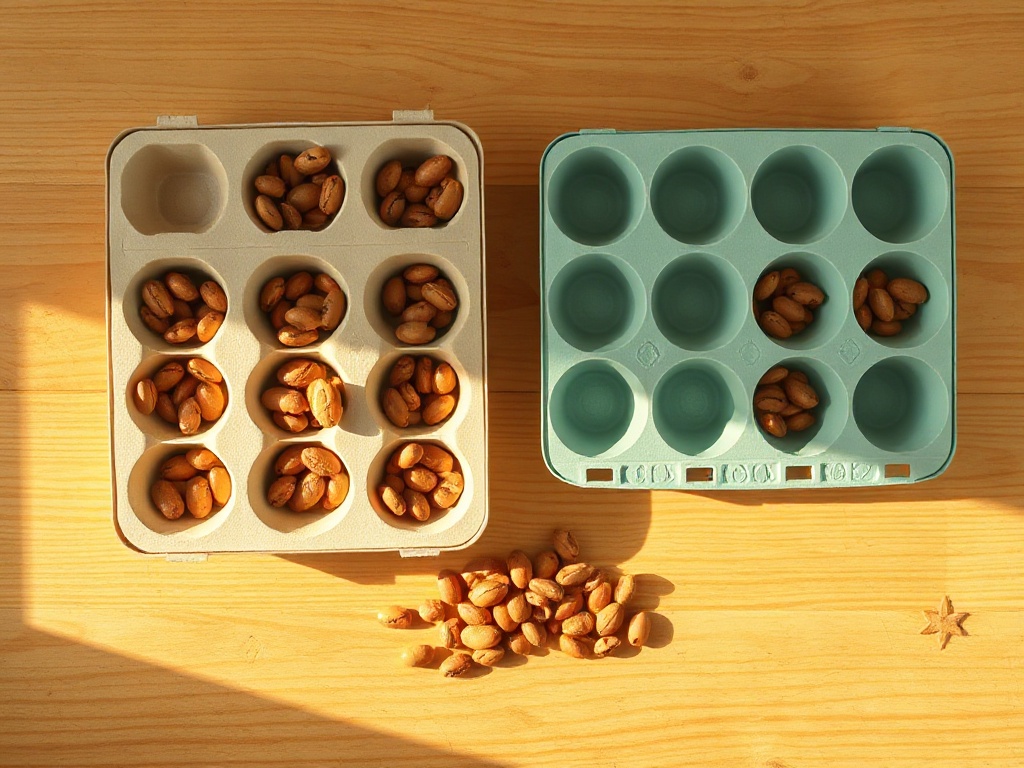
You'll need two egg cartons trimmed down to ten cups each, a handful of dried beans or buttons, and a sheet of paper. It takes about 15 minutes and suits children aged 6 to 8. Say a number — say, 34 — and your child has to show it: fill three full tens and set four beans aside separately. Don't accept a random heap. Then flip the game: you arrange the beans, and your child says the number without counting one by one. The most important part comes last — ask, "What happens if I add one more bean to that almost-full ten?" and let your child watch a new ten being born. The task is mastered once your child can lay out four numbers in a row without a mistake and explain, in their own words, what happens at 39 plus one.
The shopping game
The £3 Shop
You'll need £1 and £2 coins and a few paper price tags marked between £1 and £5 — or small household objects with tags stuck on. The game takes 10-20 minutes and works best with children aged 7 to 8. Your child is the shopkeeper, you're the customer, and you pay with coins. The trick is to count out loud correctly sometimes and wrongly other times: "So I've got two £2 coins, that's... twenty?" A child who understands will object. A child who's just memorising will nod along. Call it a success once your child catches at least two of your deliberate mistakes and explains what the correct total actually is.
The most common parenting mistake
When a child stumbles, the first instinct is to drill the counting again — once more to a hundred, then again, a little every day. The logic seems sound: if it's not going well, surely more practice is the answer. But repetition only strengthens what's already working — word memory — and does nothing for the actual gap. The child gets even faster at reciting and even more stuck when asked how many tens are in 56.
Another classic: "count out loud while we go up the stairs." A nice activity, but stairs are just a row of identical steps and show no grouping whatsoever. If you want it to actually work, climb and say: "We've done ten steps — that's one ten. Ten more?"
If your child can't say what number comes before 70, reaching 100 doesn't mean much.
What to do over the next two weeks
- Stop asking for counting to 100 as proof. Ask "how many tens" instead of "count for me".
- Pick one number a day and break it down out loud. "Today is the 23rd — that's two tens and three."
- Count backwards more often than forwards. Counting back is a far better indicator.
- Use anything that naturally comes in groups of ten — egg boxes, packs, the fingers of two people.
- When your child gets it wrong, don't correct them straight away. Ask "show me with the beans" and let them spot the mismatch themselves.
If, after two weeks, your child can show 34 with the egg cartons, say how many tens are in 56, and count on from 87 without hesitating — the base-ten system has clicked. From there, addition and subtraction up to 100 stop being a struggle, because your child is no longer shuffling digits around, but shifting quantities.