
Addition and Subtraction with a Deck of Cards: Games That Actually Work (Ages 7-9)
Counting on fingers isn't the real problem — slow recall from memory is. Three games with an ordinary deck of cards that train exactly that, in 10-15 minutes at the kitchen table.
A second-grader sits hunched over a worksheet with twenty problems. The first three he solves in his head, then he starts counting on his fingers under the table, and by the seventeenth he's drawing little stick figures in the margin. The homework gets done, but nothing sticks. That same child, sitting across from you with a deck of cards, flipping two at a time, will blurt out "thirteen," "eight," "fifteen" faster than you can flip the next pair. The difference isn't mood. The difference is that at the table the answer has to come out right away, while on paper there's always time to count.
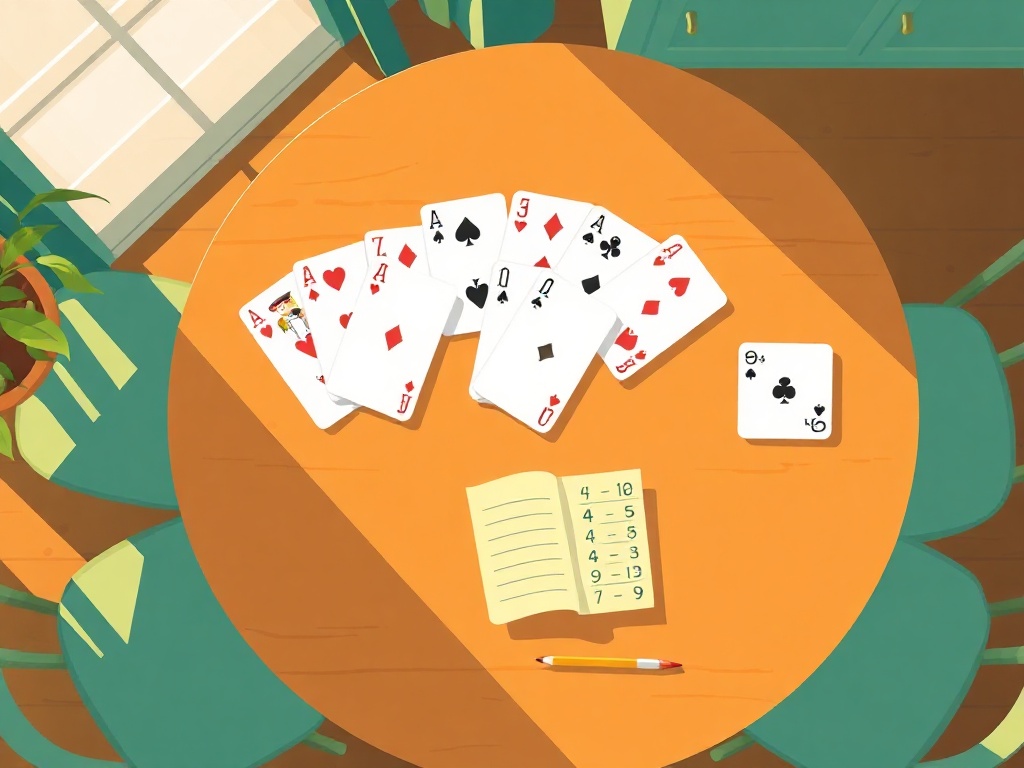
Why cards work better than a worksheet
The usual advice is: "play so it's fun, kids learn more easily when they're enjoying themselves." That's a half-truth, and it's exactly why so many parents give up after the third evening — they played, it was fun, and the next test still shows fingers being counted. Fun isn't the mechanism. The real mechanism is different: in a card game you simply can't count for long, because the other player is waiting and your card goes cold. The child is forced to reach for memory instead. The first few times they'll get it wrong — they'll say "fourteen" instead of "thirteen" — it doesn't matter. What matters is that they reached for the answer instead of counting it out.
From this follows something very practical: not every card is useful at every stage. If the child is still shaky around crossing ten, a full deck from ace to king hands them pairs they can't work out in their head, and they go right back to counting. So your first job isn't to invent a game — it's to remove the cards that get in the way.
How to set up the deck in fifteen minutes
Take an ordinary deck, pull out the jokers and all the face cards — jack, queen, king. That leaves 40 cards with values from 1 to 10, with the ace counting as 1. Everything below uses this deck. If the child is just starting second grade and still hesitates when crossing ten, also set aside the nines and tens for the first week; bring them back once sums up to 10 start coming out without a pause.
- One deck of cards with no jokers and no face cards — 40 cards.
- A sheet of paper just for keeping score, not for calculating.
- If the child gets it wrong: turn the cards face up, count the pips together, and move on. No five-minute explanations.
- Stop the game while the child still wants to keep playing — not once they've gotten bored.
Addition War
All you need is the prepared 40-card deck and a table where you can both see the same cards. Split the deck evenly, and each of you flips two cards face up at once. Whoever says the correct sum of their own two cards first takes all four. The game runs 10-12 minutes and suits ages 7-8. So you're not winning every round, agree to silently count to two in your head before answering — the child shouldn't know you're doing this. Count it a success if, by the end of the game, the child answers at least half the pairs instantly, without moving their lips or glancing at their fingers. If they're still counting on every pair, next time remove the cards above 6 and try again.
Make Twenty-One
You'll need the same 40 cards and about ten buttons or dried beans for scoring. Turn six cards face up in a row. On their turn, a player must combine two or three of them to make a sum of exactly 21 and say it out loud: "seven and eight and six — twenty-one." They take those cards, and you refill the empty spots from the deck. If no one finds a combination, turn over one more card. It takes about 15 minutes and suits ages 8-9. It's working if the child finds at least four combinations on their own during the game and catches at least one wrong sum of yours — that catch is proof they're actually calculating, not guessing.
What about subtraction?
This is where most homemade games fall apart. Addition is easy to turn into a game — flip two cards and add them. With subtraction, though, the child often just takes the smaller number from the larger one and never runs into the part that's actually hard: borrowing. So the rule "flip two cards, subtract the smaller from the larger" is pleasant enough, but a month later nothing has changed.
The Staircase Down from 50
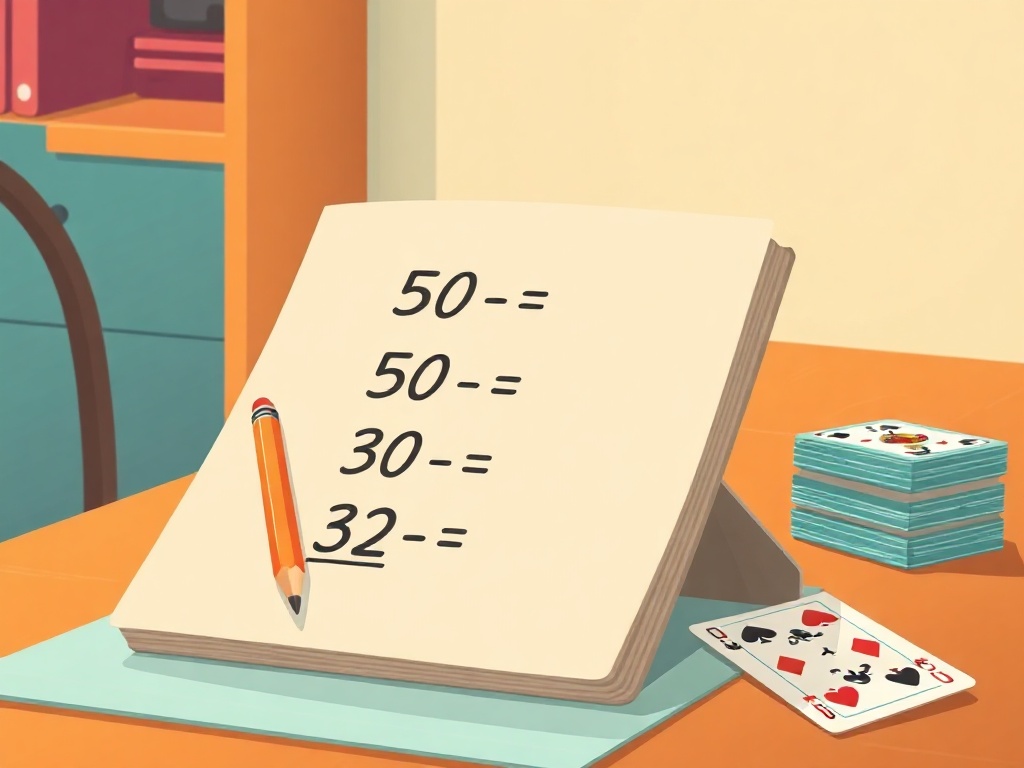
You'll need the deck, paper, and a pencil. Write 50 at the top. On each turn, a player draws one card and subtracts it from the current total, saying it out loud: "fifty minus seven is forty-three." Write it under the previous number to build a staircase. Whoever lands exactly on 0 or below loses — so the goal is simply not to be that person. The game takes 8-10 minutes and suits ages 8-9. Watch specifically for the moments of crossing a ten — 43 minus 7, 32 minus 5. It's working if the child crosses a round number without waiting for your nod at least three times in one game. If they get stuck right there, pause and walk through it out loud once: "from 43 we take away 3, that makes 40, we still have 4 left — 36." Then carry on with the game.
The most common mistake: turning the game into a test
It looks like this. The child says "twelve," the right answer is thirteen, and the parent stops everything: "Wait, wait. How much is seven and six? Come on, count it out. Not like that, look at your fingers. See, seven plus three is ten, and then..." The explanation drags on for two minutes, the game grinds to a halt, and on the next pair of cards the child goes quiet, afraid of getting it wrong again. That's how the table turns into a second worksheet, just with pictures on it.
The reason this doesn't work is simple: the child stops risking an answer. And all the benefit comes precisely from that risk — from the attempt to pull the number out of memory before being certain. If every wrong guess triggers a lecture, the safest move becomes counting slowly on fingers, or staying silent. So when a mistake happens, do exactly one thing: turn the cards face up, count the pips together for five seconds, say "thirteen," and deal the next round. Explanations have their place, just not mid-game.
A game isn't ruined by noise or distraction — it's ruined by the sentence "hold on a second, let me explain."
How to tell it's working
Not by grades — those move slowly and depend on plenty of other things. Watch the pause instead. At the start, there are three or four seconds of silence between flipping the cards and the answer, during which you can see the child counting. After two or three weeks of playing several times a week, that pause disappears for the small numbers and only remains for the harder pairs — 8 and 7, 9 and 6. That's the real progress, and you can see it with your own eyes, no test required.
- 10-15 minutes is enough; after that attention drops and the game turns mechanical.
- Four ten-minute sessions a week beat one hour-long session on Sunday.
- If the child asks to keep playing — stop anyway. You want them looking forward to tomorrow.
One deck, face cards removed, fifteen minutes at the kitchen table. It won't work miracles, but within a month it takes finger-counting out of most sums up to 20 — and that's exactly the pebble in the road that trips kids up later with multiplication.