
For Parents — Home Alone After School: What Age, What Rules, and How to Prepare Your Child (Adult Section; Guide for Parents of Children Ages 8-10)
An article for the adult section of the site: written for parents and caregivers, not for children to read on their own, and offering general guidance rather than legal advice. Being ready to stay home alone isn't about a birthday — it's about a handful of skills you build in advance. Here's how to test for them calmly, and what the first week without panic looks like.
A note before you start: this page belongs to the adult section of the site. It is parenting reading for grown-ups, not a children's page, and it offers general guidance drawn from everyday family practice — it is not legal advice. It's 1:40 pm. Your child gets off the bus, climbs three flights of stairs, and stands at the door with a key in hand. You're still at work for another two and a half hours. As a parent, the question isn't whether they'll enjoy it — almost every 9-year-old thinks they will. The question is what they'll do in the ordinary hiccups: the key turns halfway and jams, the power goes out, or the doorbell rings and an unfamiliar voice says, "Hi, I'm from building maintenance, I'm here to read the water meter." None of these are emergencies. They're just situations worth rehearsing calmly, in advance, so they stay ordinary.
This guide is addressed to the parents and caregivers of children between 8 and 10 — the age at which most families first run into this question, thanks to the gap between the school day ending and the parents' workday ending. The reader here is the adult; the child's age is only the subject, and nothing below is written to be opened by a child browsing the site on their own. It's meant to be read by the adult first, and shared with the child only in the calm, practical pieces described below. In most places the new school year starts within a few weeks of the end of summer, and that's when the schedules clash hardest.
"At what age can a child stay home alone?" is the wrong question
The most common answer is "around 10." It's convenient but useless, because it describes an average child, and you have a specific one. One 8-year-old might unlock the door, warm up their own lunch, and call calmly if something goes wrong. Another, at 11, freezes when the phone rings from an unknown number and doesn't think to open a window if a pan starts smoking.
So flip the order. Instead of counting years, check skills. If your child has already demonstrated them at least twice — not in words, but for real — you can start with short stretches of time. If not, age won't help.
- Unlocks and locks the front door alone, even when the key sticks — and knows to lock the door right after coming in.
- Can dial your number from memory or a speed-dial button and say clearly: "Mom, I'm home, everything's fine" or "Dad, I broke a glass — did I cut myself? No, but I don't know what to do with the pieces."
- Knows their home address, including floor and apartment number, and can say it out loud without stumbling.
- Can politely leave the door closed when someone they don't know rings, without feeling they owe an explanation.
- Can handle being alone in the apartment for 20 minutes without calling every three minutes or crying.
What the preparation actually looks like
This isn't something you settle over dinner conversation. It's built in steps, each one a little longer than the last. First you leave your child alone for 15 minutes while you run to the shop. Then 40 minutes while you grab a coffee nearby. Then an hour and a half. Don't move up a step until the current one has gone smoothly twice in a row — no tears, no more than one call — which in practice usually means two to three weeks between the first stage and the last, so your child collects the feeling of "I handled it" more than once.
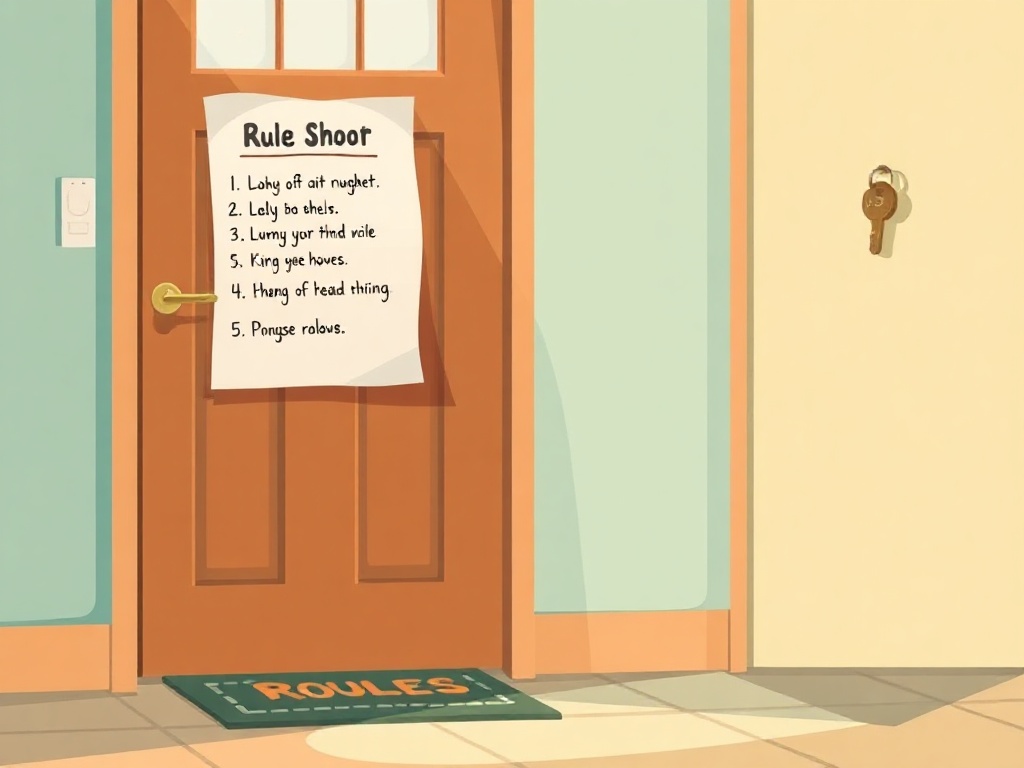
Meanwhile, do one thing many families skip: write the rules on a sheet of paper and post it by the front door. Not as a list of orders or warnings, but as a friendly reminder your child can glance at when they're unsure. Five lines are enough. These are the lines you write out for your child — the only part of this guide meant to reach them.
- I lock the door the moment I'm in and text Mom: "I'm home."
- The door stays closed until a grown-up from our list is home. I can answer through the door: "My parents can't come right now, please come back later."
- I don't touch the stove or oven. The microwave — only for things we've practiced together.
- If something breaks or spills, I call first, then clean up.
- If Mom and Dad don't pick up: I call Grandma, then the neighbor on the 4th floor.
Doorbell drill (set up and run by the parent)
A calm rehearsal, organised and run entirely by adults — the point is practice, not fear, so keep it light and stop the moment your child stops enjoying it. All you need is the front door and a friendly adult your child isn't expecting: a friend or relative who agrees to ring the bell on a set day, without your child knowing the exact time. It takes about 15 minutes and works well with children aged 8-10. Through the door, the adult says a few everyday lines your child can genuinely hear: "We're neighbors from downstairs, we have a leak," "I'm a courier, please sign here," "Your mom's waiting downstairs, she said to come down." Your child practices giving the same friendly response every time, without opening the door and without over-explaining: "My parents can't come right now. Please call back later." Then they call you immediately. They've succeeded if the door stays closed all three times, and if after the third attempt they can tell you who rang and what they wanted. Finish by telling them what they did well — and by reminding them that people at the door are almost always neighbors, couriers, or nobody important at all.
The "20 minutes alone" test (parent-led)
You'll need a phone for your child (or a landline), a sheet with three emergency numbers, and a clock they can read. It takes 20-30 minutes and suits families with 8-9-year-olds just starting this process. Actually leave — don't hide on the stairwell. Beforehand, give them one simple task to fill the time: make a sandwich, pack tomorrow's school bag, water the plants. Call once, briefly, partway through. They've succeeded if the task is done, they haven't called you more than once, and when you return they can tell you what they did, in order. If they cried or called five times — that's not a failure, just dial back to 10 minutes and try again in a few days.
The most common mistake: a phone instead of rules
Parents buy a phone, install a location app, send ten messages an hour, and assume the problem is solved. It isn't. The phone shows where the child is, but it doesn't tell them what to do — and constant check-ins teach the opposite of independence: don't decide anything until you ask. The child starts waiting for instructions even for whether to have a yogurt.
The flip side of the same mistake is worse. When the phone is the entire plan, a dead battery becomes a crisis. A child who has practiced the doorbell drill and knows where the fuse box is will manage fine even with a dead phone. A child who relies solely on staying connected to you will just sit in the dark and wait.
So the rule is: the phone is a backup, not the system. First comes the list by the door, the neighbor who holds a spare key, and the drills. Tracking comes after.
The second mistake: not talking about boredom
Preparation usually covers the practical risks and skips the most common feeling — boredom. Three hours alone in a quiet apartment is a long time. If there's nothing to do, the child will find a screen, and you'll be arguing about it for months afterward.
It's easier to agree on a plan in advance, and to write that plan on the same sheet by the door so it isn't up for renegotiation every afternoon. For example: homework and the school bag first, then half an hour of screen time on a kitchen timer the child sets themselves, and in between, two or three things the child picked in advance and wrote on the sheet — finish the comic they're drawing, the half-built block model on the shelf, twenty pages of the book by the bed, a five-minute call to a friend. If you want something to look forward to at the end of the week, agree on a small fixed weekly allowance — enough for one small treat, in whatever your local currency is — that they choose on Saturday with you, not alone.
Your child isn't ready when you feel calm about it. They're ready when they feel calm — and you can tell by how many times they call you during those 20 minutes.
The first week: what to expect
The first two days usually go great, because it's new. The third day is the hard one — the novelty wears off, and all that's left is the empty apartment. Don't scrap the whole plan over one bad afternoon. Cut the next session back to the length that last worked — often 40 minutes instead of two hours — come home half an hour early, and ask exactly what felt unpleasant. Nine-year-olds' answers are surprisingly specific: "The fridge hums and it startles me," "The neighbors were arguing," "It's dark by the time I get home." Each of those has a concrete fix: a radio on low, a note about which neighbor to ignore, a lamp on a timer switched on before they walk in.
And every evening, ask the same question: "What happened today that we hadn't talked about?" That's exactly where you'll find the things that need to go on the list by the door.
A note for parents: this article belongs to the adult section of the site and is filed apart from the children's pages, so it is meant to be reached by grown-ups rather than handed to a child to read on their own. It is written for adults and offers general parenting guidance only — it is not legal advice, and it does not tell you what the law requires of you. The rules on leaving a child unsupervised differ from country to country and sometimes from region to region — some places set a minimum age, others leave it to the parents' judgement, and school or after-school programmes may have their own requirements. Before you start, check the rules that apply where you live, consult a qualified professional if you need advice about your own situation, and make the final call based on your own child and your own circumstances.