
For Parents (Adult Section) — Pocket Money in Primary School: How Much, How Often, and What Kids Should Do With It
Parents' section — this article is written for grown-ups, not for children, and sits in the adult area of the site. A practical guide for parents of primary-school children aged 7-9: how much pocket money might make sense, how often to hand it over, and how to help a child learn to wait instead of spending it all on day one. General information for parents, not financial advice.
A note for grown-up readers: every sum mentioned below is an illustrative example only, not a recommendation — what fits your family depends on your own budget and circumstances, and for anything touching your finances you should rely on your own judgement or a qualified adviser. Imagine that on Monday the child gets a small weekly amount in coins. By Tuesday afternoon it's gone — two packs of gum, a bag of crisps, and stickers that won't matter by the next day. On Wednesday comes the question: "Can I have a bit more?" That is usually the moment that decides whether pocket money will actually teach something, or just become a second wallet the child dips into once the first one's empty.
Much of the advice on this topic stops at the amount. But the amount often turns out to be the smallest part of the problem. A child in Year 3 who gets a fixed sum every Monday and knows the next lot won't arrive for seven days may well learn more than a child getting a monthly lump topped up by Grandma every time they whine.
How much money makes sense at 7-9 years old
There's no magic number, and every family works it out around their own budget. But one rule of thumb travels well: the amount should be enough to buy something small right away, but not enough for the thing the child actually wants. Otherwise there's nothing left to plan for. The simplest way to keep the three ages apart is to set one "base week" for a seven-year-old — whatever a single small treat costs where you live — and then scale it up year by year. To make that concrete: if a chocolate bar or an ice cream runs to about £1 in your local shop, then £1 is your base week, and the figures below become roughly £1 at seven, £1.50 at eight and £2 at nine. Swap in your own currency and your own local price.
- Age 7 (Year 3): one base week, paid weekly, always in coins so the child can physically sort and count it. Rule: it's spent in your company, in shops you both know, and nothing is carried over in their pocket to school.
- Age 8 (Year 4): about one and a half base weeks, still paid weekly, part of it in a small note. Rule: a written agreement on what it covers (treats, stickers, small gifts) and what it never covers (lunch, school supplies), plus one purchase a month they must think about overnight before buying.
- Age 9 (Year 5): about two base weeks, paid fortnightly as a single sum if the child can already manage the wait — otherwise stay weekly for another few months. Rule: they may shop alone within a limit you set, and they keep a running note of what's left before asking for anything extra.
- Separately: school lunch money is not pocket money at any of these ages. Where the two get mixed, children often skimp on lunch to buy something else.
Many parents prefer to give it in coins and notes, rather than as a mental tally or something "written down in a notebook." At this age, children generally need to handle money to understand it. A child who's held five coins and watched two disappear may grasp the difference in a way that's hard to get across with an explanation alone.

Why weekly works better than monthly
Monthly pocket money looks more convenient for the parent. But for a seven-year-old, a month can be an abstraction — they often have little real sense of how far off the next payday is. One common result: the money's gone by day five, followed by three weeks of pleading.
A week, on the other hand, is something a child can more easily see. There's Monday, there's school, there's Saturday. If you pay on the same day each time — say, every Friday after school — children start doing the maths themselves: "I've got this much today, it's four days till Friday, so I can't buy something every day." That sentence is, arguably, the whole point of the exercise.
The Three Jars
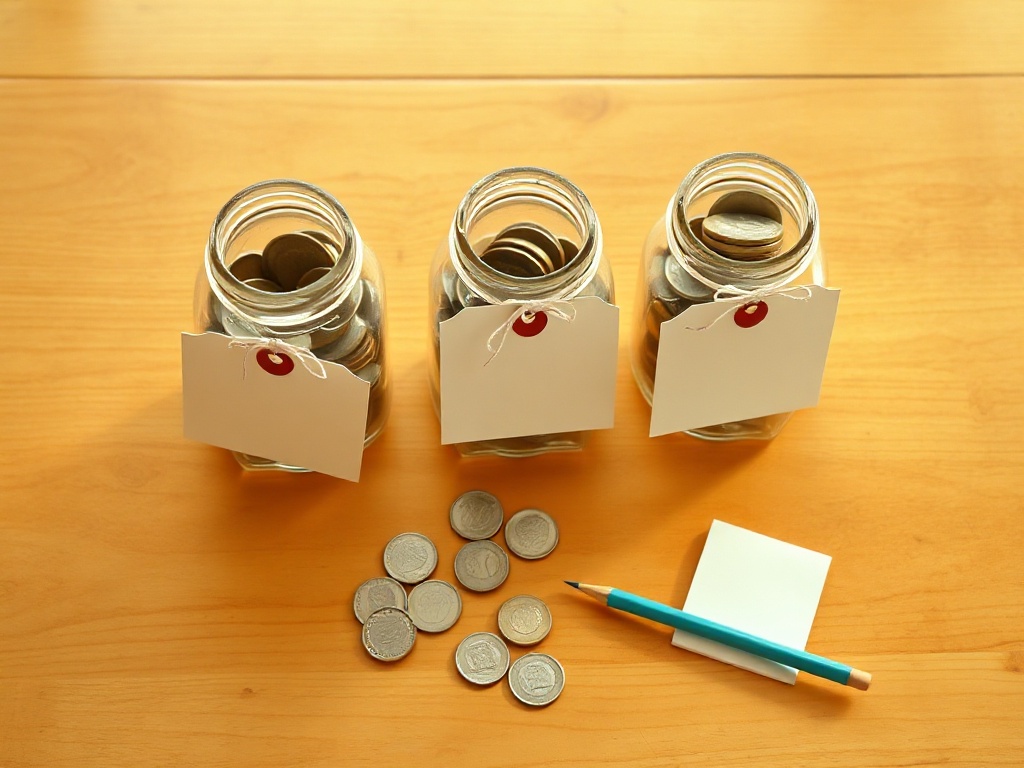
You'll need three empty jars or shoeboxes, sticky labels, a marker pen, and a sheet of small paper slips. It takes about 20 minutes the first time, then 2 minutes a week after that. Suitable for ages 7-9, with an adult setting it up alongside the child. Label the boxes "Now," "Saving," and "Giving," and decide together how the child splits their money — a split that works for many families is one half for "Now," one quarter for "Saving," and one quarter for "Giving," which is easy to do with coins because the child simply halves the pile, then halves what's left. Adapt it if your amounts divide more neatly another way. The part worth adding: every time a coin goes into "Saving," the child writes that day's date on a paper slip and drops it in too. Once a month, tip the slips out and line them up — the child can see, in their own handwriting, how many weeks that money has been waiting, which turns saving from an abstract virtue into something they can count. In "Saving," the child collects money towards something specific they've chosen and drawn on a label stuck to the outside. Call it a success if, after four weeks running, there's still money in the "Saving" jar and the child can say what they're saving it for.
What the child can buy alone, and what they can't
It helps if the agreement is clear before the first payment, not after the first row. Say it out loud and write it down on a sheet stuck to the fridge — in the child's own words, not yours.
- Decides alone: small sweets, stickers, a toy from the corner shop, a small gift for a friend — within whatever limits you set for shopping without an adult.
- We decide together: anything above a limit you pick as a family, anything they want to buy online, food for another child.
- Never bought with pocket money: things you've already said no to for another reason — this isn't a way round that decision.
And the hardest part: when the child buys something silly, it's usually better not to bail them out. A toy figure that breaks by teatime can be one of the cheapest lessons money can buy. Replace it straight away and the lesson tends to disappear.
The Shop Window List
All you need is an A4 sheet ruled into three columns and a pen; it takes about 10 minutes in the shop and another 5 at home. Suitable for ages 7-9 (Years 3-5), and an adult should go with the child on every shop trip. Before going into the shop, the child writes in the first column what they want to buy and how much they think it costs. Inside the shop, in the second column, they write down the actual price. At home, in the third column, they note whether they bought it and why — and then give their own guess a mark out of three: three for "almost exactly right," two for "close," one for "nowhere near." Keep the sheets in one folder so the marks stack up trip after trip. After three trips like this, look at the folder together. You'll know the exercise is doing its job once the marks are climbing rather than bouncing about — a sign the child is getting a real sense of what things cost.
A common pitfall: paying for grades and chores
It's tempting to tie pocket money to top marks or taking out the bins. It sounds fair, but it can backfire in two ways.
First, household chores can turn into a paid service. Once you're paying for a tidy room, the child may quite reasonably ask why they should tidy it for free today. Second, paying for marks can shift the focus from learning to the result — and in Years 3 and 4, that's often the point at which a child benefits most from understanding why they're solving the problem, not how much they'll get for it.
A cleaner line: pocket money is given because the child is part of the family and is learning to handle money. Chores get done because you're a household. If you still want to pay for something, make it a one-off extra job — washing the car, tidying the cellar — rather than the everyday stuff.
Pocket money isn't a reward and it isn't a punishment. It's a training ground where a mistake costs a week's coins, not a month's wages.
What to do when the money runs out on Wednesday
The answer that tends to work is a short one, the same every time: "I understand. The next lot comes on Friday." No lecture, no "I told you so." A lecture can ruin the lesson, because the child starts defending themselves instead of thinking.
If they push, you could offer an option that isn't a handout: they can get next week's money early, but then there'll be nothing on Friday. Let them choose. Most children take the advance once or twice and then stop asking — and that can be the moment planning starts to click.
A three-question chat
Once a month, while walking to school or doing the washing-up, you might ask three questions and actually wait for the answers: "Which of the things you bought this month are you still using?", "Which one turned out not to be worth it?", and "What are you saving up for right now?" Three minutes, no notes. If the child can answer all three without having to think too hard, your system is probably working.