
Parents' Corner: My Child Is Alone at Recess — What to Say and Do
A practical plan for parents of 7- to 9-year-olds who keep hearing "there's no room for you." Part of our parenting section — written for grown-ups, not for kids: actual phrases to use, two exercises, and a way to tell when it's working.
A note for grown-ups: this guide belongs in the parenting section and is written for parents, caregivers and teachers, not for children to read on their own. A second-grader comes home, drops her backpack by the door, and says offhand: "I played alone on the swings again today." Then she sits down to eat as if nothing happened. That "as if nothing happened" is exactly the moment most parents make their first mistake — either they let it slide, or they jump straight to "who kicked you out? I'm calling the teacher."
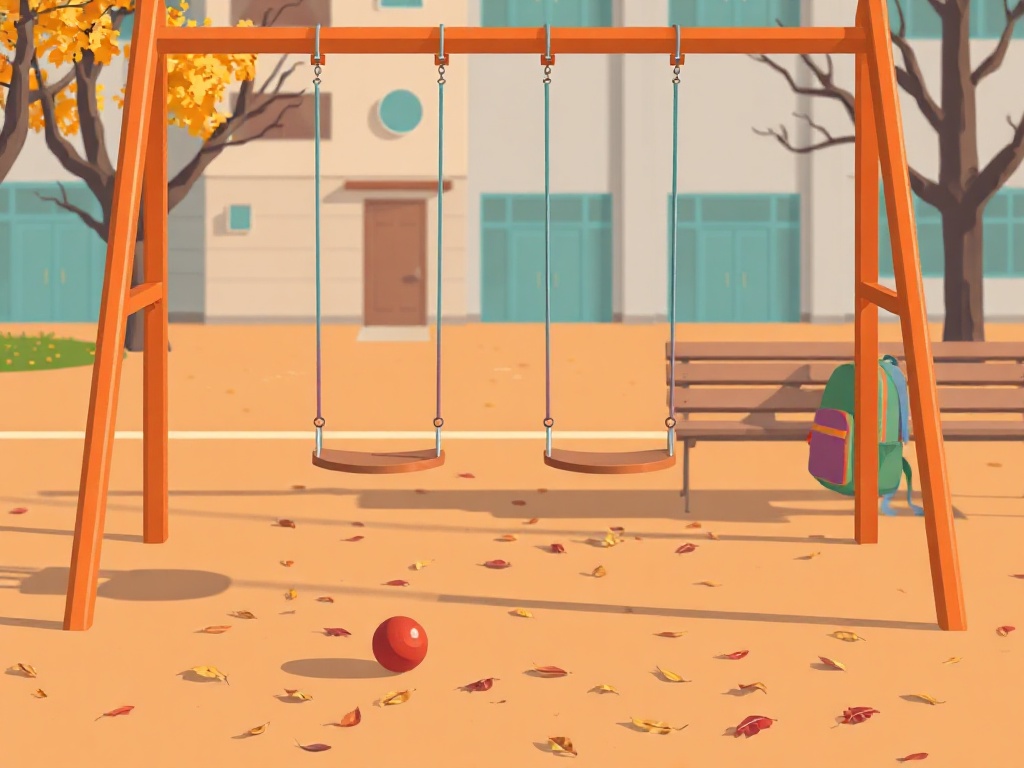
Between ages 7 and 9, recess groups become more closed off. Kids already have roles, rules, and a running storyline from previous days, and the newcomer has to break into something already in motion. That's why a child alone at recess so often hears "no" after asking "Can I play with you?" — the question stops the game and forces everyone else to make a decision. And kids this age hate stopping a game.

The first ten minutes at home: what to say and what not to say
Don't ask "Why won't they let you play?" That question sends the child looking for a reason inside themselves, and they usually find the worst one. Instead, ask about the game itself, not the rejection.
- "What were they playing while you were on the side?" — this tells you whether it's tag, soccer, pretend shop, or something with characters.
- "Who makes up the rules in that game?" — there are almost always one or two kids who call the shots. That's useful information.
- "What did you say right before they said no?" — this is where you'll hear the exact phrase. Usually it's "Can I play too?"
- "Was anyone else standing off to the side?" — if so, tomorrow's plan just got a lot easier.
And one thing that helps more than any comfort speech: name what you saw, without judging it. "You were on your own today, and that's rough. Let's try something different tomorrow." That's it. Don't turn dinner into a debrief.

Why "Can I play with you?" almost never works at recess
Picture it from the outside. A game of tag is going, six kids running, someone's "it." A seventh kid walks up and asks a question. The game stops, everyone turns around, someone has to make a call. In that moment, it's easier to say "no, we've already got enough people" than to rearrange everything.
Now the other version: the child stands near the game, watches for a minute or two, sees who's "it," and when the ball rolls out of bounds, passes it back. Nobody was asked, nobody had to decide, and the game never stopped.
Joining a game is like hopping on a moving swing: the skill isn't in the asking, it's in reading the rhythm — and rhythm is something a child can practice.
Three lines your child can practice
- For ball games: "I'll play for your team, you've got fewer players." — said while running, not before the game starts.
- For tag or hide-and-seek: nothing needs to be said. The child just starts running, and when tagged, accepts being "it." This is the fastest way in.
- For pretend play (shop, family, school): "I can be the customer who comes to return something." — offer a new role instead of asking for an existing one.
The same move works for jump rope, one of the most common games in a school yard: instead of waiting for a turn, the child picks up the free end of the rope and starts turning it. Two minutes later nobody remembers they weren't there from the start — and by the next round they're the one jumping.
The Two Doors Game
For parents to run at home with their child. All you need is a living room and one more family member. Set aside 15 minutes on two evenings in a row. Suitable for ages 7-9. Start a game — for example, building a tower out of cushions while chatting about it. The child stands to the side and tries door one: asks "Can I join too?" You honestly act out the rejection: "No, there's already two of us." Then restart and let them try door two: no question, just hand over the next cushion and say "This one's bigger, put it on the bottom." Swap roles — the child is in the game, you're on the outside. Consider it a success once the child can name the difference between the two doors on their own and demonstrate the second one without any prompting from you.
The most common mistake: calling the other parent
It's understandable. You see your child sad and want to fix it fast, so you text Martin's mom: "Your son won't let mine play, please talk to him about it." The problem is that the next day Martin walks onto the playground with instructions from home — and the kids can tell. Being let into a game on orders is obvious from a mile away, and your child gets stuck with the label of the kid whose parents interfere. The group doesn't open up; it just gets more guarded.
A second common mistake: "Just ignore them, play on your own." It sounds like it's protecting their dignity, but it actually leaves the child with zero tools. They're already playing alone — that's the problem, not the solution.
So when do you actually contact another adult? When there's a pattern of exclusion by the same child, name-calling, taking belongings, or physical incidents. Then the conversation is with the classroom teacher, not the parent, and it shouldn't sound like a complaint: "I've noticed Daria has been spending recess alone for two weeks now. Could you keep an eye on what's happening on the playground?"
How to build one friendship outside of recess
A big group is hard. One person — not so much. Kids this age make friends fastest when there are just two of them with a shared task. That's why a playdate at home works better than any talk about friendship.
A Guest for Ninety Minutes
For parents to set up and supervise. All you need is a snack and one clear activity — cookie dough, building blocks, or a deck of cards. The invitation is for 90 minutes, not a whole afternoon, and it's for one child, not three. Suitable for ages 7-9. Before the visit, sit down with your child and decide together who to invite: not the most popular kid in class, but someone who's also often left standing on the side. Also agree on what they'll do in the first ten minutes, so there's no awkward silence at the door. If they want a break outside, walking over together for juice and a waffle is plenty. Count it as a success if the two children keep playing by themselves after your first nudge, and if they seek each other out at least once at school the next day.
What to watch for over the next two weeks
- Is there at least one name your child mentions more than once? One friendship is enough to end the feeling of being a child alone at recess.
- Are they still trying to join in, or have they already stopped trying? The second is the one worth paying closer attention to.
- What do mornings before school look like? If Sunday evenings turn quiet and "I don't want to go" starts showing up every Monday, talk to the classroom teacher.
One more thing. If your child is one of the ones who sometimes says "you're not on our team," that's just as important a conversation. One sentence at home is enough: "In our family, the rule is nobody gets left out. If you've already got enough people, figure out how to include them anyway."