
How Much Screen Time Is Reasonable for a 7-10 Year Old (Without the Nightly Battle)
The exact number of minutes matters less than when and what your child watches. Here's how to make a clear written agreement that still holds up on a Saturday evening.
It's 6:40pm. You say "five more minutes," your child nods, and you head back to the kitchen. At 7:05 the tablet is still glowing, your voice goes up a notch, and they fire back with completely genuine outrage: "But I'm in the middle of something!" You're both right. You said five minutes. They heard "five minutes of something that has no pause button."

This piece is for children aged 7 to 10 — an age when a child can already read a clock, count their own time, and stick to an agreement if it's clear. For a 4-year-old things work differently, and the rules there stay entirely in the adult's hands.
Why "one hour a day, maximum" almost never survives contact with real life
The number sounds tidy until it meets an actual day. On Monday your child has football practice and doesn't touch a screen at all. On Sunday it's pouring rain, the visit to grandma's is cancelled, and that same hour stretches to three. If your only rule is a count of minutes, every day turns into a negotiation from scratch.
It holds up better if you fix the frame, not the number: which parts of the day a screen is even on the table, who presses start, and what outside signal makes it stop. The clock still matters, but it's no longer what you argue about.
- When — for example, after homework and before dinner, never the first thing in the morning and never in bed.
- How much — a specific number, but agreed in advance and written down, not invented on the spot.
- What — apps and channels you've watched together at least once.
- How it stops — by a timer's sound, one the child sets themselves, not by your voice from the next room.
- Where — somewhere you walk past: the kitchen, the living room, but never behind a closed door.
The agreement that goes on paper
Children this age have a strong sense of fairness. That's why something written on paper carries a weight words don't — it doesn't change with your mood. Sit down on a quiet Sunday afternoon, when no one's annoyed, and write five lines. Your child holds the pen; you dictate the frame, they suggest the numbers that go in it.
Give them one real choice. "On school days you get 40 minutes. Do you want it all at once after homework, or two lots of 20?" The choice turns the rule into their own decision and cuts the pushback in half when it's actually time to stop.
The Screen Contract
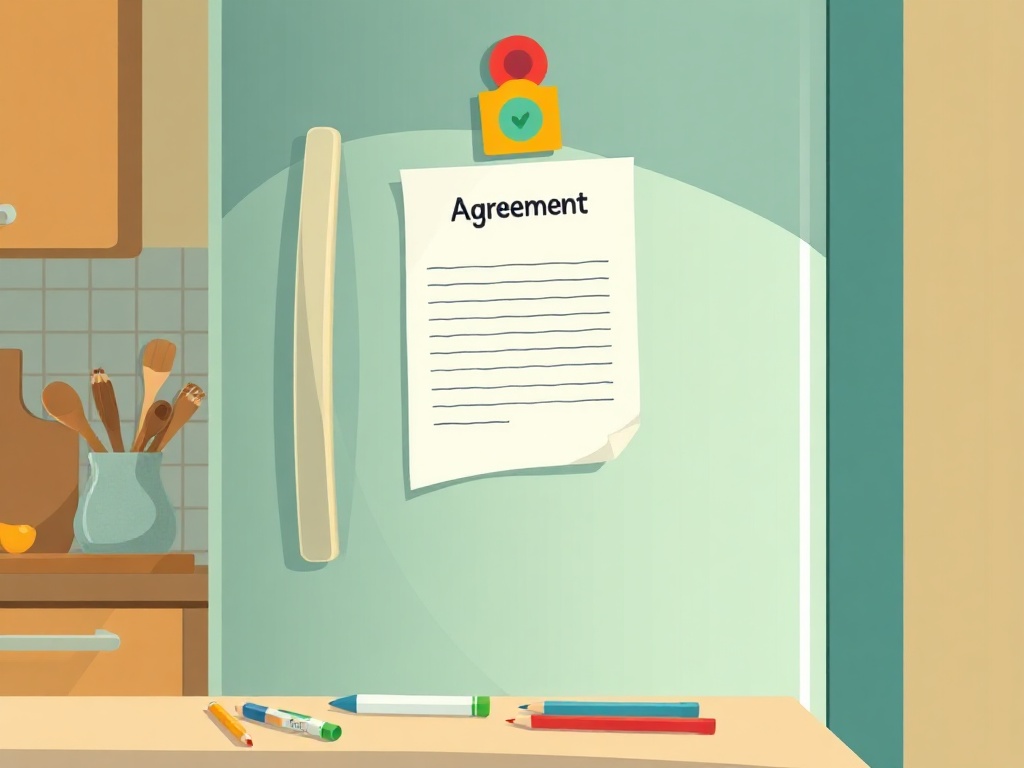
All you need is a sheet of A4 paper, a pen, coloured pencils, and a fridge with a magnet. Set aside 20 minutes on a calm day, ideally with a child between 7 and 10. Write five sentences together: when it's allowed, how long it lasts, what can be watched, who starts the timer, and what happens if the timer gets ignored. Let your child come up with the consequence — they usually suggest something stricter than you would, so soften it from there. You both sign it, and the sheet goes on the fridge. The agreement is working if, within the next seven days, your child says "it's written right there" at least once, or simply points at the sheet instead of arguing with you.
How to end screen time without a scene
Most meltdowns come from the abrupt cut-off, not from stopping itself. Games and videos are built so there's always "just a bit more" — the next level, the next episode. Your child isn't being stubborn; they're genuinely mid-task.
So build in a warning with an exact time: "The timer rings in five minutes — finish the level." And have something lined up to follow immediately — not empty space, but a concrete task: setting the table, walking the dog, peeling potatoes. The empty gap right after switch-off is the most common route into a row.
Five Minutes Before the End
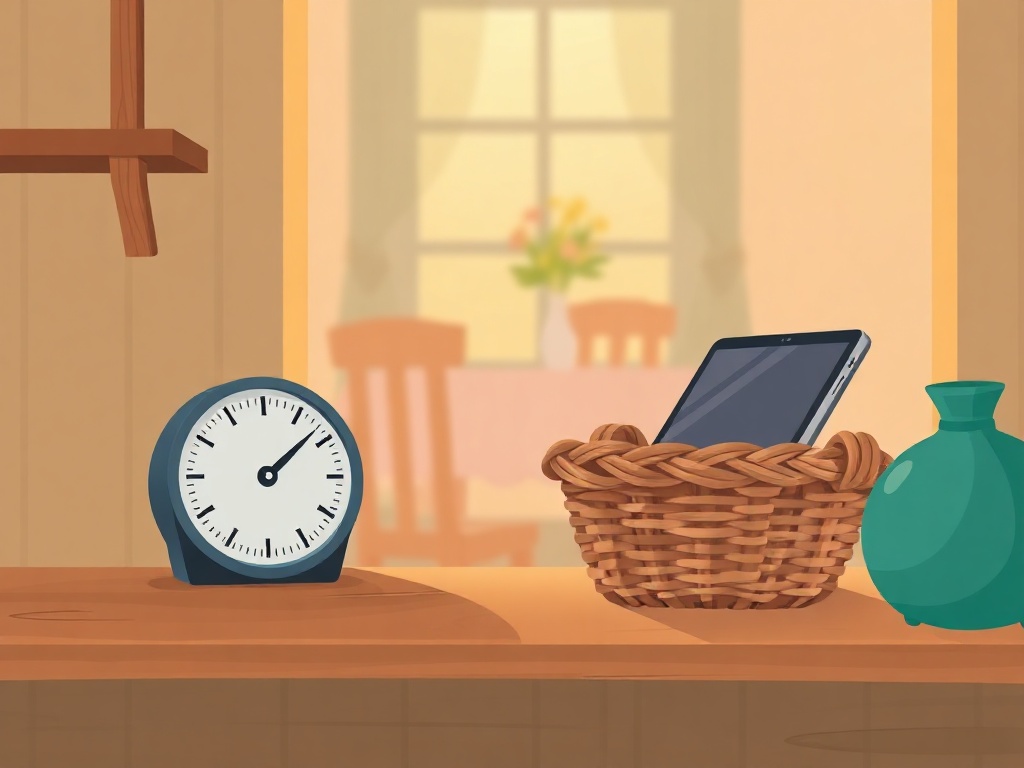
You'll need a timer — a kitchen timer, a clock, or a phone kept out of your child's hands. This takes 5 minutes at the end of each screen session and suits children aged 7 to 10. The deal is simple: when five minutes are left, say the sentence once, calmly, and leave the room. Don't repeat it, don't hover. When the timer rings, your child puts the device away in its designated spot on their own. You'll know it's working if they've switched off unprompted three times in a row, before you've had to come back into the room.
A common mistake: the screen as reward and punishment
"Finish your homework and you get the tablet. Don't, and you go without it for a whole week." It sounds logical, and at first it even works. The trouble is what it teaches your child: that the screen is the single most valuable thing in the house, since it's the currency that pays for everything else.
As a side effect, a week-long ban becomes pointless by day two — your child has nothing left to lose and simply stops cooperating altogether. It works better to treat the screen as part of the normal daily routine with its own conditions, and let the consequences come from the screen itself: didn't switch off on time today, tomorrow's allowance is 15 minutes shorter. Short, connected, easy to understand.
If a rule holds even when you're exhausted, it's a rule. If it only holds when you have the energy to enforce it, it's a mood.
And what about your own phone
An eight-year-old keeps score. They notice when dinner goes by while you're scrolling, and when a conversation gets cut off by a notification. The fastest way for an agreement to collapse is for it to apply to only one of you.
You don't have to overhaul your whole habit. Pick one clear window — say, from the moment the table's set until it's cleared — during which everyone's phone sits face-down on the windowsill. Your child will catch you breaking the rule the first time, and that's a good sign: it means the rule is alive.
What to do this week
- Pick the day and time you'll write the contract, and tell your child in advance.
- Decide for yourself, before the conversation, which two parts of the day are entirely screen-free — usually mornings before school and the last half hour before bed.
- Buy or find a separate timer, so a phone isn't used for the countdown.
- Choose one spot where the device goes after time's up — a drawer, a shelf, a basket.
- Mark a date two weeks out on the calendar when the two of you will revisit the sheet and adjust the numbers.