
For Parents: Your Child Doesn't Want to Go to Preschool or School in September — A Plan for the First Two Weeks
Written for parents of 5- to 7-year-olds (a parenting guide, not a children's page): when your child doesn't want to go to school, refusing in the morning is rarely a whim — it's almost always about predictability. Here's what to do, day by day, over the first two weeks, with concrete sentences and two activities you can do at home.
It's ten to eight. Your child is standing there with a coat in hand, but won't put their shoes on. "I'm not going today. My tummy hurts." You put the shoes on for them. In the cloakroom they cling to your neck and start crying — so you stay another ten minutes, explaining how nice the class is, promising ice cream in the afternoon. On day three it's the same thing, except now the crying starts back in the lift.
This article is written for parents of children between 5 and 7 — the final year of preschool and the first two years of school. At this exact age, a child already understands enough to negotiate with you, but still has no real sense of time: "I'll pick you up after lunch" means nothing concrete to them. That's usually why a child doesn't want to go to school in the first weeks of September: not the place itself, but not knowing when it ends.
When your child doesn't want to go to school, explaining things in the morning only makes it worse
The most common advice is to talk to your child and explain why school is a good place to be. The trouble is, you're having that conversation exactly when your child is least able to take it in — upset, in a corridor, surrounded by strangers. Every extra minute you spend in the cloakroom tells them something words never will: that there's something to negotiate here. And tomorrow they'll try again, a little harder.
Talking things through does help — but in the evening, when things are calm, without coats and clock-watching. Mornings are for action, not negotiation. That distinction is the whole secret behind these two weeks.

Week one: make the morning boring
The goal isn't for your child to be happy at drop-off. The goal is for them to know exactly what happens next, by heart. Pick one sequence and repeat it identically for five days straight — same words, same order, same length.
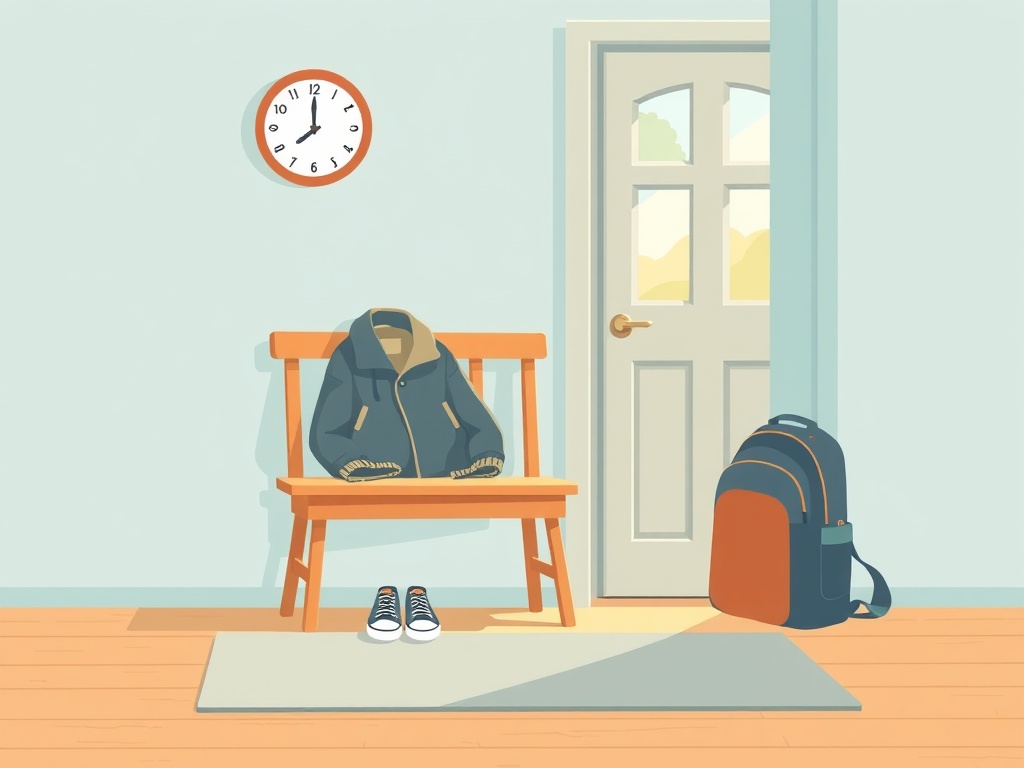
- Get everything ready the night before: clothes on the chair, backpack by the door, shoes mentally already on. Nothing gets hunted for in the morning.
- The same wake-up time every day, including days when you have time to spare. A shifting schedule is half the problem.
- Narrate what comes next in small steps: "We get dressed, we go downstairs, we pass the bakery, we arrive." Children love knowing the route.
- At drop-off: a hug, one sentence, you leave. For example: "I love you, I'm off now, I'll be back after afternoon snack."
- Don't go back for one more look. If you've left and then return, the crying starts over — and lasts longer this time.
- If possible, have the same person do drop-off every day of the first week. Alternating Mum and Dad every other day just adds one more unknown.
And here's something many parents miss: tell the teacher exactly what you'll be doing. "I give one hug, say one sentence, and leave. If they cry, please take their hand and bring them straight to something they can do." When the adults act consistently, the child stops testing for the weak spot.
Week two: hand a little control back to them
Once mornings are predictable, give your child choices — but only where the choice won't derail the routine. Not "do you want to go?" but "the red top or the blue one?", "do you want to press the buzzer, or shall I?", "who's carrying the backpack to the lift?". Small decisions they get to make lower the tension far more than any pep talk.
Week two is also the moment for a classmate's name to start coming up. In the evening, ask who sat next to them at lunch. If you hear the same name twice, invite that child to the playground on Saturday for half an hour. One familiar face at the door does more good than ten explanations.
The Clock of the Day
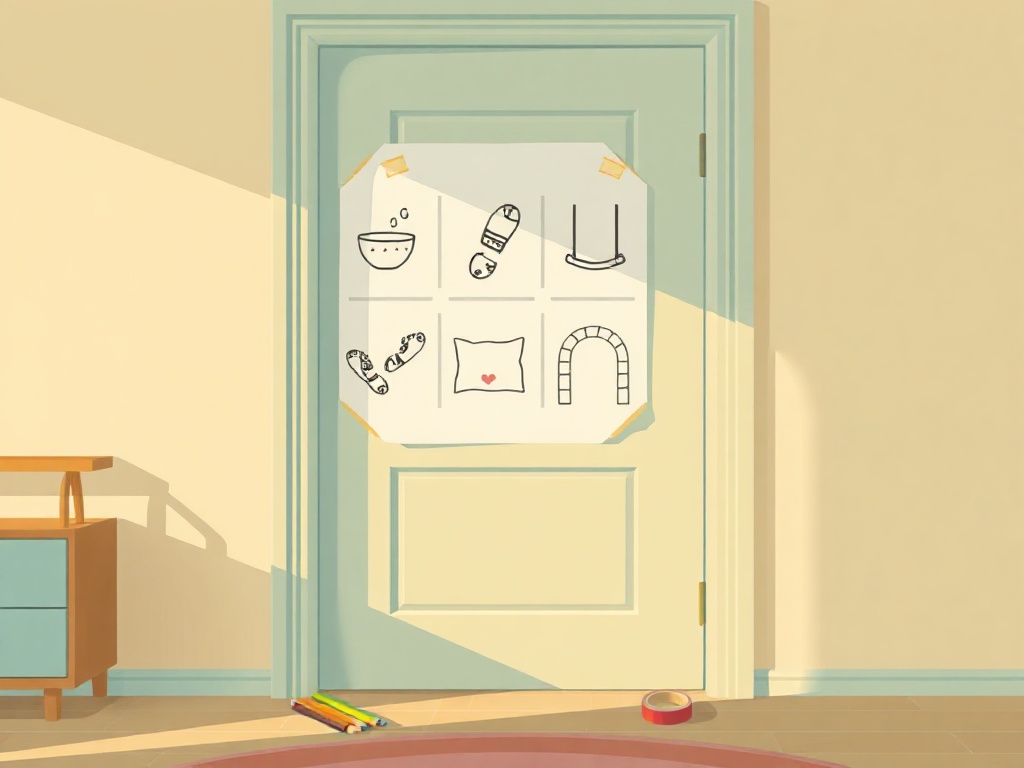
Take an A4 sheet and divide it into six squares. Draw one thing from the day together in each: breakfast, the walk there, playtime, lunch, nap or rest, and finally — you, at pickup. The child draws; you just write a single word under each picture. Stick the finished sheet on the bedroom door, and in the morning the child can simply point to how far along the day is. Materials: paper, coloured pencils, tape. Takes about 20 minutes, best done Sunday evening. Suitable for ages 5-7. You'll know it's working when the child names the next picture themselves, without you asking.
The Pocket Thing
Let your child choose one small object to keep in their pocket during the day — a smooth pebble from the beach, a button, a tiny plastic figure. Try it at home first: put it in the pocket and have them wear it for two hours while playing. Then they take it to school. There's one rule: the object doesn't come out during lessons, only in the playground. Materials: one small unbreakable object, and clothing with a real pocket. Takes 10 minutes to choose, plus a two-hour "trial day" at home. Suitable for ages 5-7. It's working if, by the third day, the child remembers to put it in their pocket without being asked.
The four mistakes that drag the adjustment out
- Sneaking off while your child is distracted. It looks painless, but the next day they won't let go of your hand for a second — they now know you can vanish.
- A reward for every day without crying: a toy, a small treat from the shop, ice cream. Within a week the expected reward grows, and by the second week the child cries precisely because crying has turned out to be worth something.
- Warning your child that they'll be left at school if the crying doesn't stop. A warning like that may work once, then turns the place itself into a punishment.
- Keeping your child home after two hard days. One skipped day almost always resets the whole process to square one, and makes it clear to the child that refusing gets results.
- Interrogating them at pickup: "Did you cry? Did someone upset you? Was it nice?" Three questions in a row send the child hunting for something bad that happened. Ask one thing instead — what was for lunch, say.
When refusal is no longer just adjustment
There's a difference between a child who cries for five minutes and then plays, and a child who won't eat all day, comes home and goes quiet, wakes at night, or slips back into habits at home they had long since outgrown. If after two or three weeks these things aren't easing off but getting worse, talk to the teacher first — they see the day from the inside and often know exactly what's troubling your child: the noise in the dining hall, the toilets, one particular classmate. After that, reach out to the school counsellor too; most schools, and some preschools, have one, and the conversation is free.
The rule behind this whole plan: a child isn't reassured by how well you've explained things, but by how consistently you behave, five days running.
What's left in your hands
One goodbye sentence that never changes. One sheet on the door with six pictures. One object in a pocket. And the decision not to stretch out the cloakroom by even one extra minute. That's all it takes when your child doesn't want to go to school — and that's exactly why it works: the child has nothing left to test.