
Multiplication Tables All Summer: Yard Games, Beach Games and Car Games
How an 8-to-10-year-old can make multiplication automatic in a few weeks of summer break, no worksheets and no desk time required. Three games with clear rules and a plain test for knowing when it's mastered.
Eight-fifteen in the morning, and the child is bouncing down the front steps counting: "three, six, nine, twelve..." Makes it all the way to thirty without a slip. Ask how much seven times three is, and silence falls. Then they start over: "three, six, nine..." This isn't laziness, and it isn't a gap in knowledge — it's exactly what you get from memorising the sequence by rote. The child remembers the chant, but can't pull out a single fact on its own.
The distinction matters, because by the time kids reach Year 5, multiplication stops being the goal and becomes a tool. When a child is dividing, simplifying fractions, or working out the area of a rectangle, there's no time to run the whole chant from the top. They need an answer in a second or two. And that quick recall is exactly what's easiest to train over summer — outdoors, on the move, with questions thrown in any order.
Who This Multiplication Tables Guide Is For
This is written for children aged 8 to 10 — kids who've gone through the times tables at school at least once and understand what multiplication means, but still count on their fingers or freeze when a question comes out of sequence. If your child doesn't yet grasp that four times three means four groups of three, start with building blocks and grouping, not the games below.

Why Worksheets Don't Help Children Learn Multiplication Tables in July
The most common parental mistake is buying a workbook of sums and enforcing the rule "twenty sums every morning, then you can go out." The problem isn't the sums themselves. The problem is that a worksheet allows counting. The child sees 6 × 7, nobody's timing them, so they doodle dots in the margin or build it from 6 × 6 = 36 plus six. The answer's correct, the page is filled in, and quick recall hasn't been trained for a single second. Worse, the worksheet turns into an entry fee for going outside, and by September the mere mention of times tables puts up a wall.
The opposite mistake is just as common — a phone app for fifteen minutes a day. It helps, but only while the child is tapping buttons. Answering out loud in front of a person is a different skill, and that's exactly what gets tested at the whiteboard in class.
What actually works: short bursts of 10-15 shuffled questions, spoken answers, no punishment for mistakes, and movement between questions. Three two-minute sessions a day beat one thirty-minute morning sit-down.
Which Multiplication Tables Facts Are Actually Hard to Memorise
Out of a hundred combinations between 1 and 10, genuinely hard ones are few. The 1, 2, 5 and 10 times tables click almost instantly. For 9 there's the finger trick. That leaves about twenty facts that account for nearly every stumble:
- 6 × 7, 7 × 8, 6 × 8 — the classic trio almost every child trips on
- 7 × 7, 8 × 8, 6 × 6 — the squares in the middle
- 4 × 7, 4 × 8, 3 × 7, 3 × 8 — the fours and threes with big numbers
- 9 × 6, 9 × 7, 9 × 8 — only if the child hasn't got the finger trick down
Make a list of these facts on a sheet stuck to the fridge, and cross off only the ones the child answers instantly on two days running. Usually seven or eight will remain. The whole summer revolves around those, not a hundred sums.
Number Steps
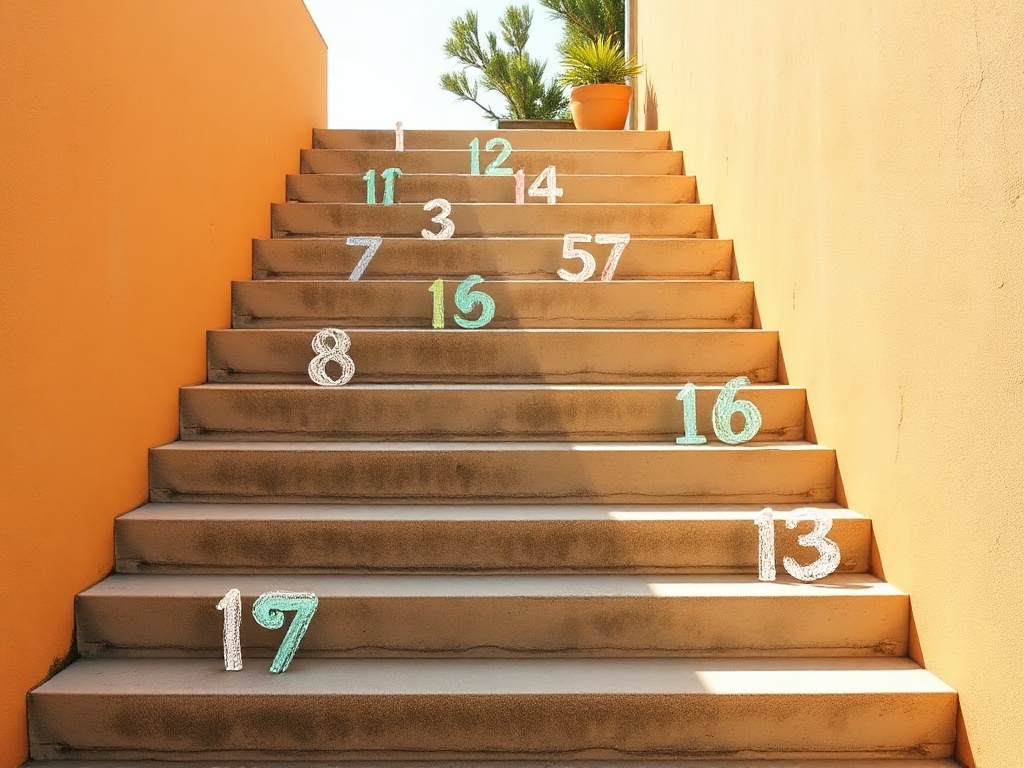
You barely need anything: chalk and the steps outside your building, the steps in the park, or a kerb. With chalk, write one number on each step — not in order, but shuffled: 42, 56, 24, 63, 48, 35, 72, 28. You call out "six times seven," the child runs and jumps onto the correct answer. Then swap roles — the child calls out, you run and deliberately get it wrong so they can catch you. The game takes 8 to 12 minutes; any longer and attention drops off. It suits children aged 8 to 10; for younger ones, stick to just six numbers. Count it mastered once, on two rounds in a row, the child lands on eight out of eight steps without pausing to count under their breath and without glancing at you for confirmation.
Beach Shop
All you need is empty bottle caps, pebbles or shells — about thirty of them — and a sheet of paper. The child opens a "shop": eight shells cost €3, a sand boat costs €4, three pebbles cost €2. You're the customer and order a sum in your head: "I'll take six boats, how much is that?" The child answers out loud, and you pay with pebbles instead of coins. Then swap roles — you buy, the child counts the change. Keep prices between €1 and €5 so the sums stay within the times tables. Twenty minutes is enough for about fifteen sums. The game works well for children aged 8 to 10, and older ones can write out the price list themselves. It's a success once the child works out five orders in a row without lining up pebbles one by one, and notices on their own if you hand back the wrong change.
Twenty Questions in the Car
All you need here is the drive to the seaside and a phone for the timer. The rule is simple: ask twenty shuffled questions in a row, drawn only from the hard-facts list on the fridge. The child answers straight away, you count the correct ones out loud — "fourteen" — and carry on. Don't correct mid-round; on a wrong answer, just say the right one calmly and move on. The whole thing takes 4-5 minutes and is played once per journey, not five times. Ages 8 to 10; for children who get distracted, cut it down to ten questions. Consider the facts mastered once the child scores 18 out of 20 on two separate days — and when, next time, they don't ask "can we do it again from the start."
If a child counts under their breath and lands on the right answer in five seconds, they don't know the fact — they're calculating it. The goal of summer is the gap between those two things.
How to Handle a Wrong Answer Without Killing the Game
Don't say "think again" — the child is already thinking. Say the answer, then immediately flip the same question round: the child got 7 × 8 wrong, you say "fifty-six," count to three, and ask "eight times seven." That second hit sticks far better than one dragged out through waiting. And this is the moment for a line that does more work than any praise: "You knew that yesterday, you'll get it next time."
If the child says "I hate times tables," stop the game that same minute, no comment. Come back to it after two days, but with a different game. The association between multiplication and dread costs far more than three skipped days.
How to Memorise Multiplication Tables Over Summer: A Week-by-Week Plan
- First week: make the list of hard facts. Just that, no games yet.
- July: one game a day, 10 minutes on average. A missed day isn't made up.
- August: cut back to three times a week, but shuffled questions only.
- The last week before mid-September: twenty questions in the car, once a day. That's it.
All told, that's about four hours across the whole summer holiday. With a workbook of sums, the same result takes twice as long and comes with a lot more breakfast-table arguments.