
Rainy Sunday Afternoon: What to Do When Your Child Says "I'm Bored"
A practical plan for parents and caregivers when your child says "I'm bored" on a rainy Sunday afternoon (ages 5-7) — two ready-made activities using things you already have at home, the one parenting reflex that usually backfires, and what to do in the first five minutes when nothing seems to work.
A note for parents and caregivers: this guide is written for the adult in the room, and the activities below are meant to be set up and supervised by you. It's half past three, rain has been drumming on the window since morning, and your child is sprawled face-down on the rug, saying for the fifth time: "I'm sooo bored." The box of building blocks is two steps away. So are the crayons. And still, nothing happens.

The first parental reflex is usually to start listing options: "Well, draw something. Or do your puzzle. Or... do you want to watch something?" Your child turns down everything, and you may well end up in front of a screen after all — not because you've given up, but because that's the one suggestion that doesn't ask them to work out where to start.
Why a list of ideas often doesn't work
When your child says "I'm bored" on an afternoon like this, the problem usually isn't a shortage of things to do. At 5-7, most kids already have piles of toys, and still can't turn "draw something" into an actual first move. In most homes it's not that there's too little to do, or even too much — it's that every suggestion on the list stops one step short of an action. The middle step is missing: what exactly do I pick up right now, and where do I put it. That's why "go draw" lands like a chore instead of an invitation.
The difference is tiny, but you feel it right away. Compare the two: "Go draw something" and "Bring me the yellow colored pencil — I'll show you something." The second one is a single action your child can do without thinking about it. And once the pencil is in their hand, the afternoon has usually already started.
That's why the two activities below don't start with an idea — they start with an object. You bring the object; your child takes it from there.
Hotel for Raindrops
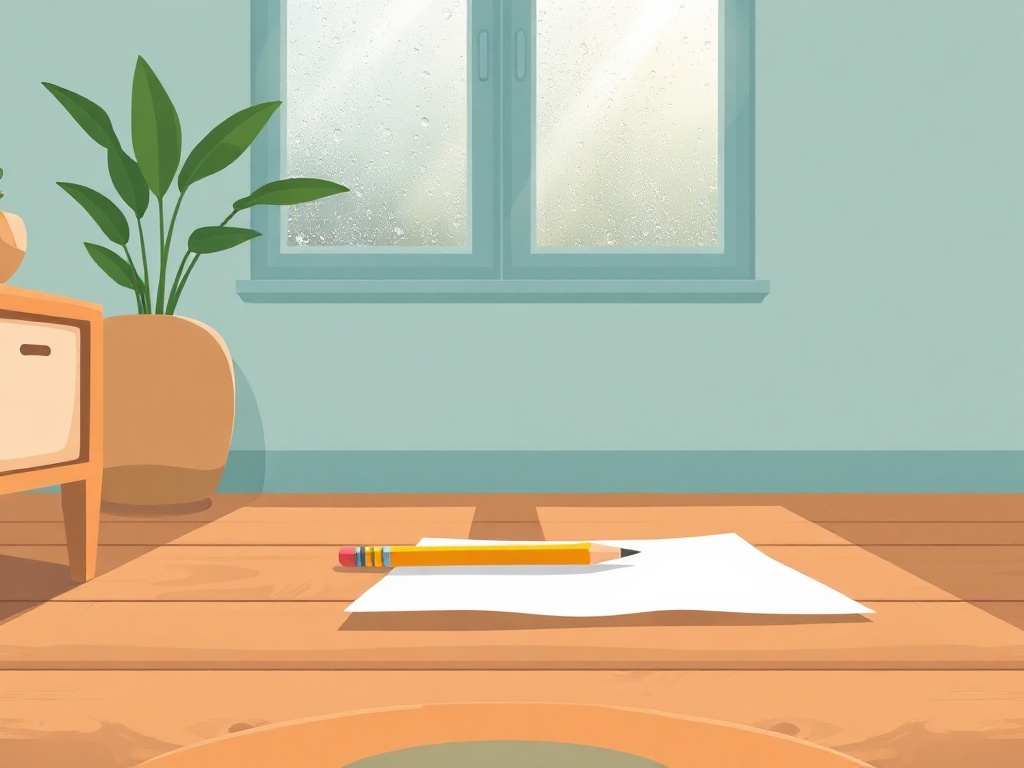
Materials: a large sheet of paper (the back of old wrapping paper works too), a pencil, colored pencils or crayons, one small slip of paper for drawing lots. Time: 25-35 minutes. Age: 5-7. How to play: sit by the window together and each pick a raindrop that has just landed at the top of the glass. Watch whose drop reaches the bottom edge first — that's the "race". Then draw a house with lots of windows, and in each window put a raindrop character: one in a hurry, one that's stuck, one that has swallowed three smaller drops. Your child comes up with the names; you write them under the windows. If they're not reading confidently yet, let them dictate to you. You'll know it has landed when they suggest a new window or a new character on their own, without you asking. Safety note: keep sharpeners and any sharp-tipped tools out of reach, and put small paper slips away afterwards if a younger sibling is around.
This one usually works because the rain that caused the boredom becomes the material for the game. Nothing to go outside for, nothing to buy.
Shop with Play Coins
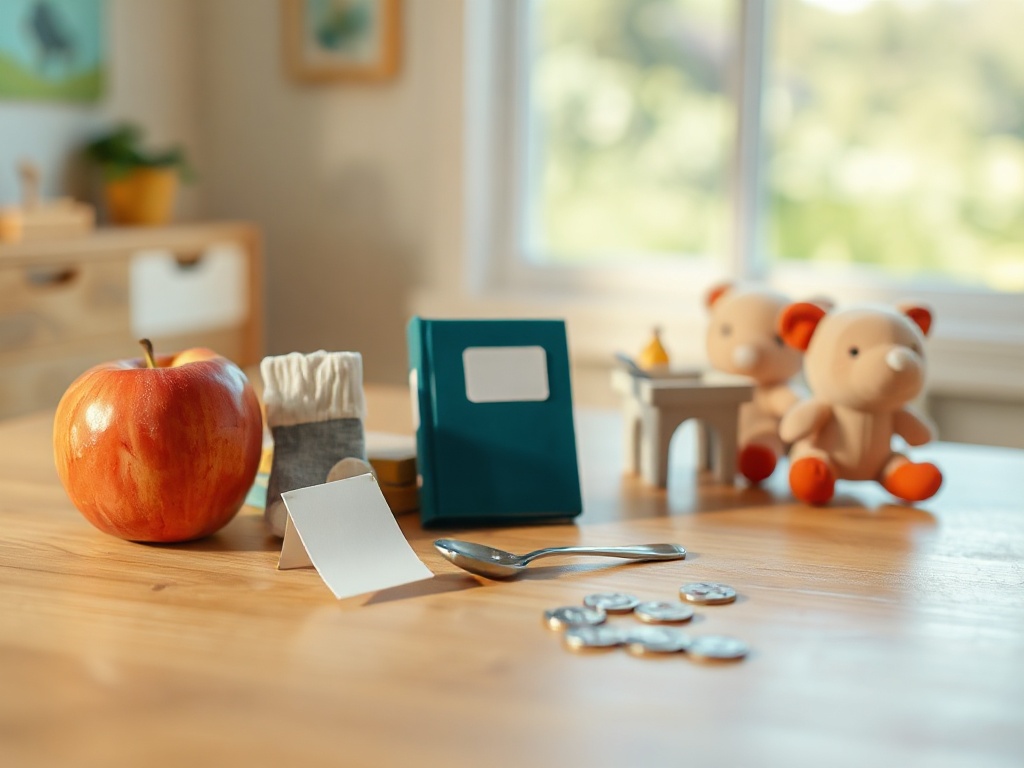
Materials: 6-8 household objects (an apple, a sock, a book, a spoon, a stuffed toy), small slips of paper for price tags, a pen, and play money — cardboard or paper coins you cut out and color together; making them can become part of the game. Time: 30-40 minutes. Age: 5-7. Safety note: use paper or cardboard coins only. Real coins and other small objects are a choking hazard at this age, and paper coins work exactly the same way in the game. How to play: your child sets out the "goods" on the table and sticks a price on each item — from 10 cents to $1. You're the customer, and you shop deliberately slowly: "I have 50 cents. Is that enough for the apple and the sock?" Count together using the coins on the table, not in your head. Then swap roles — you shop, your child takes the payment and gives change. It's working when they count the money in their hand and tell you whether it's enough, before you've dropped any hints.
Try not to turn this into a math lesson. If they get the change wrong by 10 cents, you don't have to correct it on the spot — count your own coins out loud and let them hear the difference.
A common mistake: offering three things at once
"Do you want to draw, make playdough, or play cards?" — it sounds generous, but it's usually the fastest route to "nooo" times three. It's not really the number of options; it's that a question hands the whole job back to your child: picture each one, pick a favorite, then live with the choice — all before a single pencil has moved.
And for a lot of kids, saying no costs less than choosing. Say "no" and you risk nothing. Choose and you might get it wrong. So they stay on the rug.
What tends to work instead is a single step, with no question mark: you sit down on the floor and start lining up the coins. You ask nothing. More often than not, within a minute or two there's a curious child right next to you.
What to do in the first five minutes
- Turn off the TV and your phone too — your own, because your child sees where you're looking.
- Bring one object in your hand. Not a box of supplies, not a whole cupboard — one object.
- Say what you're doing, not what they should do: "I'm going to draw a house with twenty windows."
- Stay quiet for the next thirty seconds. This is usually the hardest part.
- Once your child joins in, stop leading and start asking them: "So who lives in this window?"
For most kids this age, "I'm bored" rarely means "there's nothing to do" — it means "I don't know where to start."
What if nothing works at all
Some afternoons turn down every plan you bring them. Your child is short on sleep, you're worn out from the week, and it's been raining for three hours straight. On days like that, it helps to lower the bar: forget an hour and a half of activity, aim for twenty minutes together, after which everyone does their own thing.
Twenty minutes of folding laundry together while arguing about whose socks are whose can be plenty. Same goes for kneading dough, sorting out the drawer of cables, or wiping the inside of the window with a sponge. Plenty of 5-7 year olds like helping with real housework more than we expect — precisely because it's real, not invented to keep them busy.
One more thing worth knowing: the stretch between "I'm bored" and a child's own idea can last much longer than you'd expect, and from the outside it looks like nothing at all — wandering between rooms, pulling at the curtain, lying on the rug again. That empty stretch isn't a sign the afternoon has failed; it's often where the idea is actually being made. Parents who sit through it tend to get a shoebox garage or a strip of tape running down the hallway on the other side of it — and unlike anything on your list, that one belongs entirely to the child.
What stays after the afternoon is over
Not the drawing of raindrops so much as the habit: next time it rains, your child may head for the window instead of the screen. And you'll already know that instead of reeling off ideas, it can be enough to bring one colored pencil and sit down on the floor.