
Keep Your Big Kid Busy: Two Quiet Time Missions for a 5-7 Year Old
From our Parents' Corner: a quiet time guide written for grown-ups, with two tested solo missions that keep your big kid busy for a good twenty minutes — useful for any stretch when your hands are full. No new purchases and nobody has to play along.
A quiet time guide for parents and caregivers on how to keep your big kid busy — this one is written for the grown-ups of the house, not for the kids to read themselves. The pattern is familiar to anyone with more than one child: you finally sit down to something that needs both hands, and within a few minutes the older one has drifted in from the other room, sleeve-tugging, wanting in on whatever you're doing. Not because they have nothing to do — because whatever they had going ran out and starting something new on their own is the hard part.
The usual advice is "give them something new." You buy a puzzle, it lasts seven minutes, then the toy joins the pile with the others. The problem isn't the toy. What tends to hold a child's attention is structure: inventing a task, setting the rules, and deciding when it's finished is a lot to ask of a five-year-old on their own, and most kids this age still want a hand with that part. If you hand them that structure ahead of time, the child can happily stay with it until the timer goes off. If you don't, they're back every three minutes.
One clarification about age matters here: everything below is meant for a parent to set up, and it has been tested with children between 5 and 7 — kids who already follow spoken instructions with several steps but don't yet read long text. It won't work with a three-year-old, and an eight-year-old will find it dull.
What makes a solo activity actually go the distance
The difference between an activity that lasts three minutes and one that runs a full stretch comes down to four things. First — there's an end product, something to show off at the finish. Second — there's a rule that adds a bit of challenge (not just any castle, but a castle made only of blue blocks). Third — the child knows when it's over: a sand timer, a kitchen timer, an alarm set on the phone on the table. And fourth — they know what to do if they get stuck, without coming to find you.
That last point needs to be spelled out beforehand, in words the child can repeat back. For example: "If something isn't working, set it aside and move to the next thing. I'll take a look as soon as I'm finished here." Say it once, ask them to repeat it in their own words, and then actually keep your promise — otherwise they won't believe you next time.

A museum on the couch: the first mission to try
Mission for parents to set up: Couch Museum
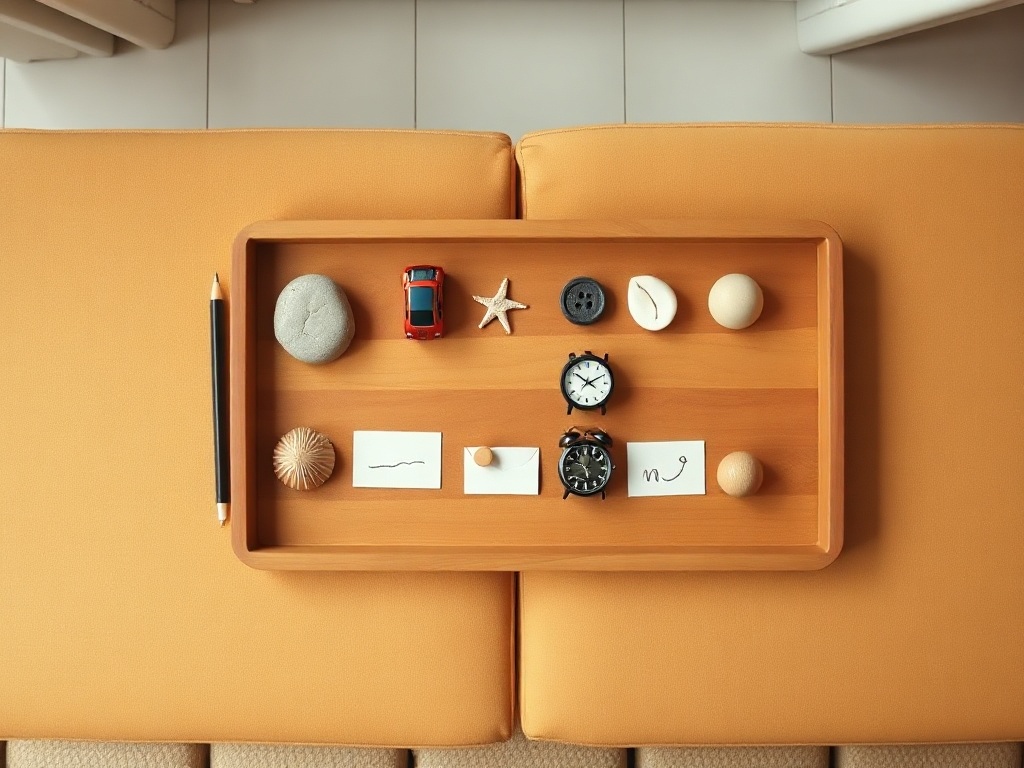
You'll need a tray or a large board, six to eight slips of paper and a pencil, and stickers or tape. Explain the mission to your child like this: they go around the apartment and collect exactly eight objects following a given theme — "things smaller than my hand," "things that are round," "things that were mine when I was little." They arrange them on the tray and write or draw a label for each: what it is and where it's from. At the end, they give you a tour of the exhibition and explain every piece. Takes 15 to 25 minutes, suitable for ages 5-7 — with five-year-olds, have them draw the labels instead of writing. Call it done when the tray holds eight objects with eight labels and the child can say one sentence about at least five of them; in our house that's roughly where the interest runs out anyway, so it's a finish line rather than a test to pass.
The tour is a key part, not decoration. In our house, the child works with more focus knowing there'll be an audience at the end. And you get your time too: the tour takes three minutes, and by then the stretch of calm you needed is already behind you.
One marble, one track: the second mission
Mission for parents to set up: The Marble Run
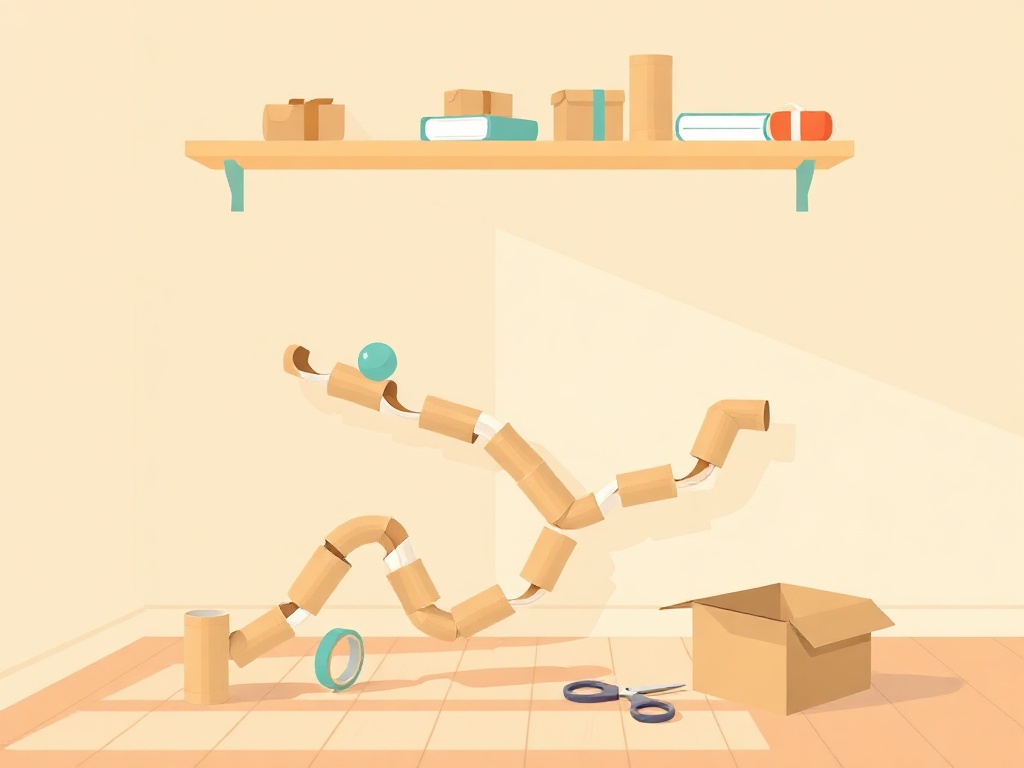
Gather cardboard tubes from paper towel rolls, a few boxes, tape, and a marble or bottle cap. There's one task to give your child: get the marble from the highest point down to a box on the floor without touching it. The rule that keeps the child engaged is that every time the marble falls off the track, they may fix only one thing and try again. Counting the attempts is part of the game. Takes 20-30 minutes, works well across this age range, and for six- and seven-year-olds you can add a second condition: the track must include at least one turn. Treat it as finished when the marble makes the trip twice in a row — one clean run can be luck, and the second one is usually where the child decides the track is done.
The materials for this game cost nothing if you save up the tubes for a week beforehand. The only thing you might need from a drawer rather than the recycling is tape — and you'll reach for that a hundred more times anyway.
The most common mistake: the game starts when you're already busy
I did it this way for the better part of a year, and so does nearly every parent I've compared notes with. Something urgent comes up, you sit down to deal with it, and on the way you toss out to the older one: "Go play something." It almost never works, and the reason is simple — by that point the child has already noticed your attention shifting, and that's exactly when they want it back. Also, "go play something" isn't a task — it's an invitation for you to think for them.
Flip the order. Set up the task five minutes before you get busy, while you're still free and can look them in the eye. Explain it, answer questions, start the timer, and only then turn to your own thing — the call, the younger one, the thing that needs both hands. The child has already started something of their own, rather than being dropped in the middle of nowhere — and that small shift is what usually carries them all the way to the timer.
A second common mistake is a quick, distracted "well done." A "good job, sweetie" tossed over your shoulder counts for less than we think. Spend those two minutes at the end and ask specific questions: which part was hardest, what did they try first, what would they change next time. Then the next task gets accepted without any haggling.
How to keep quiet time from turning into screen time
- Rotate tasks from a list so you're not inventing something new right when you're most tired. Ours has eight, one sticker per finished mission: 1) Couch Museum; 2) The Marble Run; 3) a blanket-and-chair den with one rule — it has to hold a flashlight and a cushion; 4) a portrait gallery, four drawings of people in the house, one sentence under each; 5) a sorting job — a box of buttons or bricks split into five piles by a rule the child picks; 6) a paper town, three buildings taped together on a sheet of A4; 7) a treasure hunt in reverse, where they hide five things and draw the map for you; 8) a tower that has to survive being counted to twenty out loud.
- Keep the materials in one busy bag or box the child can reach alone; if you have to get something down from a shelf, the plan falls apart before it even starts.
- The same activity gets repeated at most twice a week — the third time it's already "this again."
- Make the timer visible. A wall clock or kitchen timer does more work than a phone, because the child can check for themselves how much time is left.
What sticks after a few weeks
The goal isn't silence at any cost. After a month of missions like these, you may stop having to set anything up at all: the older child starts doing something worth far more than a quiet half hour — inventing their own tasks, with their own rules and their own endings. You'll hear them say "now I'm going to build a bridge only out of red ones and then show you" — and that's the moment they no longer need you to get started.
Don't hand them a new toy. Hand them a mission, a rule, and a time it ends.