
Chestnuts, Acorns, and Leaves: What to Do With Them When Your Child Brings Them Home
Stuffed pockets after a walk in the park aren't rubbish to throw out — they're material for two specific activities. Here's how to turn them into 20 minutes of play, with no glue on the table and nothing to buy.
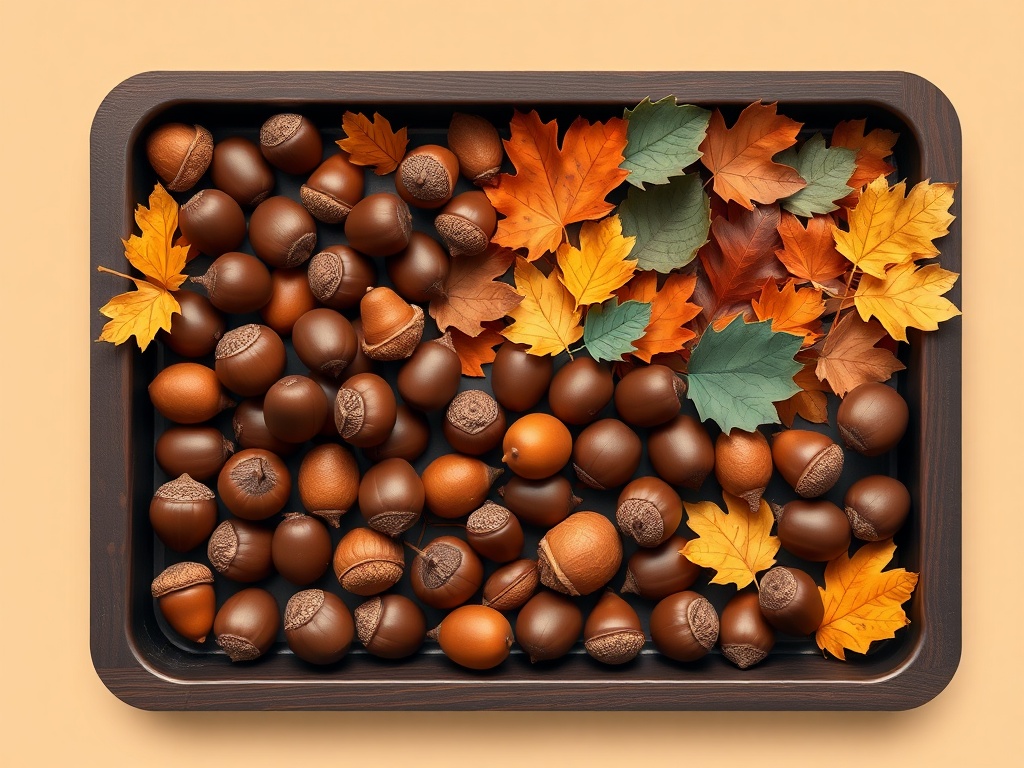
The jacket pockets are bulging, the hood is weighed down, and at the bottom of the backpack there are fourteen chestnuts and a handful of dried leaves rolling around. You know how this ends: within a week the chestnuts shrivel up in a plastic bag on the balcony, and someone throws them out while the child is at nursery. A shame, really, because between the walk and the bin there are at least two weeks of proper play.
We're talking here about children aged 5 to 7 — the ones who can already count to twenty and hold scissors more or less properly, but who don't yet have the patience for an activity with four steps and drying time in between.
Why chestnut-and-toothpick figures aren't the best idea
The first thing everyone suggests is little figures made of chestnuts joined with toothpicks. The practical problem is this: to get the toothpick through, some adult has to drill into the chestnut with an awl or a drill, the child stands to one side waiting, and the finished figure dries out within three days, the toothpicks loosen, and it falls apart. The child was involved for five minutes, you worked for twenty, and the result goes in the bin.
The difference is simple. Autumn nature play works best with things that get used again and again — for counting, for sorting, for games with rules. Not for decorations that need to survive. The chestnut shrinks, the acorn grows a little grub, the leaf crumbles. So stick to activities where there's nothing to preserve, only something to play with.
How to prep your finds for two weeks of autumn nature play
- Tip everything into a colander and rinse with cold water — the mud from the park comes off in a minute.
- Spread the chestnuts and acorns on an old towel on the windowsill and leave overnight; damp ones go mouldy fast.
- Put the leaves between the pages of a thick book, a few pages apart, and weigh it down with more books on top. They're ready after 3-4 days.
- Throw out any acorn with a little hole in the side — that's exactly where a grub will emerge after a week in a warm room.
- Store everything in a cardboard box, not a plastic bag. Plastic bags trap moisture.
Autumn Treasures Shop
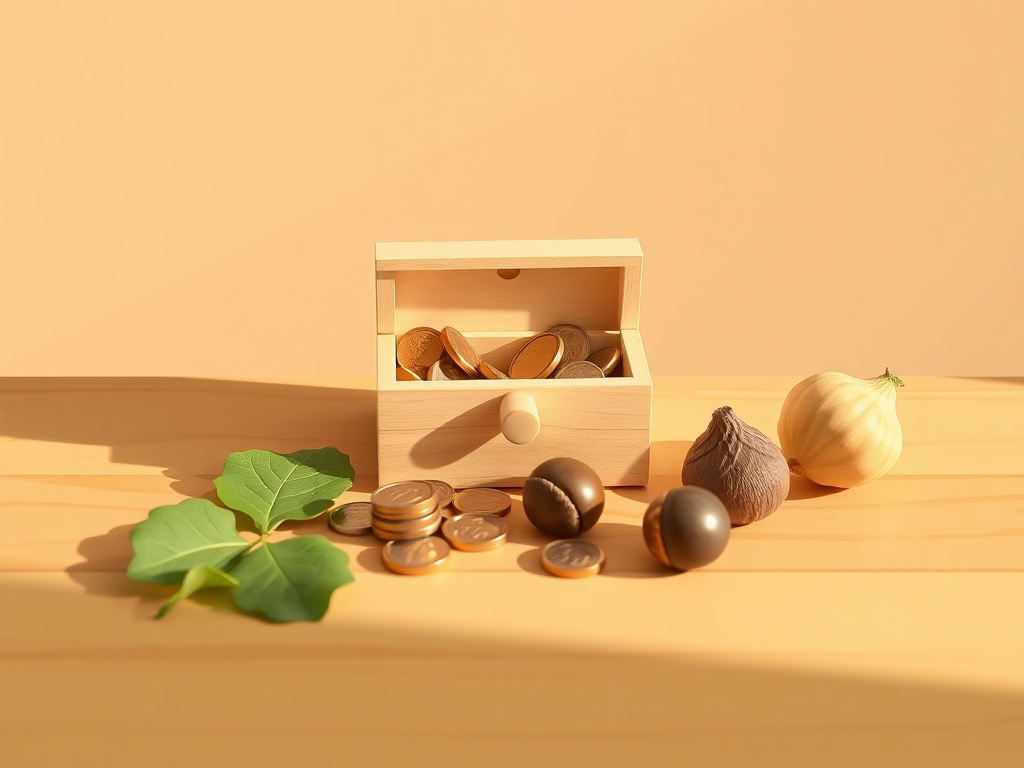
Put 1p, 2p, 5p and similar small coins on the table and set out the goods: a chestnut costs 2p, an acorn — 1p, a pretty leaf — 5p, a pod — 3p. The child is the shopkeeper, you're the customer, and you deliberately count slowly and get it wrong: "I want two chestnuts, so that's 3p I owe you, right?" — let them correct you. Then swap roles and they go shopping with 10p, having to work out what they can afford. Materials: the park finds, small coins (under a pound in total), and a box to use as a till. Time: about 20 minutes, with a second round the next day. Age: 5-7, though with five-year-olds stick to amounts under 5p. Consider it a success if the child says on their own how much money they have left after a purchase, without you prompting them.
Guess What You're Holding
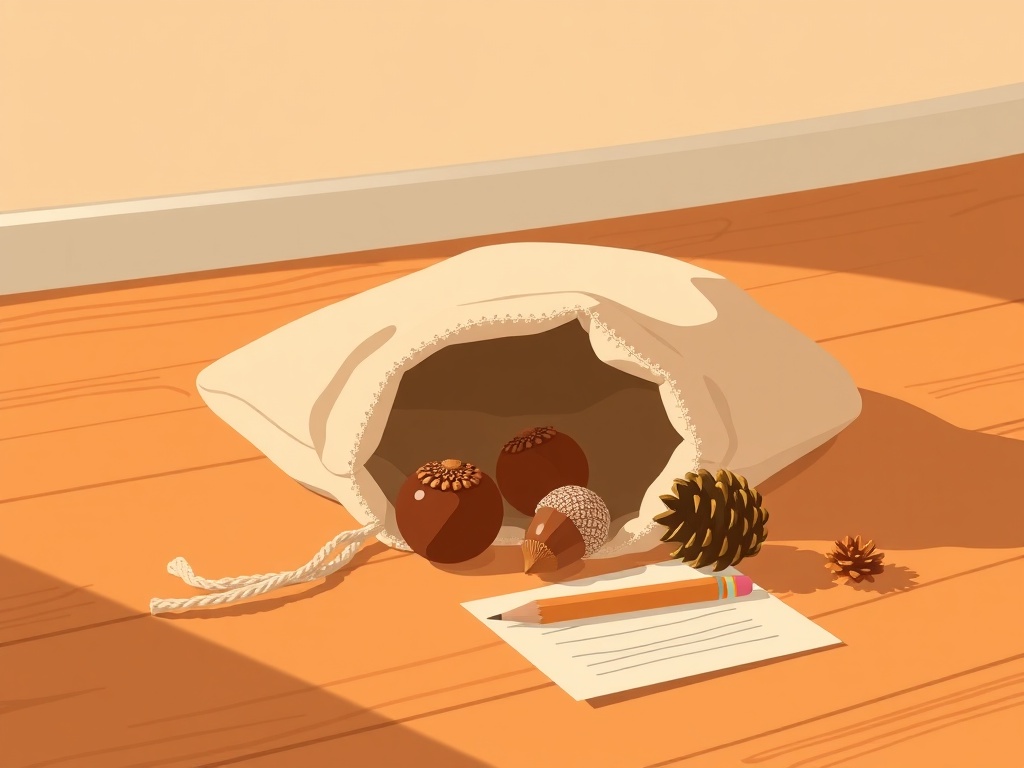
Take an ordinary cloth bag or a pillowcase and drop in six or seven of the finds — a chestnut, an acorn with its cap, one without, a dry leaf, a pod, a twig, a pebble from the path. The child puts a hand in without looking, takes hold of one thing, and describes it out loud before pulling it out: "It's round, smooth, cold on one side and rough on the other." Only then do they guess and check. The point isn't the guessing, it's the describing — write their words down on a sheet of paper as they say them, exactly as they come out, and read the list back at the end; that sheet is the one thing worth keeping. Then swap: you put your hand in and describe, and let the child correct you when you call an acorn cap a hat. Materials: a bag you can't see through, six or seven finds, a sheet of paper and a pen. Time: 15-20 minutes, and it works again the next day with three items swapped out. Age: 5-7; with five-year-olds start with four items that feel very different from one another. Consider it a success if the child uses two words in one description — not just "hard" but "hard and pointy."
One practical note for both games: chestnuts, acorns and small coins are exactly the size that goes into a mouth or a nose, so stay at the table while you play and put the box up on a high shelf afterwards — especially if there's a younger brother or sister crawling about the house.
A common mistake in autumn nature play: reaching for the glue too soon
Almost every leaf activity starts with glue and a sheet of card. The result is familiar — the child glues seven leaves onto one spot, the glue seeps through, the card wrinkles, and after five minutes the activity is over because there's nothing left to do. Once it's glued down, it can't be moved.
Flip the order. First arrange things without glue: on the floor, on a dark tray, on a white sheet of paper. The child can rearrange things thirty times, make a row from the smallest to the biggest leaf, sort by colour, build a face out of acorns and then knock it down. The glue comes at the end, and only for one composition they truly like. That way it's a reward, not a starting point.
A few phrases that come in handy during the walk itself
- "Find me a leaf bigger than your hand." — the child measures instead of just collecting.
- "Which tree did this chestnut fall from? Let's check if there are more underneath."
- "We each collect ten things. You count mine, I'll count yours."
- "Which leaf makes the loudest crunch when you step on it?" — this question sometimes gets a full ten minutes of devotion.
- "One thing stays here for another child to find. Which one do you choose?"
Material from the park is free and gets replenished every autumn — which is exactly why you can play with it boldly, scatter it about, and toss it out without a shred of regret.
When to throw it all out
After about two weeks the chestnuts turn brown and shrivelled, and the acorns start to smell. Don't wait for it to get to that point with drama. Say it in advance: "We'll play with these until Sunday, then we return them under the tree." Returning them is part of the game — the child scatters them around the park themselves and knows there will be new ones next year. No need to keep a box of dried-out acorns around until March.
And if you do want something to last, let it be the sheet of paper with the child's words from the guessing-bag game. It weighs a lot less than a bucket of chestnuts, and a year from now it'll be an even more delightful read.