
Turn Old Toys Into a Game: The €3 Plan for January 10th
After Christmas the toy box is full, but the kid is bored. Here's how 3 euros and a few rules turn old toys into a game that lasts more than one evening.
Saturday morning, January 10th. The rug is covered with things bought three weeks ago — a building set, two toy cars, an art kit, a plush dog with a sound button. The kid walks past them, kicks a loose cap, and says, "I'm bored, there's nothing to play with." And that's completely honest. Not a lie, not spoiled behavior. Just objects sitting there with no job to do.
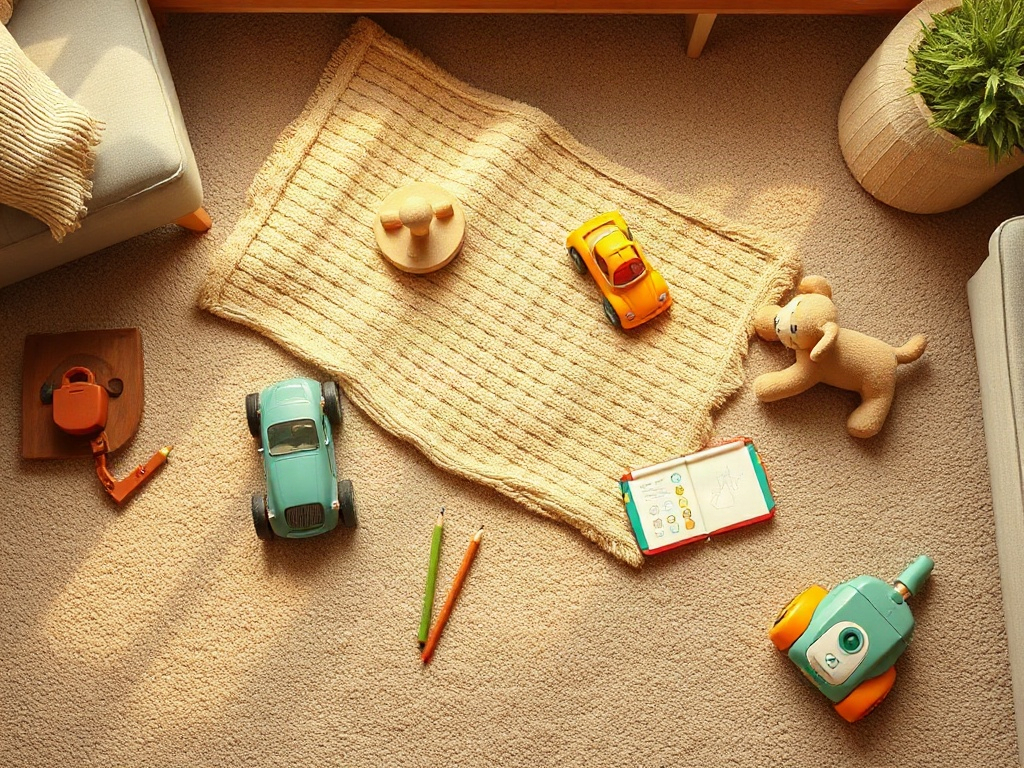
The usual move is to look for something new. But the new thing wears out in three days too. What's missing isn't an object, it's a rule — who wins, when the game ends, what happens if you mess up. A toy without a rule is just a thing. With a rule, it becomes a game. And that's exactly what these 3 euros from Christmas money should buy: a rule.
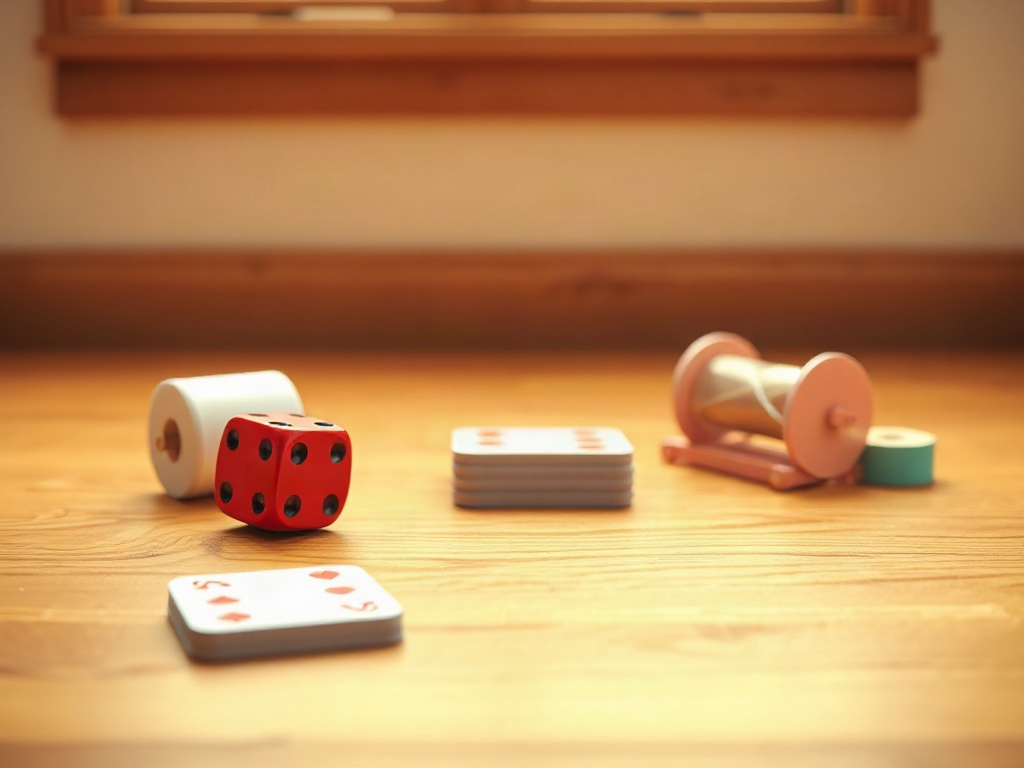
Why a new toy gets boring in three days, but a deck of cards doesn't
The difference is simple: the toy car does the same thing every time, while the cards deal out differently each round. An 8-to-10-year-old can already think in rules — they understand turns, points, exceptions, penalty moves. So they're ready to invent their own games, not just be handed finished ones.
That's why the 3 euros shouldn't go toward another box of something. They should go toward whatever adds randomness and counting: a die (about €1), a simple deck of cards, a small egg timer or stopwatch, a pad of sticky notes, a dice-shaped word cube. Any one of these, dropped in among the old toys, turns them into pawns, obstacles, or prizes.
- A single die adds randomness — now nobody knows who's going to win.
- A timer adds tension — three minutes is short, and you can feel it.
- Sticky notes add a map to the room — every toy gets a point value.
- A piece of chalk or a roll of masking tape adds boundaries — where the playing field ends.
Step one to turn old toys into a game: take stock, don't tidy up
Before inventing anything, the box gets tipped out. Not to organize it — to actually see it. The kid pulls out each item and says out loud what it does: "This rolls." "This stands up straight." "This makes noise." "This comes apart." That's the key move. In the game, the plush dog isn't a dog anymore — it's "the thing that makes noise," which means a signal, an alarm, a referee.
An invented example of how that sounds out loud: "Mum, the dog isn't a dog anymore. It's the alarm. If you step on it, you lose your turn."
Museum of Boring Toys
All you need is the contents of the gift box, sticky notes, and a pencil — about €1.50 total for the notes if you don't already have some. Set aside roughly 25 minutes; it suits 8- to 10-year-olds. The child lines up 10-12 objects in a row and sticks a one-word note on each describing what it does: rolls, stands, makes noise, lights up, hides things. Then the notes get flipped over, and from memory the child has to say which object has which "power." Finally, they pick three objects with different powers and announce what kind of game the three could make together. You'll know it landed when the child can explain a game with at least two rules — how you win and what's not allowed — without an adult adding anything.
How to turn old toys into a game worth playing more than once
There's a short recipe that works almost every time: goal, obstacle, ending. The goal is what you're trying to achieve — move something, collect points, get there first. The obstacle is what gets in the way — the die, the timer, the no-go zone on the rug. The ending is when it stops — at 10 points, after three minutes, when all the cards run out.
Without an ending, the game dissolves into an argument. That's the most common problem with homemade games: it starts off fun, and seven minutes later someone storms out of the room. So the ending gets agreed out loud before the first move, and written down on a note stuck to the table.
The €3 Game: "Rug Circuit"
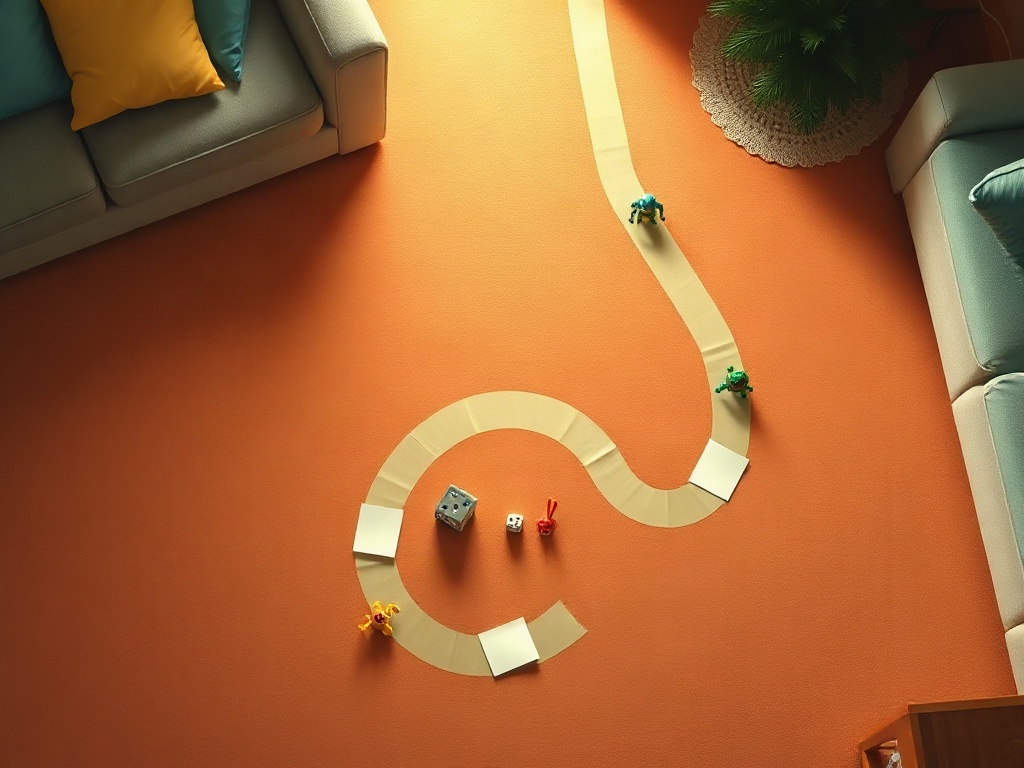
You'll need one die (about €1), sticky notes and masking tape (about €2 combined), and 8-10 toys from the box. Two to four players, best around ages 8 to 10; marking everything out takes about a quarter of an hour, and a round runs 10-15 minutes. Use the tape to mark out a path across the room. Toys are placed along it as stations, each with a sticky note showing a value: 1, 2, or 3 points, with a single station worth minus 2. Roll the die and move forward that many stations, scoring the points on whichever station you land on. The game ends when someone reaches 15 points. Watch what happens after round one: if the kids go straight into a second and change a rule themselves because they noticed something wasn't working, the game has taken hold.
What the adult does while the child invents
The most useful role is to be a fellow player asking questions from inside the game, not from the sidelines. "What happens if you roll a six twice in a row?" "Am I allowed to land on your station?" "Who keeps score?" Every such question forces the child to decide something and put it into words. That's the real work here — not dreaming up an adventure, but patching the holes in the rules.
One more thing: the rules get written down. Half a sheet of paper, five lines, in the child's own handwriting. Putting it on paper turns the game into something that still exists tomorrow, not just something that happened tonight. A week later, it gets pulled out and played again — usually with a new station added.
A common mistake: the adult invents the game, the child just plays it
The temptation is strong because it's fast. In four minutes you can put together a decent game, the child plays it once, and the next day says they're bored again. The reason is mechanical: inventing is the fun part, and it's already been taken. The child only got to execute — and executing someone else's rules runs out of steam fast.
A second common failure: buying a "game" for 3 euros — a tiny puzzle or a pack of stickers. That's not a rule, it's just another object that will be lying in the same box in two days. A die costs about the same, but it can be used in twenty different games, because it doesn't carry its own theme.
And third: too many rules at once. If there are seven conditions at the start, nobody remembers them and the game grinds to a halt on the third turn. Start with two rules. Add the rest only once the game has actually been played through to the end at least once.
How to tell it worked
- The child asks for a second round without being prompted.
- The rules change between rounds — meaning the child is thinking about balance, not just following along.
- A toy that hasn't been touched since December 25th suddenly has a role.
- A week later, the game gets pulled back out instead of staying forgotten under the sofa.
What lasts beyond that Saturday morning on January 10th is something more durable than one day's entertainment: the child learns that boredom is a problem to solve, not a state to sit in. And that the gift box isn't finished — it was just waiting for someone to give it rules.