
Animals and Their Homes: Why Every Home Fits Its Owner (Quiz for Ages 6-9)
A fun quiz that shows why every animal builds exactly the kind of home it needs. Kids will discover the connection between an animal's home, its food, and its safety.
An animal's home isn't just anywhere — it protects it from cold, from rain, and from predators. In this quiz you'll find out why a beehive is made of wax, why moles live underground, and how the shape of a home helps its owner survive. Every question asks you to work something out from a clue, so get ready to think, not just remember!
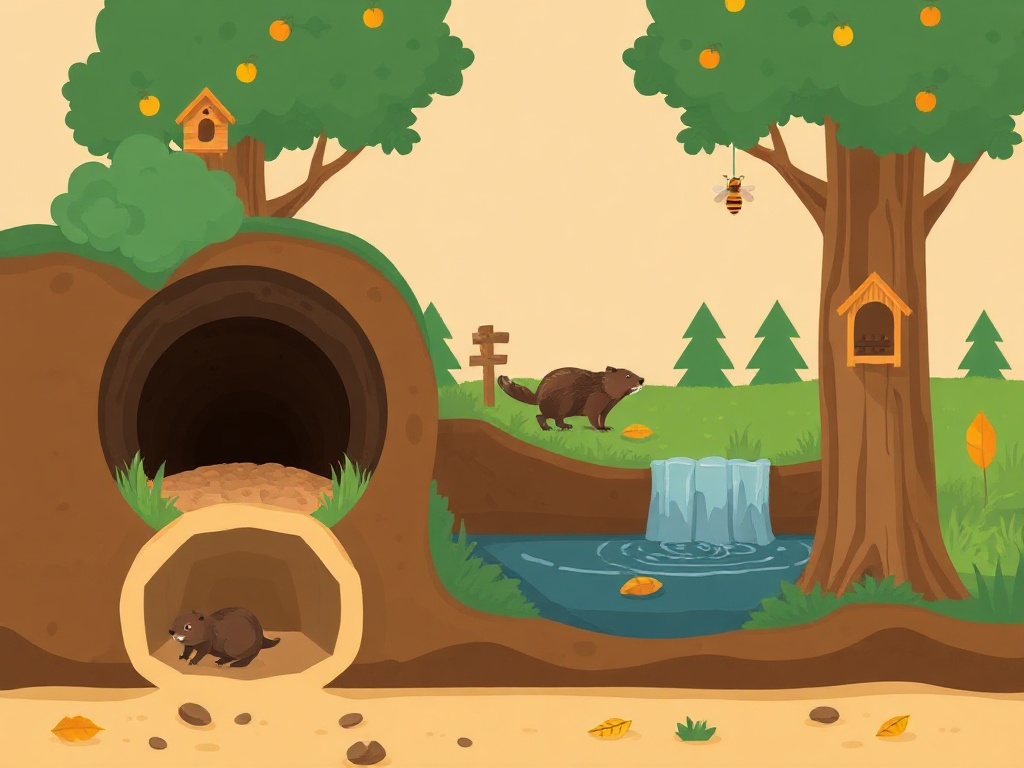
Quiz: Match the Home to the Animal That Needs It
Do You Know Where Animals Live?
1. A beehive is built out of wax and is full of small six-sided rooms. What are those rooms mostly used for?
- Keeping the honey and the baby bees warm and safe
- Collecting rainwater for the hot summer days
- Marking the trail back to the best flower patch
- Drying out the pollen before the bees eat it
Answer
Keeping the honey and the baby bees warm and safe
A hive is a pantry and a nursery all in one — bees store their food there and raise the next generation.
2. Which animal builds its home from branches and mud right in the river?
- The beaver
- The otter
- The duck
- The squirrel
Answer
The beaver
The beaver builds a dam and a lodge in the water, because an underwater entrance keeps predators out.
3. Why do birds often build their nests high up in trees?
- To stay far from animals that might eat the eggs
- To be closer to the sun so the eggs stay warm
- So the chicks learn to fly sooner
- So the rain runs off the leaves instead of the nest
Answer
To stay far from animals that might eat the eggs
Height is protection — cats, foxes, and snakes have a hard time reaching a nest high up.
4. Moles live in tunnels underground. What do they most likely eat?
- Worms and insects they find in the soil
- Fruit that falls from the trees above
- Fish from the river nearby
- Grass seeds from the meadow
Answer
Worms and insects they find in the soil
An animal eats what it finds in its home — underground, that means worms and insects.
5. A snail crawls slowly and can't run from anything. How does carrying its shell everywhere help with that problem?
- It can hide instantly, wherever it happens to be
- It can slide much faster over rough ground
- It can climb walls that other animals can't
- It can scare a bird away with the shell's bright pattern
Answer
It can hide instantly, wherever it happens to be
The shell is a portable home — a snail never has to search for shelter, because it always carries it on its back.
6. In autumn, a squirrel hides nuts and acorns in many different spots. What would likely happen if it forgot some of its hiding places?
- New trees could sprout from the forgotten seeds
- The forgotten nuts would stay fresh until the next autumn
- Other squirrels would dig up every single one of them
- The oak tree would make fewer acorns the following year
Answer
New trees could sprout from the forgotten seeds
Forgotten acorns sprout in the soil, so squirrels unknowingly help the forest grow.
7. A bear hibernates in a den for the winter, while a stork flies south. Why do these two animals handle winter so differently?
- A stork can't find food here in winter, but a bear can live off its fat reserves
- A bear is too heavy to travel far, so it has no other choice
- A stork's nest is built for summer rain, not for snow
- A bear's thick fur keeps it warm, so it stays awake all winter
Answer
A stork can't find food here in winter, but a bear can live off its fat reserves
Food is what decides it: the stork looks for it elsewhere, while the bear sleeps to use up as little energy as possible.
8. A family wants to hang a birdhouse in their yard, and a cat naps under the apple tree every afternoon. What's the smartest choice when picking a spot?
- Hang it high and sheltered, on a tree the cat can't climb up to
- Hang it low so the children can peek in at the chicks
- Place it right beside the front door where everyone can watch
- Hang it on a thin outer branch so it sways in the breeze
Answer
Hang it high and sheltered, on a tree the cat can't climb up to
Birds only move into homes that are dry, quiet, and out of reach of predators — and the napping cat is exactly the predator to plan around.