
Vacation at Grandma's House in the Country: Rules for Chickens, Cows, and Guard Dogs (Ages 7-10)
A dog on a chain isn't mean, and a cow isn't big and gentle just because it's big. Practical rules and two exercises a child can pick up on the very first evening in the country.
The gate creaks shut, the bag gets dropped on the doorstep, and the child dashes off to the henhouse because they've heard clucking. Grandma calls out behind them, "Slow down, don't run!" — but it's already too late, the hens have scattered, and the rooster is standing square across the path with his head lowered. That exact second decides how the whole vacation is going to go.
Kids are usually told "don't touch the animals." It sounds sensible and it doesn't work for even one day. The child came to the country precisely to touch things, to feed the animals, to carry the water bucket, to collect eggs — and they'll do it the moment no one's watching. A more useful rule is this: approach so the animal sees and hears you before you actually reach it. Most unpleasant mishaps in the country happen with a startled animal, not a vicious one.
Why surprise is more dangerous than teeth
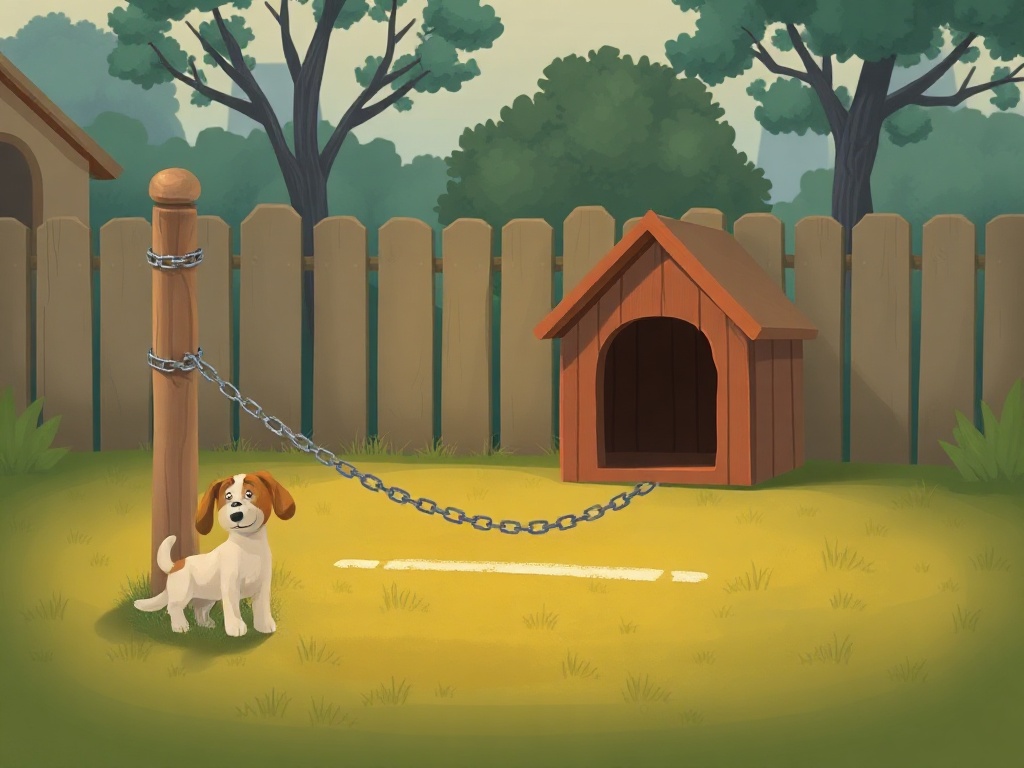
A cow can see almost everything around her, but she has a blind spot directly behind her — right where her hind legs are. If a child walks up quietly from there and touches her, she'll kick without being the least bit angry. A dog on a chain guards the yard; when someone steps inside the radius of that chain, the dog doesn't stop to work out whether it's a child or a burglar. And a mother hen with chicks will peck at any hand that comes near the nest, no matter how gently it's offered.
That's why at Grandma's a child learns one habit: speak before you arrive. Not a whisper, not a shriek — just a normal voice. "Here I come, Bessie!" "It's just me, Rex!" The animal lifts its head, recognises you, and you're no longer a surprise — you're someone it knows.
The three distances a child needs to tell apart
- Far and safe: the child can see the animal but could calmly turn around and walk away. This is where you watch from, and where you ask Grandma, "Can I go closer?"
- Close, but only with a grown-up: up to the cow's fence, up to the henhouse door, up to the end of the dog's chain. You only step in here when Grandma or Mum is right beside you.
- Grown-ups only: behind the cow, inside the reach of the chain, in the pigpen, next to a mother dog with puppies. The child never goes in here, even when the animal looks fast asleep.
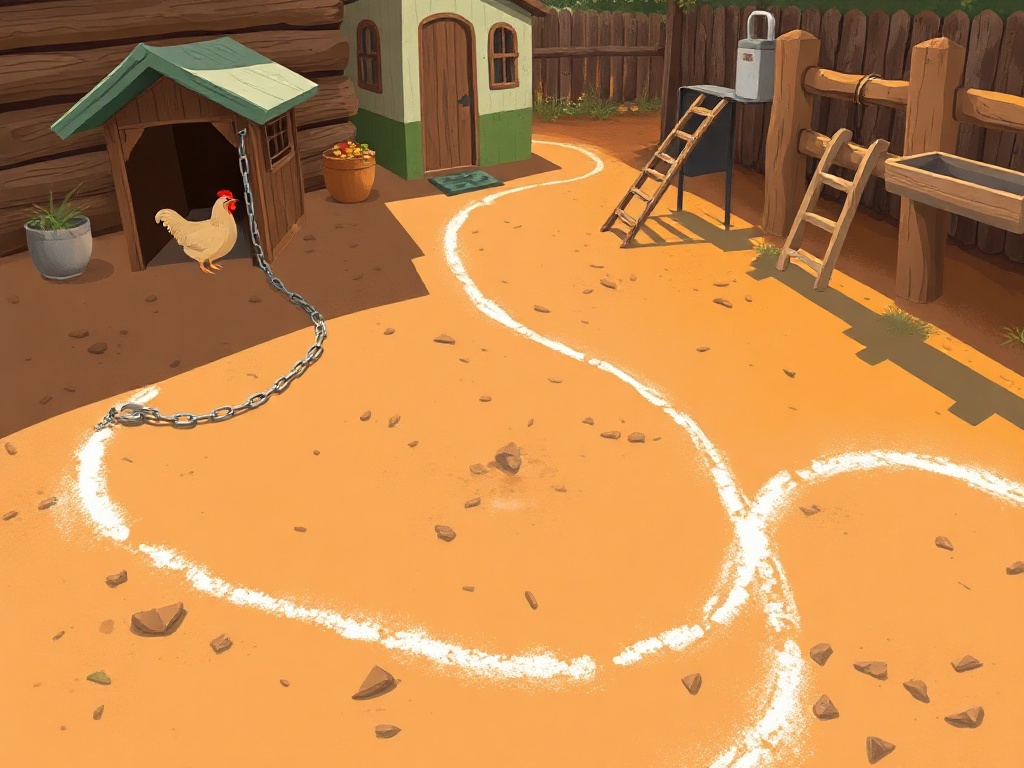
The dog's chain is worth measuring out loud on the very first day. Grandma holds one end, the child walks alongside it counting steps. Five steps? Then the line is drawn at six. That line sticks in a child's memory far better than the words "don't get too close," because the child measured it themself.
Chalk tour of the yard
All you need is chalk or a few sticks and half an hour after breakfast, while the animals are calm. Good for children aged 7 to 10, together with an adult. Walk around the yard, and wherever an animal lives, draw a line on the ground — as far as the chain reaches plus two steps, as far as the cow can reach with her head over the fence, where the hen's nest begins. The child draws the line, the adult explains why it goes exactly there. At the end, the child walks the yard alone and points to each line, saying out loud what's behind it. The exercise is done when the child can find all three lines without a hint and give one simple reason for each — for example: "I don't go in here, because Rex can't tell it's me until I call out."
How to collect eggs without getting pecked by a broody hen
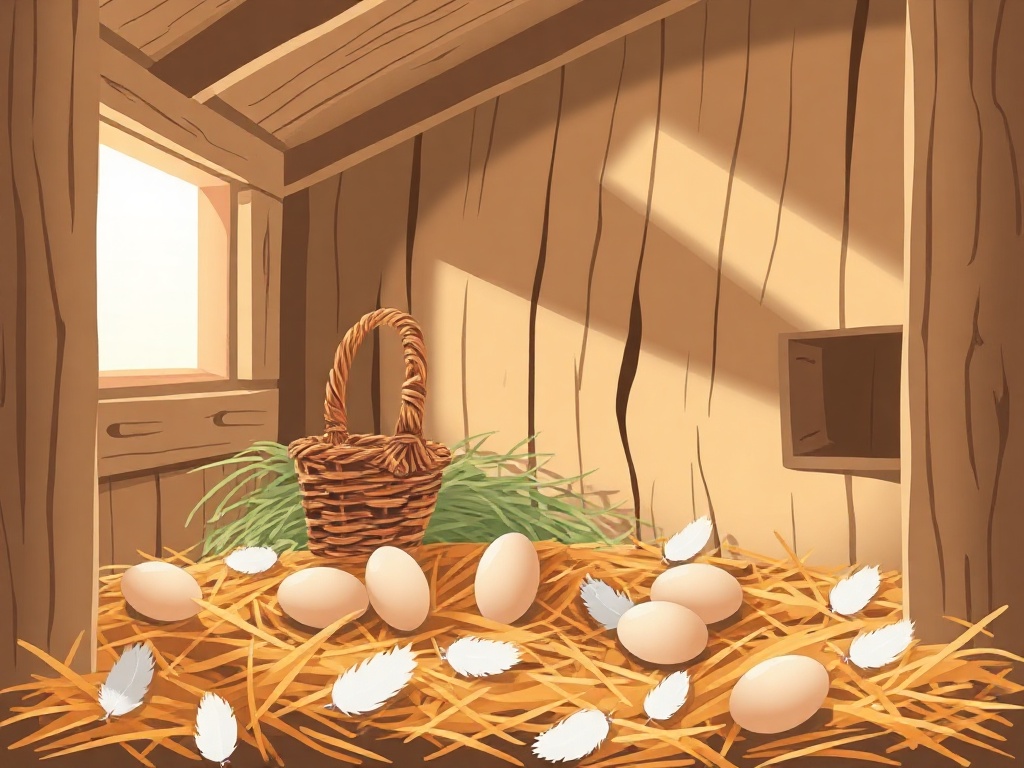
Collecting eggs is the most coveted job in the country and the most common source of tears. The routine is simple and learned in one go. First, knock on the henhouse door and say loudly, "Coming in!" — the hens step back. Go in slowly, no running, with a small basket in one hand. Pick up each egg with a flat, open palm underneath it, not with two fingers, and put it straight in the basket, never in a pocket.
If a hen is sitting and won't get up, she isn't being lazy — she's broody. Leave her be and call Grandma. And most important of all: after the henhouse, before any bread, wash your hands with soap and warm water while counting slowly to twenty. The same goes after petting the dog, and after the milk pail.
A rule the child can repeat on their own is a real rule. Everything else is just words said in passing.
A common mistake: "Our dog is friendly, he doesn't bite"
This line gets said in every yard, and it's a trap for three reasons. First, the child files it away as a general rule and applies it to the neighbour's dog, which they're meeting for the very first time. Second, "friendly" means friendly with the people of the house he knows — and a grandchild who visits twice a year is, to the dog, a guest, not family. Third, dogs don't bite out of meanness; they bite out of surprise, out of pain, or because they're guarding their food bowl. Even the gentlest dog will growl if someone yanks its tail while it's eating.
Better to say something specific: "Rex is friendly when you call his name and he comes over to you on his own. He's not friendly when he's eating, when he's sleeping, and when he's behind the gate." A child can actually act on that — unlike the vague "friendly dog."
Two more mistakes that happen every single summer
- The child runs at the animal with arms outstretched. To a dog, a running child looks like a chase; to hens, it looks like a hawk. The rule is the opposite: stop, crouch down, and wait for the animal to come to you.
- Hand-feeding a large animal. A cow or a horse takes food with tongue and teeth all at once and can't tell a carrot from a finger. If the child wants to feed the cow, put the food in the trough or on a flat, open palm — but only with the adult's hand underneath it.
The "Stop, Crouch, Wait" game
For this game all you need is a yard and about ten minutes before dinner; a stuffed toy works fine instead of a real animal if the dog is resting. Good for 7-9 year-olds. The adult stands about ten steps away and plays the animal — sometimes "the dog" glances over, sometimes "the cow" turns its back. The child walks up calmly, says the animal's name out loud, stops at the marked line, crouches down, and waits to be "noticed." If they start running or cross the line, the round starts over from the gate — no fuss, just try again. The game is mastered once the child completes three rounds in a row without skipping any of the three steps: the voice, the line, the crouch. After that, the same routine is repeated once for real, with the dog, while the adult holds the chain.
What should stick after the vacation
By the end of the week the child should be able to say three sentences without prompting: "I call out before I get close." "I know how far the chain reaches." "I wash my hands after the yard." Once those three sentences are there, the rest takes care of itself — which hen lays where, which cow is more patient, which dog loves having its ears scratched.
One more thing that's often left out. Tell the child what to do if something goes wrong: don't run, don't scream — stop where you are, cross your arms over your chest, and call an adult in a normal voice. Running signals "chase me" to almost any four-legged animal. Standing still doesn't — it's boring, and a dog pays no attention to something boring.