
The Cousin Arrives Sunday, and the New Toys Are Off-Limits: Swap Rules to Set Before the Doorbell Rings
A practical plan for 4-6 year-olds who don't want to hand over their new things to a visiting cousin. Two games, exact phrases to rehearse, and rules agreed on before the guests arrive.
Sunday, quarter to three. The cousin's arriving around four. Your child is sitting on the rug with the new magnetic tile set — a gift from four days ago, still smells like the box — and when you casually suggest, "you two can play with these together," they clutch it to their chest and say: "No. Mine." And you already know how the afternoon is going to go.
The usual advice is to explain that sharing makes people happy. Except that line lands exactly when it's least useful — after the doorbell, in front of an outside witness, over an object the child hasn't even had time to feel is truly theirs yet. "Give it to him" in that moment doesn't teach generosity. It teaches exactly one thing: hide the new stuff better next time.
Why the new toy isn't up for negotiation
Between ages four and six, a child is still building the very idea of "this is mine." A new item isn't a toy yet — it's proof. Proof that someone was thinking of them, that the birthday was theirs, that there's something in this house that isn't shared with anyone. Handing it to a cousin who'll walk off with it in his hands (that's how it looks from the inside) feels like having the proof taken away.
So the approach that actually works isn't convincing your child the toy doesn't matter. It does matter. What works is sorting things into two piles before the guests arrive — and letting your child do the sorting.
The conversation to have half an hour before the doorbell
Sit on the floor. Not in passing, not while doing the dishes. On the floor, next to the toys, and say: "Grandpa's bringing Martin over at four. Let's decide which things you'll play with together and which ones get a rest in the cupboard." Notice the verb — not "you'll hide," but "get a rest." It's a small difference, and children accept it far more easily.
- Grant three untouchable items. Not one, not everything — three. Big enough to cover the new toy and the favourite stuffed animal, small enough not to empty the room.
- Those three things physically go somewhere else — the top shelf, the bedroom drawer, a bag in the hallway. Out of the guest's sight means out of the argument.
- Everything else stays on the rug and is shared by default. Don't ask about it again once the cousin's already inside.
- Say out loud what happens if Martin asks for something from the top shelf: "Then you say: not today, come see the train set instead." Rehearse the line twice. Out loud, word for word.
- Agree on an ending: "When Martin leaves, everything goes back." Many children aren't resisting sharing itself — they're doubting whether their things will actually come back.
If your child insists that even three untouchable items aren't enough, don't haggle for long. Say: "Today it's three. Next Sunday we'll count again." A boundary that doesn't budge under pressure is actually reassuring.
Game: The Swap Shop
The Swap Shop
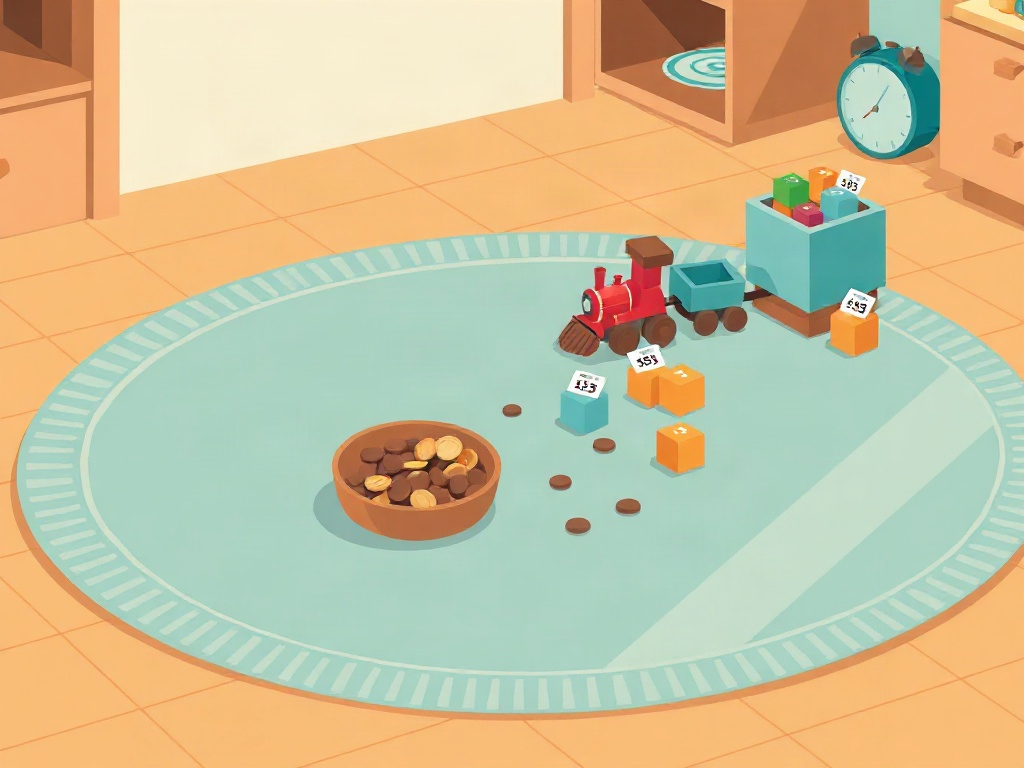
Put a bowl of about twenty buttons, bottle caps, or dried beans on the table — these are the "coins." Each child gets ten. Toys from the shared pile are laid out on the rug, and the children agree together, before play starts, on a price of one to three coins for each. Then it's simple: want the train set? Pay two coins to whoever's holding it right now, and it's yours for five minutes, until the timer rings. Small objects for coins, a kitchen timer or a phone, fifteen to twenty minutes total, for kids aged four to six — that's all you need. Count it a success if at least three swaps happen without an adult stepping in and without tears. If your child is six and already confident counting, make them the "cashier" — it'll keep them more engaged and channel their energy into the rules instead of into defending their toys.
This game works because it removes the scariest part: uncertainty. The child isn't giving up the toy "forever" — they're lending it for five minutes in exchange for something they're holding in their own hand. And they watch it come back. After three or four rounds of that, the tension visibly drops.
Game: Two Builders, One Box
Two Builders, One Box
Pour the blocks or magnetic tiles into one shared pile between the two children and set a task neither can finish alone: a tower taller than the seated child, a bridge a toy car can drive under, a fence around the chair. There's one rule, stated up front — it's not about who placed more pieces, it's about whether the structure stands. All you need is the building set, a blanket to mark off the "construction site," and ten to fifteen minutes; suited to ages four to six. It's worked if, at the end, the children look at the build together and someone says "we made this" instead of "this part's mine." If the structure collapses — even better: a toppled tower is a shared loss, and that brings kids together faster than any tower left standing.
The most common mistake: "He's your guest, let him have it"
That line sounds like teaching hospitality. In practice it does something else — it tells the child that their right to their own belongings depends on who just walked into the room. The result is predictable: next time, the child hides the toys before you've even suggested anything, and refuses to bring them out even when no one's asking for a thing.
The second most common mistake is the opposite extreme — the adult pulls the object out of the child's hands and passes it to the guest to "end the scene." The scene does end, in thirty seconds. But the child has just learned that whoever's bigger gets to take things, and that protesting is pointless — which is exactly what they'll turn around and do to their little brother.
"Not today. Come see the train set instead." — six words that save half an hour of meltdown, as long as they've been rehearsed before the guests arrive.
What to do once they've already started fighting
- Separate the object, not the children. The toy goes on the table for three minutes and nobody touches it. The argument fizzles out faster than if you'd sent the kids to different rooms.
- Ask what each one wants, not who did what. "You want to build with the tiles, and you want to sort them by colour. Can we do both?" Surprisingly often, you can.
- If the conflict is over something that was in the untouchable three, take the blame out loud yourself: "I forgot to put that away." Your child shouldn't pay for a prep step you skipped.
- After the guest leaves, spend five minutes putting everything back in its place — together. That ritual closes out the day and confirms the agreement was real.
How to make it a habit, not a one-off trick
If the cousin visits regularly — once a month, every other Sunday — sort the piles every single time, even when there's no new toy and tension is at zero. Three minutes before the doorbell. Precisely because it becomes boring and predictable, the child stops experiencing it as something being taken away and starts doing it on their own. A sign you've gotten there: one day you'll catch them putting two items away in the drawer without a word from you.
And the new toy? After a week or two it's no longer proof — it's just a toy. At that point the child usually pulls it out on their own and hands it to the cousin, no prompting needed. That's the whole point, and it takes nothing more than a little patience and an agreement made in good time.