
Fall Planting of Onions and Garlic: Row, Step, and Counting Games for Kids Ages 7-9
How to turn the last October weekend at your grandparents' garden into four games of measuring, counting, and pacing — without turning your child into unpaid labor.
The ground is cold, but not frozen yet. Grandma sorts the onion sets into two bowls — the smaller ones set apart — and hands the child a garden trowel. Four minutes later the child is crouched off to the side, poking a stick around for worms. Sound familiar? The problem isn't lack of interest. The problem is that the child has been given a task with no beginning and no end: "help out." Nobody works well with a task like that, let alone a nine-year-old.
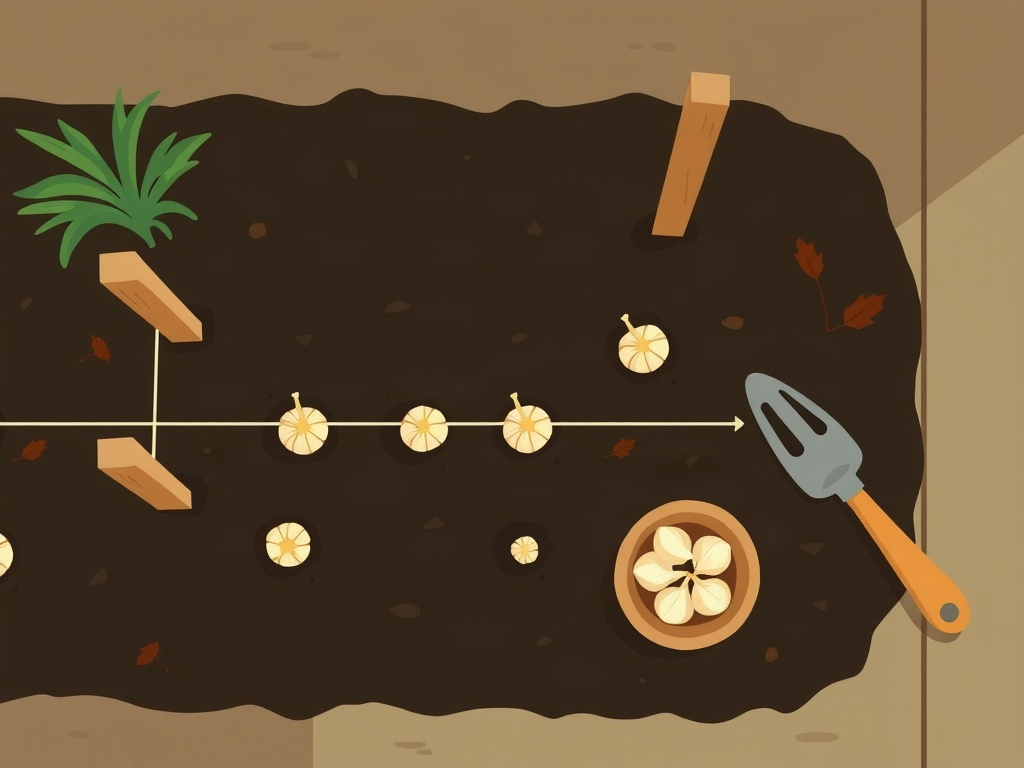
Planting onions and garlic in late October is basically the perfect math game disguised as real work. There are rows — so there are straight lines. There's spacing between cloves — so there's measuring. There's counting, and counting that will actually get checked on the spot tomorrow. And best of all: the result won't show until April, which is just long enough a wait to stick in memory.
Why "help Grandma" doesn't work, but "this row is yours" does
When a child is helping, they're an assistant. An assistant waits for instructions, does things half-heartedly, and gets bored, because there's no way to fail and no way to succeed either. When a child is in charge of their own row, everything flips. They have a boundary (this row, from the nettles to the fence post), a unit of measure (one step between onions), a count (how many cloves go in), and a check (spring will show whose row is straighter).
The difference is purely in the words, but it changes the whole afternoon. Instead of "careful, not that deep," you say: "it's your row, you decide how deep your finger goes." The child starts talking out loud — and that's the moment we're after: "Wait, I counted seventeen, but there are three left in the bowl."
First: measure with the body, not a tape measure
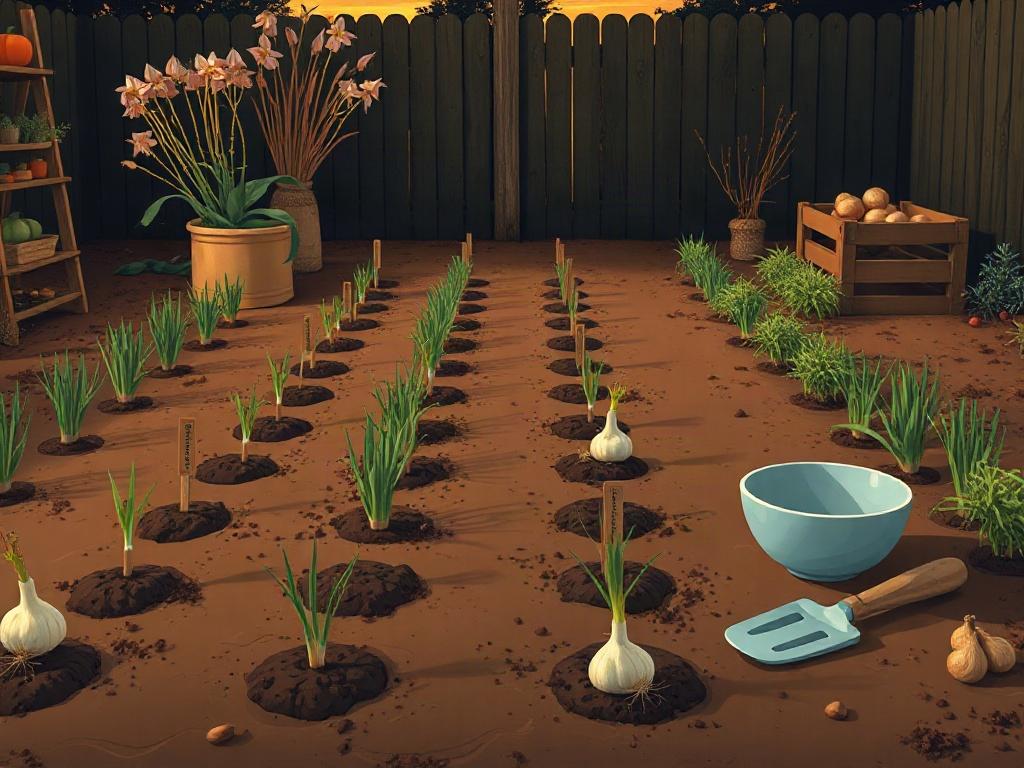
In the garden, a tape measure is slow and beside the point. For kids aged 7-9, it's far more useful to discover that their own body is a unit of measure. An open palm is about 15 centimetres — exactly the spacing between two garlic cloves. One shoe placed heel-to-toe in front of the other gives the spacing between rows. One rule worth setting from the start: whoever measures, counts. Don't split the two jobs between two kids, because then nobody owns the mistake.
- Garlic goes in pointed-end up — that's the one rule that really must be followed, and the child can check every single clove themselves.
- Depth: push your index finger into the soil up to the second knuckle — that's deep enough.
- Between two cloves: one of the child's open palms.
- Between two rows: two child-sized steps, heel to toes.
- After covering — a gentle pat with the palm, not stomping with a foot.
The "Is the Row Straight?" Game
Tie a string between two sticks at each end of the bed — that's the line the row follows. The child gets a small bowl of onion sets and the job of planting them all at equal one-palm-width intervals, with no onion allowed to sit more than one finger-width off the string. A younger sibling can hold the bowl and hand over one onion at a time. You'll need: string, two sticks, a bowl with 20-25 onion sets, a trowel. It takes about 20 minutes for a 3-metre row, and it's best for ages 7-9, since younger kids can't yet hold a straight line without support. Success is judged at the end, not during the work: the child walks the row, counts the planted onions out loud, and if the count matches what was in the bowl, and none sits more than a finger-width from the string, the row is done and gets a marker.
Second: turn counting into a bet
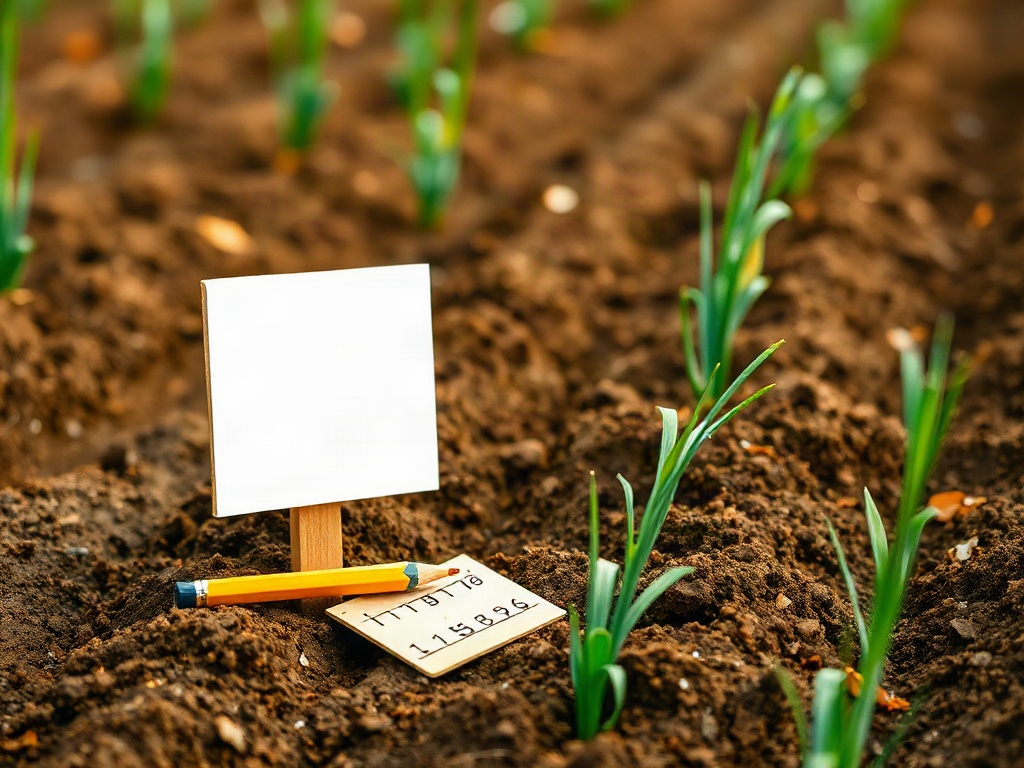
Plain counting out loud gets dull by the thirtieth onion. So flip the order: guess first, check after. Ask the child how many onions they think will fit in the row — they name a number, you write it down in pencil on a little board, and only then do you start planting. The gap between the guess and the real count is the one thing the child will remember from that day, especially if they were off by twenty.
The Bet: "How Many Will Fit?"
Before planting, everyone taking part — the child, you, the neighbour's kid if they're around — writes down a guess for how many garlic cloves will fit in the row. Then you plant and count out loud in groups of ten. You'll need: a pencil and a scrap of cardboard or a small board, a bowl of garlic, a prepared row. Takes 15 minutes; suits ages 7-9 — with seven-year-olds, count together in tens, with nine-year-olds let them count solo and then ask how far off they were. Success isn't the most accurate guess — it's the child being able to state the difference: "I said 40, 34 went in, I was off by six." If the child works out the difference on their own, the game has done its job.
"Mum, if 34 fit in one row, how many is that in four rows?" — that's the question we came to the garden for.
Games for the gap between two rows, while you wait
A child won't dig for an hour and a half straight. So slot in short movement breaks between rows that stay on the same theme — steps and counting.
- Steps from point to point: how many child-steps is it from the well to the bed? How many of yours? Why are the numbers different when the distance is the same?
- Bring exactly six: send the child for six onion sets — not five, not seven — and don't give them a bowl, they have to carry them in a cupped hand.
- The row in reverse: count the planted onions backwards, from the end to the start. Surprisingly tricky, and kids love it.
- The markers: the child writes "garlic" and "onion" plus the date on wooden plant labels. Come April, you'll be glad you did.
The most common mistake: turning the garden into an exam
The temptation is huge. The child is counting, you spot an opening, and you jump in: "So what's 34 plus 34? Come on, you know this. What about times four?" Three questions like that in a row, and the child realises you're not planting together anymore — they're being tested outdoors. From that point on they'll count silently in their head, just to avoid giving you an opening for the next question.
The opposite works better: you count out loud and get it wrong on purpose. "Twenty-eight, twenty-nine, thirty, and... eleven." The child will correct you instantly, and love every second of it. The second common mistake is pushing on with planting until the supply runs out. Don't feel you must finish the whole bed no matter what — leave ten onions for the next day. The child should leave the garden feeling there's unfinished business, not that they've been let off the hook.
And third: don't fix a crooked row in front of the child. If you gave them a row, it's theirs, even if it wanders. Come spring, the bed itself will show the difference, and that will teach a far stronger lesson than your hand quietly shifting three onions while they're looking away.
What's left after the afternoon
A row with a name. A marker with a date. A number written on a little board that won't be checked until April. And a child who now knows their own palm is about 15 centimetres wide — knowledge they'll pull out next time they need to eyeball something without hunting for a ruler.