
February School Drawings: How to Choose What Stays Without Tears
At the end of the term, the backpack comes home stuffed with sheets of paper, notebooks and craft projects. Here's how to sort through it all together with a 7-10 year old so the choices are theirs — and you don't end up with three boxes cluttering the house.
The backpack opens and forty sheets of paper spill out: two identical snowmen, a notebook with three pages filled in, a cotton-wool craft project that's already falling apart, and a drawing of a house that the child says "is for grandma." You glance at the cupboard, where the same pile has been sitting since September. So you decide to deal with it while the child is out at the playground — quicker that way, and no tears. Until a week later comes the question: "Mum, where's the dragon with three wings?"
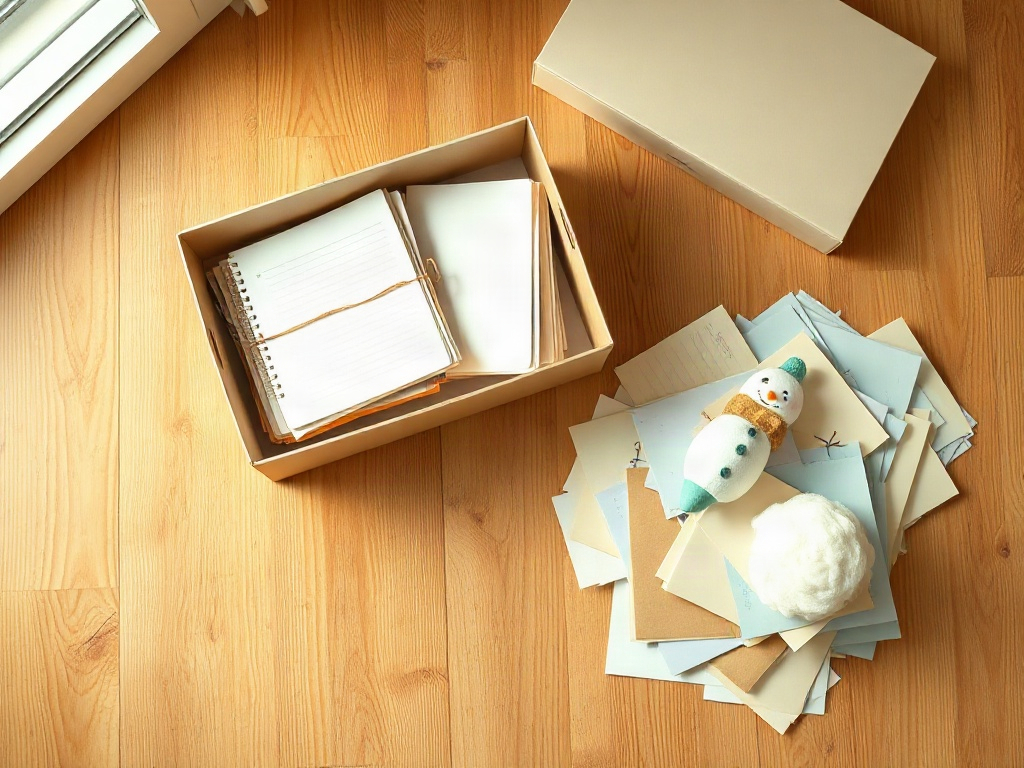
That's exactly where it goes wrong. Not in the throwing away, but in the secret throwing away. A seven- or eight-year-old already remembers what they drew and when; by nine or ten they can tell "I dashed this off" apart from "I spent three hours on this." That distinction is your tool. Use it, and the child will shrink the pile themselves — more than you'd ever dare to.
Why "we'll keep everything" is a bad idea at exactly this age
A box where everything matters equally is a box where nothing matters. The child never opens it — because digging through a hundred sheets isn't fun, it's work. The opposite doesn't work either: when a parent decides alone and quietly, the child learns that their things are rubbish to grown-ups. Between these two extremes there's a third option: a box with a ceiling. A fixed size that never grows. Something new comes in — something old goes out. And the child does the choosing.
A plain shoebox does the job. If you want something sturdier, a clip folder or an A3 plastic box costs around £3-6 at a stationery shop. More important than the box itself is the rule: it never gets swapped for a bigger one.
First sort: the "Museum, Post Office, Bin" game
Museum, Post Office, Bin
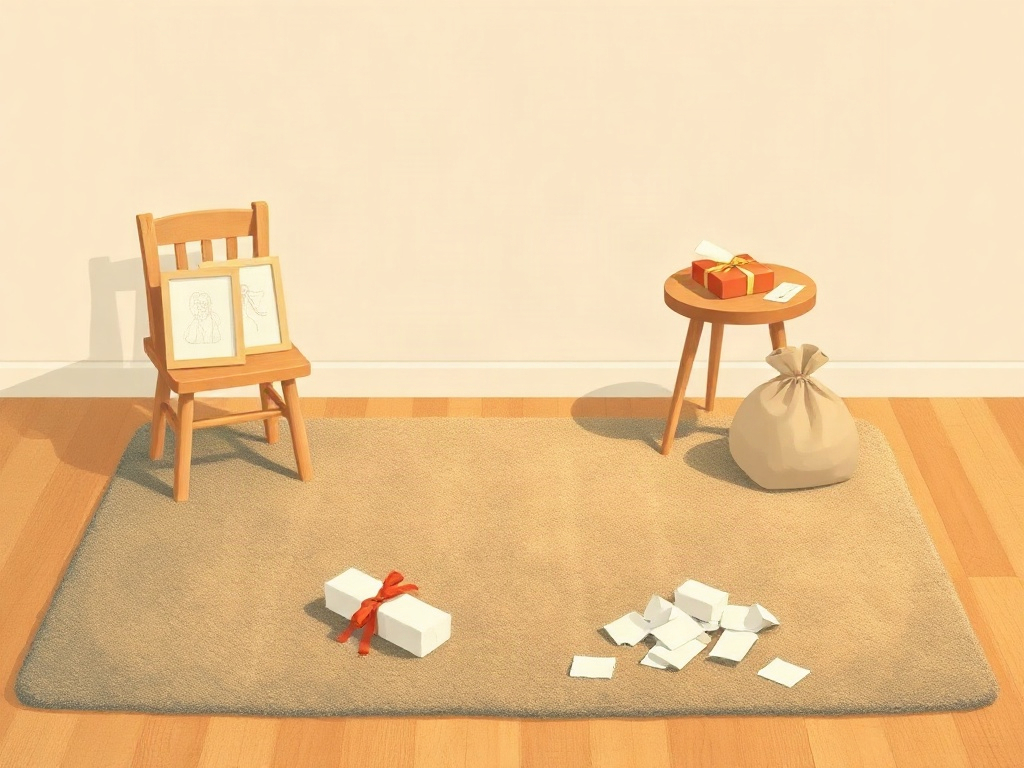
All you need is three spots on the floor — a chair, a table, and an empty bag — plus the whole pile of sheets from the backpack. The game takes about 25 minutes and suits children aged 7 to 10. Explain the three spots like this: the chair is the "museum" — this holds the things the child would show off to a visitor; the table is the "post office" — work that will be gifted to grandma, an aunt, a neighbour, so it leaves the house but doesn't go in the bin; the bag takes everything else. You simply hand over the sheets one by one and stay quiet. If the child hesitates for more than five seconds, the sheet goes into a separate "later" pile. At the end, count them up: how many in the museum, how many at the post office, how many in the bag. The goal is for the museum to be the smallest pile. If it isn't, run a second round on the museum pile alone. It counts as a win when the child puts at least five sheets in the bag themselves and can explain why for at least one of them: "that one's a rough draft, I did it in two minutes."
This game works because it doesn't ask "can we throw this away." It asks something else entirely — "who is this for." For a child, gifting something isn't a loss. Great-grandma, who gets a drawing in the post or in person, is a much better home for it than the cupboard.
Second step: photograph it to let it go
Term photo album
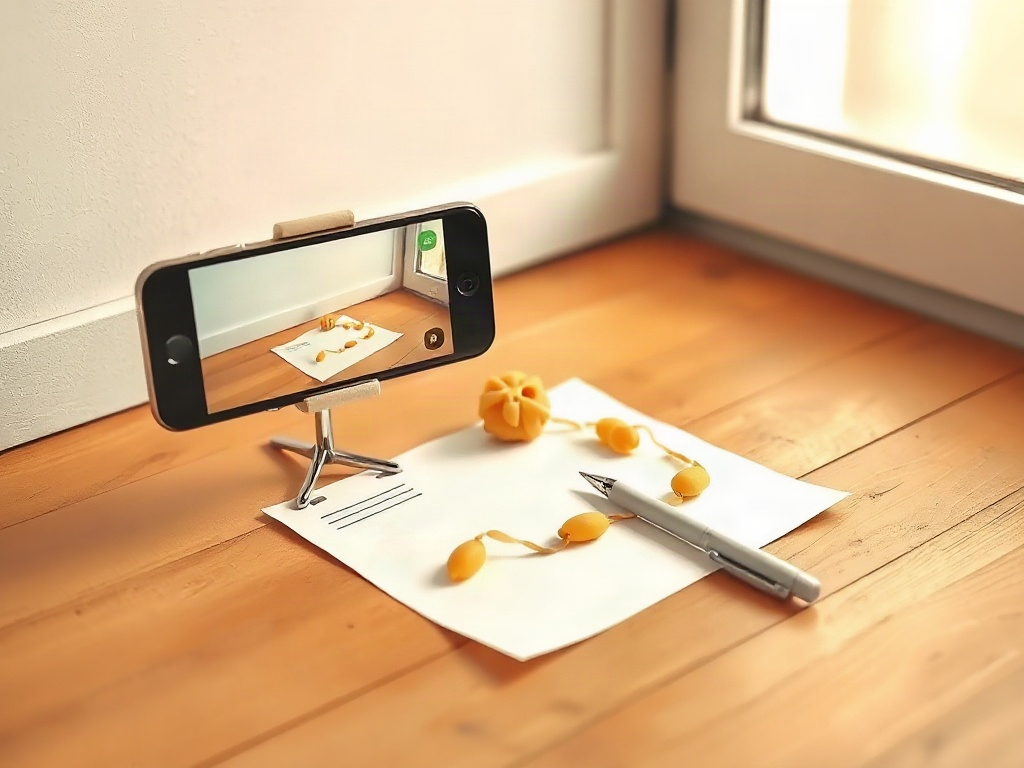
You'll need a phone with a camera, a clear patch of floor by a window, and a sheet of paper for labels. Set aside 20 minutes, ideally on a Saturday morning. Ages 8-10 — at this age the child can take the photos themselves. Here's how it works: spread out the bulky, crumbling items on the floor — the pasta-shell crafts, the paper garlands, the box made from recycled materials. The child sits down, holds the object, and you photograph it together with them. Then they dictate a sentence while you write it on the label: "February, made the basket with Daria from my class." Photograph the label too. Finally, look through all the photos in order on the screen — that's the term's album. It's a success when, after looking through them, the child says on their own that at least two objects can go now, because "they're staying in the photo."
One warning: the photo only works if you actually look at it afterwards. A folder on the phone that nobody ever opens is the same box, just invisible. So looking through it together is part of the game, not an afterthought.
What goes in the box and what doesn't
- Goes in: the first page from the handwriting notebook at the start of term, and the last one — so you can see how the handwriting has changed.
- Goes in: one drawing per month, chosen by the child, not by you.
- Goes in: anything with a date or a classmate's name on it — years from now, that's a memory of the class, not of the drawing.
- Doesn't go in: a colouring-book template the child has simply coloured inside the lines.
- Doesn't go in: a duplicate. If there are three near-identical fish, keep one.
- Doesn't go in: anything torn, damp, or stuck to another sheet.
The common mistake: sorting on Sunday evening
Parents tackle the pile exactly when they finally have a free moment — Sunday evening after dinner, before Monday. But by then the child is tired, and a tired eight-year-old says "I want to keep it" about absolutely every sheet, even the blank one. Not because they love it, but because they've got no energy left to choose. Choosing is work for the brain, and the brain clocks off before the day does.
The other version of the same mistake is sorting in front of guests, or in front of a sibling. The moment there's an audience, the child starts performing — either acting grown-up and throwing away too much to earn praise, or clinging to every sheet so a younger sibling can't claim them. Do the sorting in the morning, just the two of you, with a clear finishing line: "until the pile's done," not "until we've sorted it out."
Don't ask "can we throw this away" — ask "which of these two would you frame." That question, a child knows how to answer.
If they get upset anyway
It happens — usually over one particular sheet that, on the surface, looks like a scribble. Don't explain why it isn't important. Ask what was going on while they were drawing it. Usually the answer is something like "we made this when Martin broke his arm," and then it's clear the sheet isn't holding onto a drawing, but a day. That sheet stays. The box has room for about ten like it.
And one more thing that saves half the tears: don't empty the bag in front of the child. Leave it by the door until the next day. If they pull two sheets back out of it in the morning — fine, they keep them. More often than not, they forget the bag exists at all.
What's left in the end
After the two games, the box will hold between ten and twenty sheets for the term, the phone will have an album of about fifteen photos, and grandma's fridge will have three new drawings on it. The pile on the cupboard disappears. And come June, when the backpack comes home stuffed once more, the child will already know how this works — and you won't be sorting it alone.