
Games Under the Walnut Tree: How to Turn Saturday-Afternoon Walnut Gathering into a Counting Lesson
Practical games for kids ages 5-7 while the family gathers walnuts at the country house in late September — with sacks, handfuls, cracking, and real counting.
Wet grass, a sack that keeps sliding sideways, and a kid who, after seven walnuts, says: "Can I go play now?" Anyone with a walnut tree in the yard at the country house knows this scene. From there things usually go one of two ways — either the kid wanders off to kick a ball while the grown-ups gather, or stays and grumbles. There's a third way.
The third way is to stop treating gathering as a chore to get through despite the child. A five-to-seven-year-old can't handle forty minutes of monotonous bending over, that's true. But they can handle six five-minute rounds, if each round has a start, a rule, and a number at the end. The only difference is in the structure.
Who this is for, and what's left at the end
I'm writing for children between 5 and 7 — kids who already count to twenty but still trip up somewhere around thirty-one. Older kids will want something else: speed, records, hammering with a real hammer. Here we're talking about handfuls, sacks, and little piles.
By the end of this afternoon your child will know how many walnuts fit in one handful (usually 3 to 5, if the hand is small), will have counted aloud to at least a hundred in groups of ten, and will have finished something that genuinely needed finishing. That last part matters more than the first two.
The most common mistake: giving the child "their own" little sack
It sounds logical — the child gets a small bag, you fill the big sack, everyone minds their own business. In practice the opposite happens. The child collects a dozen walnuts, their little bag stays nearly empty, they watch your sack grow, and they understand one thing: their work doesn't count for anything. Then they lose interest — not out of laziness, but because they've understood the situation correctly.
Flip it around. One sack, a shared one, and the child is the only one allowed to pour into it. You gather into little piles on the ground, they go around with a small bucket and collect them. Suddenly the whole sack passes through their hands. A sack that started as just a sentence — "We need to fill this sack today" — becomes theirs.
The handful and the little pile
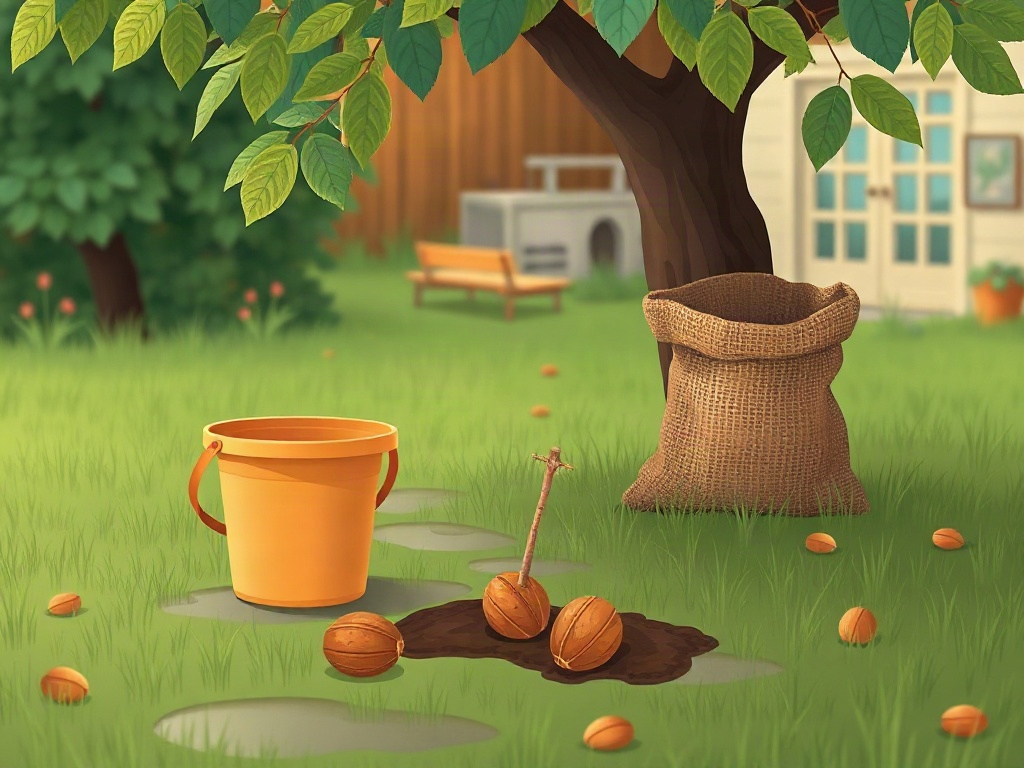
You'll need a plastic bucket or small basket, the sack, and three or four cleared spots on the ground for piles. The game runs twenty minutes, with a break in the middle, and suits kids aged 5-6 perfectly. The rule: the child doesn't carry one walnut at a time, but one full handful. When they reach the bucket, they say out loud how many walnuts are in the handful — "four," "three," "five again." Every ten handfuls, set a twig aside so you can see how far along you are. At the end, count the twigs together. Real counting-as-math kicks in the moment you ask: "Ten twigs, ten handfuls each — how many handfuls was that?" Whether they get it or not, the child starts counting by tens on their own. Count it a success if they said the handful's number out loud at least ten times without being prompted, and if you reached five twigs.
What about cracking — when and how
By late September the green husk is already splitting, and some walnuts drop bare on their own. The rest need peeling, and a few need cracking on the spot to check whether the kernel is good. Here parents usually do one of two things: either they don't let the child near a hammer at all, or they hand over the real hammer and hover over them, nerves on edge.
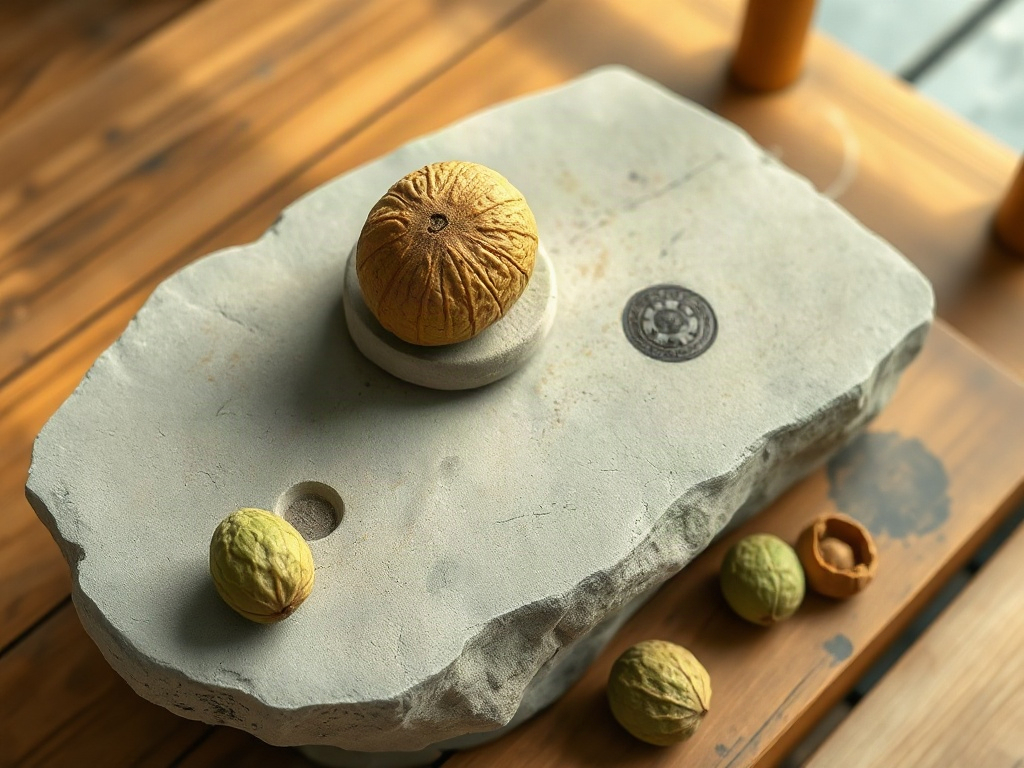
The middle ground is simple. A flat stone as an anvil, another rounded stone as a hammer, walnut on top. The child doesn't strike — they press and tap. If the walnut doesn't crack, it just isn't ripe enough yet for cracking — that's information, not failure. Hands turn black from the green husk and it won't wash off for three days, so either bring gloves or make peace with it beforehand and don't complain afterward.
Three piles: good, black, and squirrel food
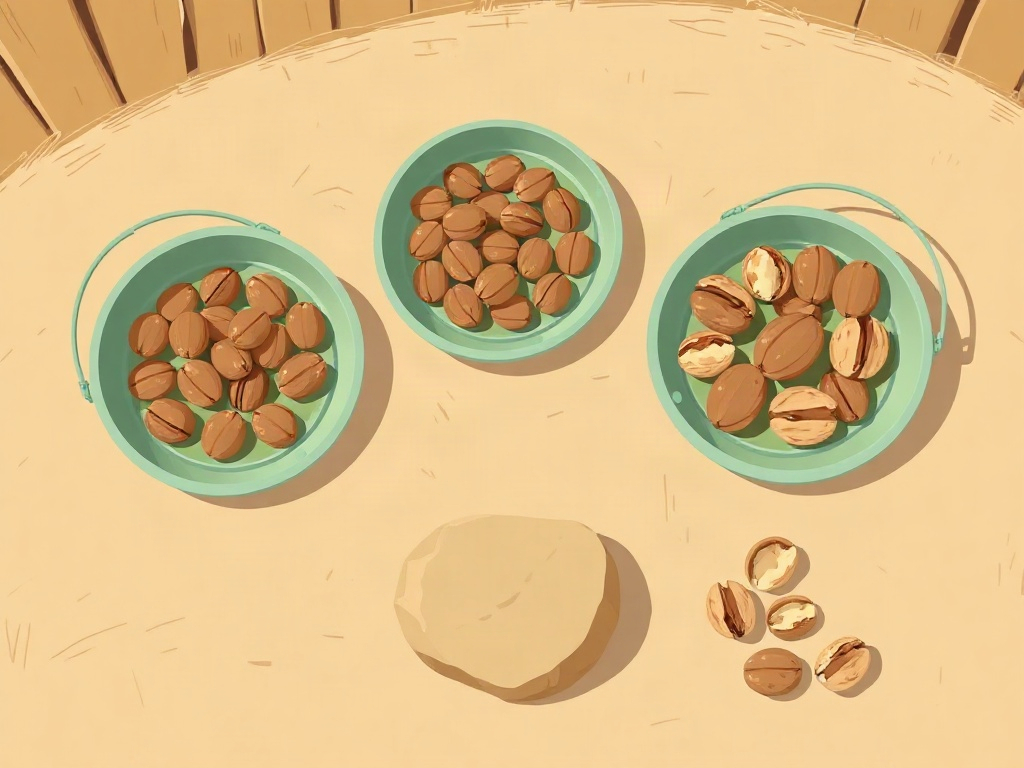
You'll need three old bucket lids, or three circles drawn in the dirt with a stick, plus a stone for cracking. Fifteen minutes is enough, and sorting suits 6-7-year-olds best because it calls for a decision, not just carrying. The child picks up a walnut, examines it, and places it in one of three circles: whole and clean — first circle; with a black spot or soft to the touch — second circle; completely broken or empty — third circle, "squirrel food." Every ten walnuts, they say out loud how they've split them up: "seven good, two black, one for the squirrels." This is where the least obvious lesson sneaks in — that groups add up. Success looks like sorting a hundred walnuts, and saying "I'm not sure about this one" and asking instead of guessing, at least once.
Phrases that actually work
- "This sack is yours to fill — I'm only making the little piles for you."
- "How many were in that handful? Say it before you drop them in."
- "We got to thirty. Let's carry on from there, not from the start."
- "We're stopping now — not because you're tired, but because that's one round done."
- "Don't count the one under the beam — that fell last week already."
And one thing not to say: "Come on, just a bit more." The child has already learned that "a bit more" never ends, and that's exactly why they sit down on the ground.
How to wrap it up so it actually means something
The ending matters as much as the game itself. Weigh the sack on the kitchen scale in front of the child and write the kilos on a sheet taped to the kitchen wall. Next Saturday, a new number goes underneath. Three weeks running — three numbers the child can compare on their own, no explanation needed for what "more" means.
If you sell part of the walnuts at the market, let the child set aside their own share in a separate bag and see what it comes to — 2 or 3 euros is completely real and far easier to grasp than the abstract "we made some money." If you don't sell any, that works too: a handful goes into Sunday's walnut cake, and that's visible enough.
A child doesn't get tired of the work. They get tired of work with no number at the end.
What to do if it's raining or the ground is wet
Late September in the countryside is rarely dry. Wet walnuts stick to leaves, and mud gets under the fingernails. Move the sorting under the porch roof or onto the terrace table — the gathering outside only takes ten minutes, and the sorting works perfectly well indoors, dry. Spread out a newspaper, tip in half a bucket, and let the child work sitting down. It works just as well and has one advantage: you can actually hear the numbers, since no one's shouting from across the yard.