
Home Safety: A Quiz for Parents of Kids Aged 5-10 (Parents' Section)
A short home safety quiz for the grown-ups' part of the site: eight everyday situations — medicines, the hob, windows, hot tap water, cleaning products, time home alone, smoke alarms and the front door — each with an explanation of why the answer is right and why the other options come second.
PARENTS' SECTION — FOR ADULTS. For parents and carers: this is adult-section content, not a page for children to read or work through alone. Please read this first. Everything below is general background information for parents. It is not medical, legal or emergency advice. For anything concerning your own child, or for any suspected poisoning, burn or injury, contact your doctor or your national emergency or poisons line straight away, and check the rules that apply where you live. Home seems like the safest place, but it's exactly where most minor accidents happen to children. This home safety quiz is written for parents and carers to work through on their own. It doesn't check whether you remember the rules by heart. It checks whether you understand why one choice works better than another. A child this age can now climb, unscrew, copy and reason, and most household rules were written for a younger, smaller child. Answer calmly and read the explanations at the end of each question — a home safety quiz is most useful when you think through the reasoning, not just the right option.
Home Safety Quiz for Parents: Kitchen, Bathroom, Furniture, Fire and Doors
The eight questions below follow the route a child actually takes through the house on an ordinary day — the kitchen while dinner is cooking, the bathroom they now use alone, the sofa under the bedroom window, the hallway door when the bell rings. Each one describes a situation rather than a rule, and the explanation underneath sets out what changes once a child is old enough to climb, open and argue back.
How to Read the Answers
Each question has three options, and in most of them more than one is genuinely true. The wrong options describe real concerns that simply aren't the main risk in that situation. So the task isn't to spot the sensible-sounding answer. It's to decide which risk comes first when a child this age is in the room. Every explanation therefore does two jobs: it says why the chosen option comes first, and what keeps the other two in second place. Tap "Answer" only after you've committed to a choice. Read the explanation even when you were right — the useful part is usually the second half, where it says what to change at home rather than what the correct option was. If you and your partner disagree on a question, that disagreement is worth more than the score. It's normally a sign that the rule in your house has never actually been agreed out loud.
Quiz for Parents (Adults' Section): How Safe Is Your Home? Room-by-Room Questions for Ages 5-10
1. A grandparent stays for the weekend and leaves a weekly pill organiser on the bedside table. Why does that organiser deserve more attention than your locked bathroom cabinet?
- Because an organiser has no child-resistant cap and sits at reach height, and loose tablets look like sweets
- Because an adult's prescription is dosed for adult body weight, so it does more harm per tablet than your own medicines
- Because an organiser holds a whole week of doses, so more tablets sit in one place than in a single blister pack
Answer
Because an organiser has no child-resistant cap and sits at reach height, and loose tablets look like sweets
Colourful tablets and syrups look like treats, so access — not tidiness — is the main risk, and the medicines that actually get reached are usually the ones outside the cabinet: a handbag by the door, a bedside table, a visitor's pill organiser, which has no safety cap at all. The other two options are true, but they only matter after the child has the tablets in their hand: adult dosing and a week's worth of doses in one tray both describe how bad a swallowed dose could be, while the open, unlatched, reachable container is what decides whether it gets swallowed at all — and that is the part you can change this weekend. At this age "high up" alone stops working too: a 7-year-old climbs onto the closed toilet lid or a chair, and a child-resistant cap is only child-resistant, not childproof. When someone comes to stay, agree where their medicines will live for the weekend before the bags are unpacked.
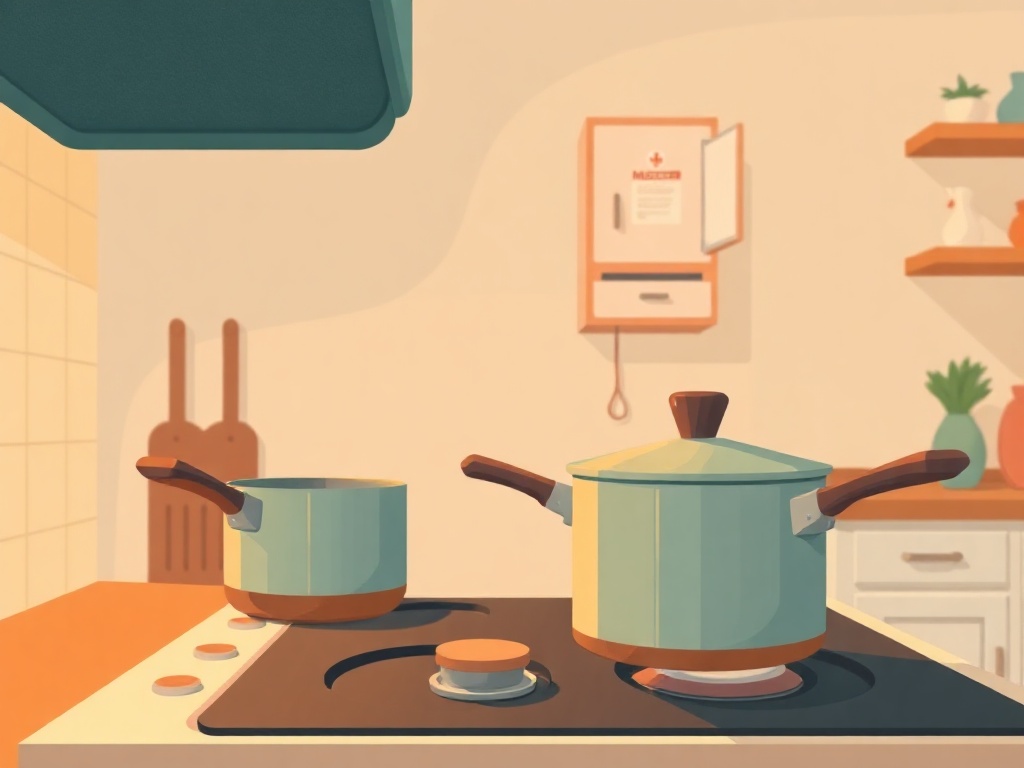
2. A 6-year-old is playing in the kitchen while you cook. Which arrangement reduces the risk most?
- Pot handles are turned inward, toward the wall
- Handles stick outward so you can lift a boiling pan off the heat without reaching across it
- Pots sit on the front burners so you can see what's happening without turning your back on the child
Answer
Pot handles are turned inward, toward the wall
A handle sticking out is exactly at a child's hand height, and one tug can spill the hot contents. The other two options optimise for the adult: an outward handle is genuinely easier and safer for you to lift, and a front burner really is easier to watch — but both put the hot pan on the side of the hob a child can reach, and the child's reach is the risk that arrives without warning. Cooking on the back burners with handles turned in does the same job more reliably than remembering to turn handles every time. Worth knowing: most scalds at this age don't come from the hob at all, but from a mug of tea, a kettle flex hanging over the counter edge, or a bowl carried out of the microwave — hot drinks and freshly boiled water are hot enough to scald a child's thinner skin very quickly, which is why they are worth keeping well back from the counter edge.
3. Your 7-year-old likes kneeling on the sofa that stands under a bedroom window. Where's the problem in that arrangement?
- Because the insect screen and the low sill won't hold a child's weight, and the furniture turns the window into a climbing frame
- Because a child kneeling on the back of a sofa can tip the whole thing forward on top of themselves
- Because things get dropped out of an open window onto whoever is passing below
Answer
Because the insect screen and the low sill won't hold a child's weight, and the furniture turns the window into a climbing frame
A screen is built to keep insects out, not a child in — it pops out of the frame under a few kilos of leaning. The other two options are real, but they are smaller versions of the same set-up: a tipping sofa and a dropped toy are recoverable, while a fall through the window is the one outcome you cannot undo, so it decides where the furniture goes. At this age the old tipping-furniture question quietly turns into a window question, because the child now supplies the climbing and the furniture only has to supply the platform. Move beds, sofas, toy boxes and low bookcases a good arm's length away from windows, fit restrictors that limit the opening to roughly 10 cm, and open the top sash rather than the bottom one. The same logic still applies to a bookcase or dresser your child climbs: anchor it to the wall, because open drawers push the centre of gravity outside the base and the whole thing comes forward. While you're in the room, tie any blind cords up out of reach.
4. Your child now baths alone and works the taps themselves. Why check the hot water setting now?
- Because hot tap water can scald a child's skin far faster than an adult expects, and no adult hand is testing it any more
- Because the stored water has to stay hot enough to keep Legionella bacteria from growing in the cylinder
- Because the hot tap heats the metal spout itself, and that is what a child sitting in the bath leans against
Answer
Because hot tap water can scald a child's skin far faster than an adult expects, and no adult hand is testing it any more
Independence in the bathroom removes the adult who used to check the temperature with an elbow, and the hotter the water, the less time there is to react. The second option is a genuine reason not to simply turn the cylinder down — but it is an argument about how to solve the problem, not a reason to leave the tap as it is; the third is real but limited to a small area of contact the child pulls away from. Setting the hot water thermostat, or fitting a thermostatic mixing valve so the bath tap delivers a comfortable bathing temperature rather than full cylinder heat, keeps the water usable and takes away the fast-scald range — a mixing valve is also the answer to the storage question, because it lets the cylinder stay hot while the tap stays safe; ask a qualified installer what settings apply to your system, and have any change to a boiler, cylinder or valve done by them. Teach the order too — cold in first, cold off last. Two more things change at this age: worn red and blue markings stop being reliable, so let your child learn the taps by feel, and a door that locks from the inside should be one you can release from outside with a coin or a screwdriver kept nearby. And while your child baths alone, water in the tub is still worth respecting: keep the bathroom door unlocked, drain the bath as soon as it's finished, and don't leave a younger sibling in the water even for a moment.
5. You've poured a limescale remover into a spare spray bottle and left it on the kitchen worktop. Why should it go back into its own bottle behind a latch under the sink?
- Because the original label carries the dosage and first-aid details emergency services need, and the worktop is within reach
- Because a trigger spray turns an acidic cleaner into a mist that reaches the eyes and airways of whoever is standing nearby
- Because a spare bottle isn't made to hold a descaler and can weaken or leak at the seams
Answer
Because the original label carries the dosage and first-aid details emergency services need, and the worktop is within reach
A decanted bottle loses the dosage and first-aid information printed on the label, and a verbal ban doesn't survive a curious moment — the original container also tells emergency services exactly what was swallowed. The mist and the leaking seams are both real, but they stay second because they change how much harm a contact does, while the missing label and the open worktop change both the chance of contact and your ability to respond afterwards — and the missing label is the only one of the three that still hurts you an hour later, in the car, when someone asks what was in the bottle. Two items under that sink deserve separate attention: laundry and dishwasher capsules, whose soft, sweet-looking film bursts under a squeeze or a bite, and any two products that must never meet — bleach plus a limescale or ammonia cleaner releases a gas that harms whoever is standing in the room, child or adult. Photograph the label of anything swallowed instead of bringing the bottle later, and call your national poisons line or emergency number straight away rather than waiting to see what happens.
6. Your 10-year-old stays home alone for 30 minutes. What's most important to have prepared beforehand?
- A clear rule about who to contact and how — rehearsed together with the child
- A list of the emergency numbers and your address written out and stuck on the fridge
- A check-in call agreed for the halfway point so you hear that everything is fine
Answer
A clear rule about who to contact and how — rehearsed together with the child
All three are worth doing, and the fridge list and the check-in call are the two things most families already have. They come second for the same reason: both depend on a calm child. A written list has to be found, read and understood by a 10-year-old who is frightened, possibly in a different room from the fridge, possibly in the dark — and under stress a child doesn't read lists, they repeat what they've already said out loud. A check-in call is fixed to your clock, not to the event: it tells you everything was fine at minute fifteen and does nothing at minute two or minute twenty-eight, and it gives the child no script for the moment in between. A rehearsed rule is the only one of the three that is already inside the child when the doorbell goes. Keep the list on the fridge and make the call if it reassures you — but rehearse the specific moments first: what they say on the phone (their name, the street and house number, what has happened), which one named neighbour they knock for if the flat has to be left, that the door stays shut for a delivery or a meter reader even when the person says you sent them, that a smell of gas or a smoke alarm means going outside first and calling from there, and that the hob, oven and bath stay off while you're out. Younger children in this age range shouldn't be left alone at all, and local laws and guidance on the minimum age for staying home alone differ from place to place, so check the rules where you live; the rule is rehearsed long before it's needed.
7. The smoke alarm sounds in the middle of the night. What do children this age most often actually do?
- Many sleep straight through it, so an adult has to reach them
- They wake immediately and follow the escape route you taught them
- They wake up and call out until someone answers
Answer
Many sleep straight through it, so an adult has to reach them
This is the one question where the other two options aren't just secondary but are the assumptions most escape plans are quietly built on — which is why it is worth getting right. A standard alarm is loud enough to wake an adult but often not enough to bring a deeply sleeping child up out of the night's first hours, and children who do wake frequently head for a hiding place or for you rather than for the door. So option two — waking immediately and walking the route — describes the best case and not the one to plan for, and option three assumes both that the child wakes and that calling out is fast enough, when the plan has to work if neither happens. Plan instead on an adult reaching each child. That changes what the equipment has to do: alarms on the ceiling, where hot rising smoke reaches first, one in the hallway and ideally one inside each bedroom so it's heard through a closed door; bedroom doors shut at night, which buys minutes; and an escape route walked twice a year, including who fetches whom, a meeting point outside, and a warning that firefighters in breathing gear look and sound frightening but are the people to go to. Follow your local fire service's current guidance on where alarms are required, how they should be fitted and how to plan an escape with children.
8. You've taught your child not to open the door to strangers. Where does this rule usually fail in practice?
- Because risky situations often involve people the child already knows, and the rule doesn't cover that
- Because a rule that is never rehearsed at the actual door is hard to apply when the bell is ringing
- Because children can't judge from the doorway whether an adult in a uniform or a work jacket is genuine
Answer
Because risky situations often involve people the child already knows, and the rule doesn't cover that
Sorting the world into strangers and known people leaves the most common situations on the safe side of the line. The other two options are true and both worth fixing — but they describe a rule that is right and hard to apply, while this one describes a rule that is applied perfectly and still lets the wrong person in: a child who follows "no strangers" exactly will open the door to an uncle, a neighbour or a parent's friend without hesitating. Rehearsal and uniforms are second because rehearsing a rule with a gap in it just makes the gap automatic. Replace it with a permission rule the child can actually apply: nobody comes in, nothing is collected and nowhere is visited unless you have said yes to that person this time — including relatives, neighbours and a parent's friend. Then rehearse that at the door, which also settles the uniform problem, because the answer no longer depends on judging the visitor. Give it a shape your child can use under pressure: a short list of two or three named adults who are allowed to pick them up, a family code word for any change of plan, permission to say "I have to ask first" and close the door, and an explicit promise that they will never be in trouble for checking with you, even at 10 at night.
What to Change at Home This Week
The point of the quiz is to walk through the reasoning and then adjust one or two things at home this week. Concretely: press the test button on every smoke alarm tonight and note the date, anchor the one bookcase or dresser your child actually climbs, move the handbag with the painkillers off the hall shelf, and get the laundry capsules behind a latch. Then settle the three things that depend on where you live rather than on general advice: the emergency number your child should say out loud — look up the one that applies where you live and have them practise saying it — your national poisons information line saved in both parents' phones, and the age at which your country's rules or guidance allow a child to be left at home alone. A note on the figures above: the ages, temperatures and patterns described here are general orientation for parents, not figures taken from any one authority, and the specific numbers that matter in your home — safe hot water settings for your system, where alarms must be fitted, the minimum age for staying home alone — are set locally and change over time. Check them against the current guidance of your own national health service, fire service and child-safety or consumer bodies, and ask a qualified installer about anything involving a boiler, cylinder or mixing valve.
Note for readers: this page is kept separate from the children's pages in the site navigation. Please see the note at the top for the scope of the advice given here.