
Half an Hour of Shade-Grown Coffee: Games for Three Cousins of Different Ages in the Backyard
How to invent a game where a 5-year-old, an 8-year-old, and an 11-year-old play together without an adult having to referee arguments. Two ready-made games with rules that balance the age gap on their own.
It's August, three in the afternoon, and the yard smells of sun-warmed stone and scorched grass. You've just poured your coffee and sat down under the tree when the 5-year-old shows up: "She said I'm slow and I don't count." A minute later the 11-year-old arrives too: "It doesn't work with her, she doesn't get the rules." And your coffee goes cold.
The usual advice is to simplify the game for the youngest one's sake. Try it once and see what happens: the oldest gets bored within four minutes and starts clowning around, the little one senses the game has been "rigged" for her and feels even more offended. Simplifying doesn't level things out — it just makes the game boring for two out of three kids. What actually works is different: the same game, but three different jobs within it. Then no one compares who's faster, because they're not doing the same thing.
Why it's easier to pull off in a backyard
A backyard has natural boundaries and natural "stations" — the outdoor tap, the woodpile, the tree, the gate, the old table. These are ready-made landmarks you don't have to invent. In a flat you'd have to explain where "base" is; out here you just say "the tap" and everyone knows. The second advantage is noise: in the yard, kids can shout, and shouting burns off a lot of the tension that would otherwise turn into an argument.
Before you sit down, spend exactly three minutes handing out the roles. Those three minutes are the price of your thirty.
How to give three different roles within one game
- The oldest (10-11) gets a role that requires judgment: they're the referee, the mapmaker, the timekeeper. Not "the better player," but the one with authority — that's enough to keep them from getting bored.
- The middle one (7-9) gets a role that requires action and speed: they run, hide, search, count. This age wants to move and to succeed right away.
- The youngest (5-6) gets a role that requires just one repeating thing: a sound, passing an object, saying a word. No counting past ten, no keeping track of three conditions at once.
- Swap the roles halfway through — otherwise the youngest starts feeling like theirs is "the baby role."
Treasure of the Three Guards
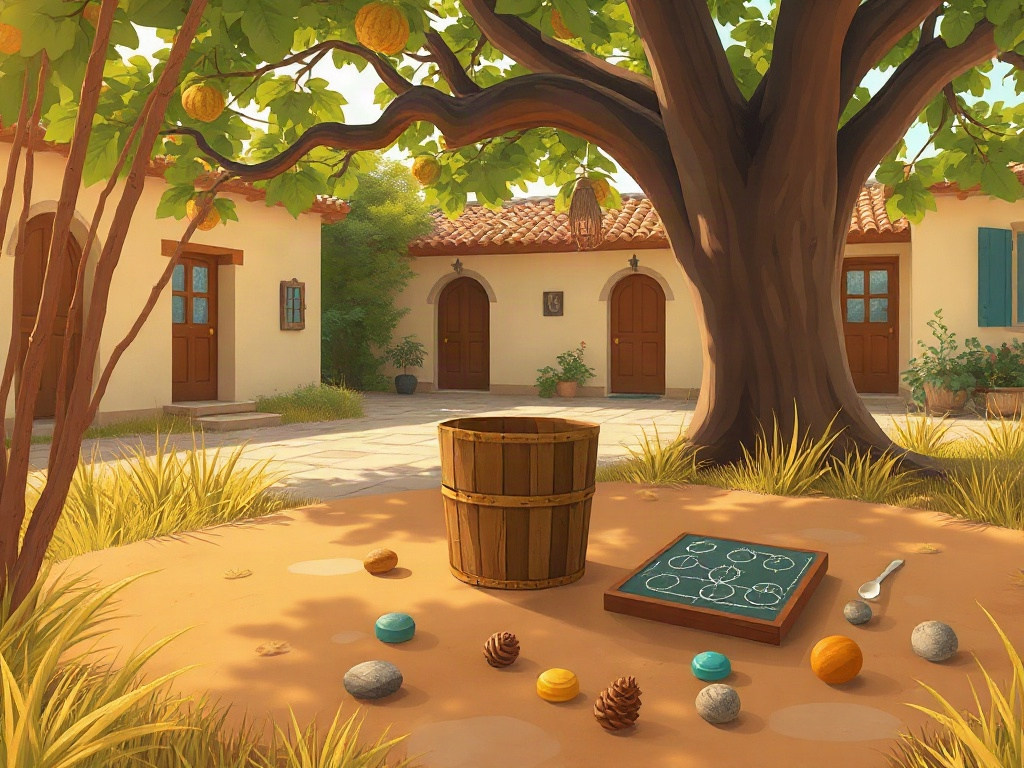
All you need is stuff already lying around the yard: a bucket or cardboard box for the "treasure chest," six to eight small objects (bottle caps, pebbles, pine cones, an old spoon), and a piece of chalk or a stick to draw on the ground. The game runs 25-30 minutes and works for ages 5 to 11, as long as the roles are assigned. The oldest hides the objects around the yard but is only allowed six hiding spots, and must draw a simple map with six circles on the ground — they're the mapmaker and don't search. The middle child searches; they're the only one allowed to touch the hidden objects. The youngest is the "thermometer": they stand by the treasure chest, and whenever the middle child gets close to a hiding spot they shout "hot," and when they move away, "cold." That's their only job, and they do it for the whole game. Once everything's found, the roles rotate: the youngest hides (only three objects, with help from the oldest), the oldest searches, the middle one becomes the thermometer. Count it a success if both rounds finish without you getting up from your chair, and if the youngest shouted "hot" at least ten times — that means they were genuinely in the game, not on the sidelines.
If you have a car port, a tree, or even a rope strung between two posts, the second game holds attention even longer, because it builds up a running score.
The Ant Bridge
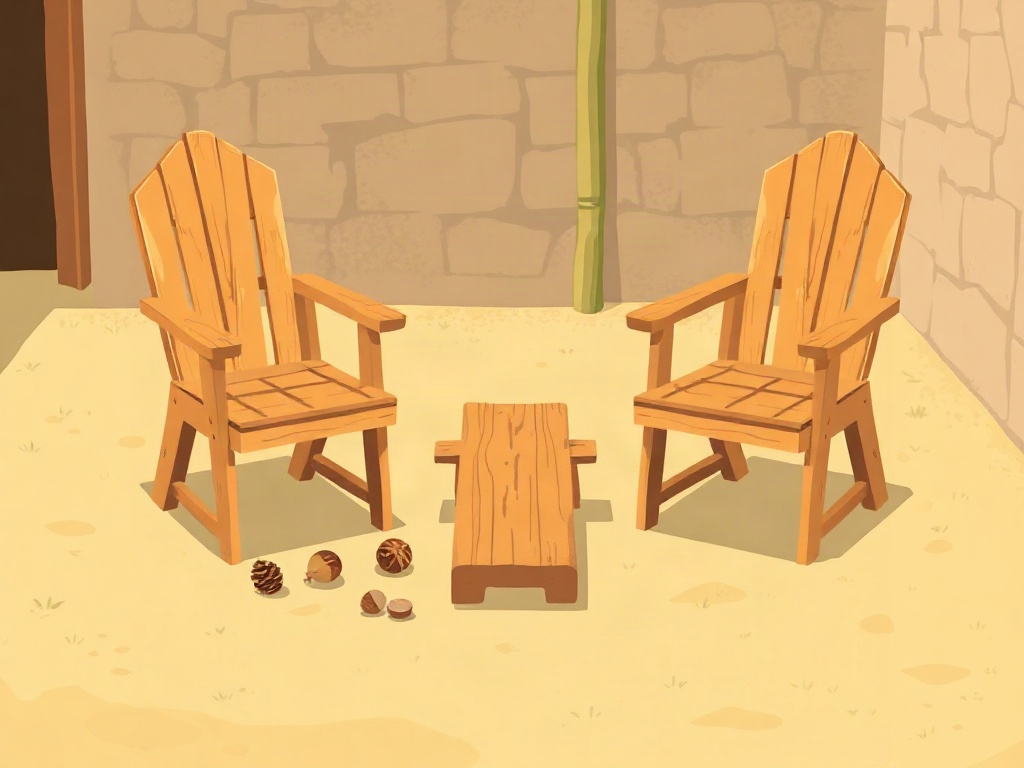
You'll need two chairs or two rocks set about five to six meters apart, a plank or a straight stick, and about ten "loads" — pine cones, walnuts, bottle caps, small stones. It takes 20-25 minutes and works for ages 5-11. There's one rule: the load must travel from one end to the other without touching the ground, and no one is allowed to carry it the whole way alone. The youngest stands at the start and hands off the load — their word is "ready." The middle child carries the load to the midpoint, where the plank or stick is placed, and must walk across it without stepping off to the side. The oldest takes over from the midpoint, but with one added challenge: they carry the load on the back of their hand, or balanced on a small board. Count the dropped loads. The goal isn't zero — the goal is for the second round to have fewer drops than the first. If they drop a load, they only go back one step, not all the way to the start; otherwise the little ones give up. You'll know it's working when they say, on their own, "let's go again, we'll drop fewer this time" — that's the moment the game becomes theirs, and you can go refill your coffee.
The most common mistake: putting the oldest child in charge
It sounds logical — they're eleven, they can keep an eye on the little one. In practice, that's not a role, it's a job. After seven or eight minutes the oldest stops playing and starts managing: "Not like that," "I told you," "Wait." The middle one gets annoyed at being bossed around, the little one senses she's being tolerated rather than included, and eventually all three end up at your feet — exactly what you were trying to avoid.
The difference between "being in charge" and "being the referee" is small in words and huge in practice. Whoever's in charge is responsible for the people; the referee is responsible for the rules. Give them something concrete: they keep score, they watch the clock, they decide whether a load has fallen or not. When their authority is limited to one specific thing, they enjoy exercising it and stay out of everything else.
A second mistake of the same kind: promising a prize at the end. "Whoever wins gets a €2 ice cream." Then the game stops being a game and becomes a competition with a foregone outcome — and in a contest between a five-year-old and an eleven-year-old, the winner is known in advance. If you want something at the end, make it shared and independent of the result — cold juice for all three, say, once both rounds are done.
"I'm the thermometer, I get to say when it's hot!" — when the youngest child describes their role with pride instead of complaining that they don't count, the game has been built right.
What to do right before you sit down
- Say out loud when it ends: "You play two rounds, then you come find me." A five-year-old doesn't understand "half an hour," but they understand "two rounds."
- Point out the boundary with your hand: "From the tap to the gate. Not past that." One sentence, shown, not explained.
- Assign the roles by name and have each child repeat theirs back in two words. If the youngest can't repeat it, the role is too complicated — shrink it down to a single sound.
- Agree on what happens during a dispute before there is one: "If you can't agree, the round counts as a tie and you start over." That removes any reason to come find you.
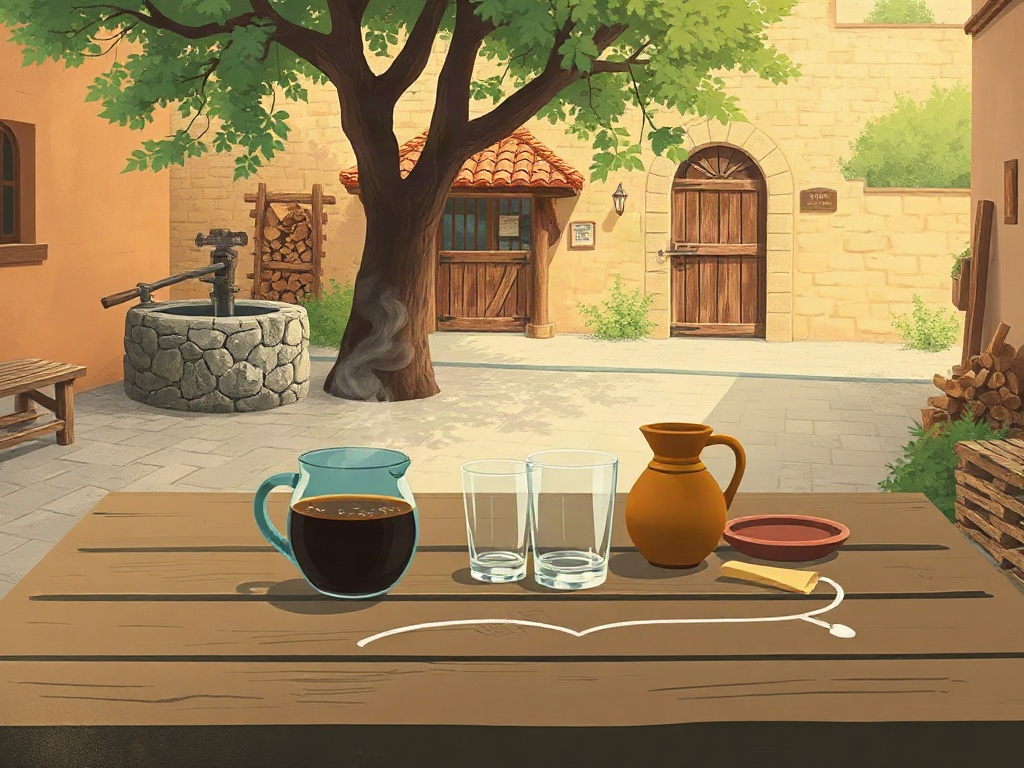
- Leave water and cups on the table. Half of all interruptions are about thirst, not fights.
And one more thing rarely said out loud: half an hour is a lot. If the first time you only manage seventeen minutes, that's a win, not a failure. The second day, the same game runs longer, because the rules are already known and don't need explaining. So don't switch games every afternoon — repetition is what stretches out your time under the tree.