
Back to School Blues After the Long March Weekend: 2 Games for Parents of Kids Who Won't Hear About School
A guide for parents of 7-10 year olds. On Sunday evening, after three days off around the March holiday, your child says "I'm not going." Instead of a lecture about responsibility — two quick games that beat the back to school blues without a single explanation.
Sunday, 8:10 pm. The backpack has been sitting untouched by the door since Thursday. Your child is lying face-down on the rug, still wearing their martenitsa — the red-and-white thread children in Bulgaria and across the Balkans put on for Baba Marta on 1 March and keep until they spot the first sign of spring — and says: "I'm not going tomorrow. I hate school." You take a breath and start the sentence you've already said three times this year — about how important it is, how quickly the day will pass, how happy they'll be to see their friends. It doesn't work tonight, and it didn't work the three times before.

This piece is written for parents, and the two games in it are built for children between 7 and 10 — the age when a child can already put a refusal into words, but still can't switch on their own from three days of freedom to a world of bells and homework. It's easy to read as laziness or stubbornness. Usually it's something else: the back to school blues that show up at the end of any long weekend.
Why the "school is important" talk never fixes the back to school blues
When your child says "I'm not going," they're not actually arguing against the value of education. They're expressing a feeling: school seems distant, heavy and foggy to them. Three days off a schedule is enough to blur the details — who sits where, how far you'd got in maths, where the blue notebook is. All that's left is the general weight of the word "school."
And you answer with an equally broad word: "it's important." A hazy feeling, met with a hazy reply. That's why the conversation just goes in circles and ends either in raised voices or a hug, after which nothing has actually changed.
The opposite approach works — bring back the details. Not through explanation, but through a hands-on activity that takes under fifteen minutes and never once says the word "tomorrow."
Backpack Detective
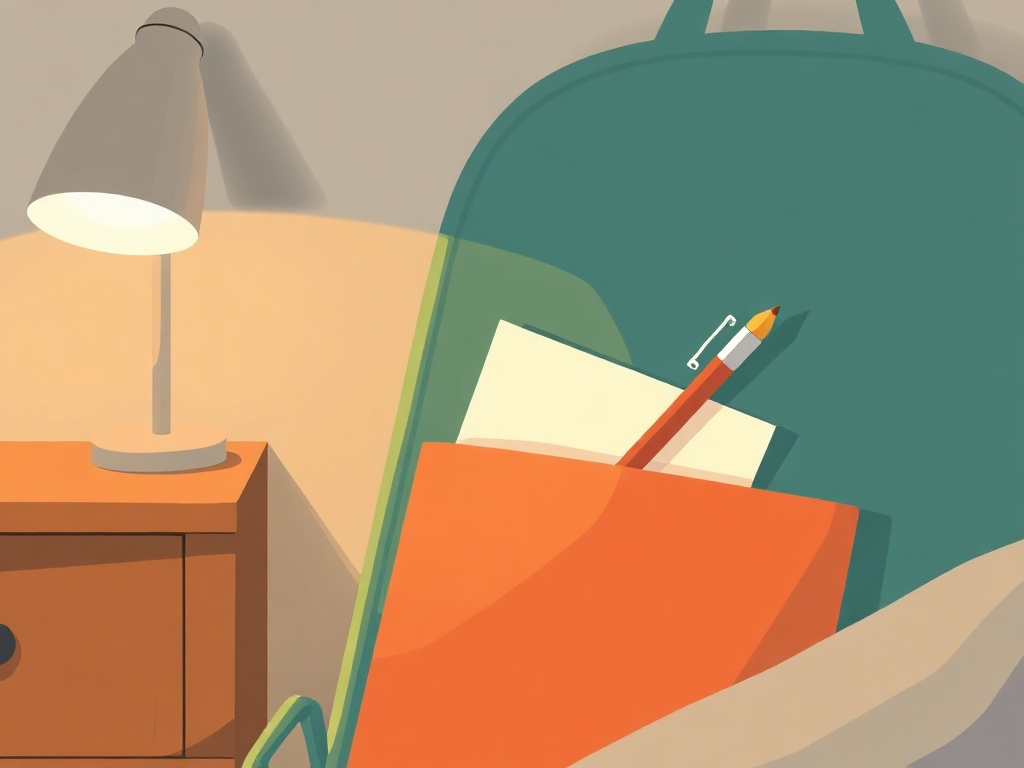
Tip the entire backpack out onto the floor — yes, all of it, crumbs included — and play detectives. Your child is the agent, you're headquarters. The mission: find and list out loud seven things that prove last week really happened. Anything with a name, a date or a person attached counts: "spelling test, I got an A," "drawing of a snowdrop," "note from Mrs. Johnson," "Martin's pencil, I borrowed it." "Textbooks" or "notebooks" don't count — send them back to name which book and how far they'd got in it. For each item found, you just say "confirmed" and write it down on paper. You barely need anything: the empty backpack, a sheet of paper and a pen; it takes 10–15 minutes and suits ages 7–10 exactly. The sign it has landed is your child reaching item seven and carrying on unprompted — often by item five or six they've stopped naming objects and started telling stories about them.
What's actually happening here: tipping everything out is physical, noisy and a little bit forbidden — kids love being allowed to make a mess. While rummaging through it, your child reminds themselves, on their own, that school is a place with familiar people and unfinished business, not a punishment waiting at the end of the weekend. Nobody told them that. They discovered it.
Three Questions for Tomorrow
Sit facing each other, and your child has to come up with three questions they don't know the answer to — questions that will only be answered tomorrow, at school. They can be completely silly — "Did Danny get his haircut?", "Is PE going to be outside?", "Will Mrs. Peters forget about the homework?" Write them down on a small slip of paper, have your child fold it up and tuck it into the front pocket of the backpack. The next day, when they get home, pull the slip back out and check the answers together. A slip of paper and a pencil are the whole kit, and five to eight minutes is enough; ages 7 to 10 all manage it, though with 7-year-olds you might help out with the first question as an example. You'll know it landed when your child digs the slip out on the walk home, before it has even crossed your mind.
This game does something a pep talk never can: it turns tomorrow from an obligation into an open question. An unanswered question tends to stay open in the back of your mind, and you quietly start waiting for the answer. And a child who's waiting for something is no longer running from it.

The most common mistake: paying them off with a reward
The temptation is huge. "If you go tomorrow without a scene, I'll get you something from the shop on Friday." A couple of euros, drama over, everyone's happy. For tonight.
The problem shows up next time. The reward tells your child: "You're right, tomorrow is something unpleasant — so unpleasant that it has to be paid for." You've just confirmed the very point you were arguing against. And since a price has now been set once, next Monday's negotiation starts from there, not from zero. It's a familiar pattern for many families: the amount quietly creeps up over a few months while the scenes stay much the same.
- Don't ask "why don't you want to go" on Sunday evening — your child doesn't have a ready answer, and they'll invent a reason to cling to later (my tummy hurts, Nick's been mean to me).
- Don't promise that "tomorrow will be fun" — if it isn't, you lose their trust right before the next long weekend.
- Don't start with homework. Bring back the feeling of the place and the people first, the notebooks after — otherwise the first thing they associate with school is a task they've been putting off for three days.
- Don't run both games back-to-back in the same sitting. Backpack Detective is for Sunday afternoon, Three Questions is right before bed.
If the morning still goes badly
Some mornings, no game from the night before helps, and your child cries at the door. In that case, the only thing that works is shrinking the horizon. Not "the whole day," but "until first break." Say it plainly: "You're going until first break. If it's still awful after that, we'll have a proper talk tonight." It's a short, doable sentence — and, crucially, you actually follow through: that evening, you ask and you listen without commentary.
Your child isn't resisting school. They're resisting the lack of detail about it.
The March long weekend comes round every year, and by mid-March the tiredness has already built up on both sides. That's exactly why it's worth turning these two games into a ritual rather than a one-off rescue against the back to school blues. Do them three long weekends in a row and your child starts to expect them — and there's a fair chance that by the fourth time they'll sit down on their own and ask where the slip of paper is.