
60 Minutes in the Dentist's Waiting Room: Two Quiet Games That Need Nothing but You
A practical plan for an hour of waiting with kids aged 5-7 at the dentist's office — four quiet games that work without a phone, without printouts, and without disturbing other patients.
A Friday afternoon in January, quarter past three. You've booked the whole family for the annual check-up, because that's the sensible thing to do — one visit, everyone gets seen. At the front desk you're told there are two people ahead of you. You sit down. The older child has already read every sign on the wall, and the younger one has slid off the chair and is lying flat on the floor. Fifty-five minutes to go.

The usual advice here is "bring something to distract them." Colouring books, a story book, a phone. The trouble is that distraction only fights boredom, and in a waiting room boredom is only the second-biggest problem. The first is the body. A five- or six-year-old can't sit still for forty minutes — not because they're naughty, but because it's simply not possible. Colouring doesn't fix this: the child leans over, sits up, hunts for the blue pencil, drops it under the chair of the man opposite, crawls after it. You've occupied their attention, but their body is still roaming the room.
The games below are chosen on a different basis: the child stays in the chair, hands are either busy or still, the voice is quiet, and the attention goes on something that doesn't run out after three minutes. They're written for ages 5 to 7 — the age when a child already understands a rule but still can't wait in silence.
Why a waiting room is harder than a supermarket queue
In a supermarket, the queue moves. You can see the people ahead of you shrinking in number, and that alone is information — the child senses that something is happening. At the dentist's, the door opens at unpredictable intervals, and nothing changes in between. There's no window onto the process. For a small child, that's like waiting for something that might never come at all.
So the first thing to do, before any game, is make the waiting visible. Ask at the desk how many people are ahead of you, and say the number out loud: "Two. Once two people have come out through that door, it's our turn." Then give each child two small objects — pebbles, buttons, two paper napkins folded in four. Every time someone comes out, the child sets one aside. It's a small thing, but it changes the whole tone of the hour: the child isn't waiting endlessly any more, they're counting down.
The Quiet Detective
You need nothing at all — just the room you're sitting in. The game takes 10 to 15 minutes and suits children aged 5 to 7. One parent picks an object visible from where the child is sitting: the clock, the door handle, the blue sign, the plant in the corner. They don't say what it is. The child asks questions that can only be answered with "yes" or "no", and must whisper them — that's part of the rule, and children take to it more easily than you'd expect, because whispering feels like part of the game rather than a restriction. Real questions at this age sound like: "Is it made of wood?", "Can you touch it with your hand?", "Are there letters on it?". If the child gets stuck, help with a leading question — "Ask whether it's up high or down low." Then swap roles, and the child picks the object while you ask. Call it a win if the child has asked at least five questions before guessing, and has stayed in the chair the whole time. With two children, let the older one pick the object — the younger one is usually better at asking questions than at thinking one up.
Fingers Tell a Story
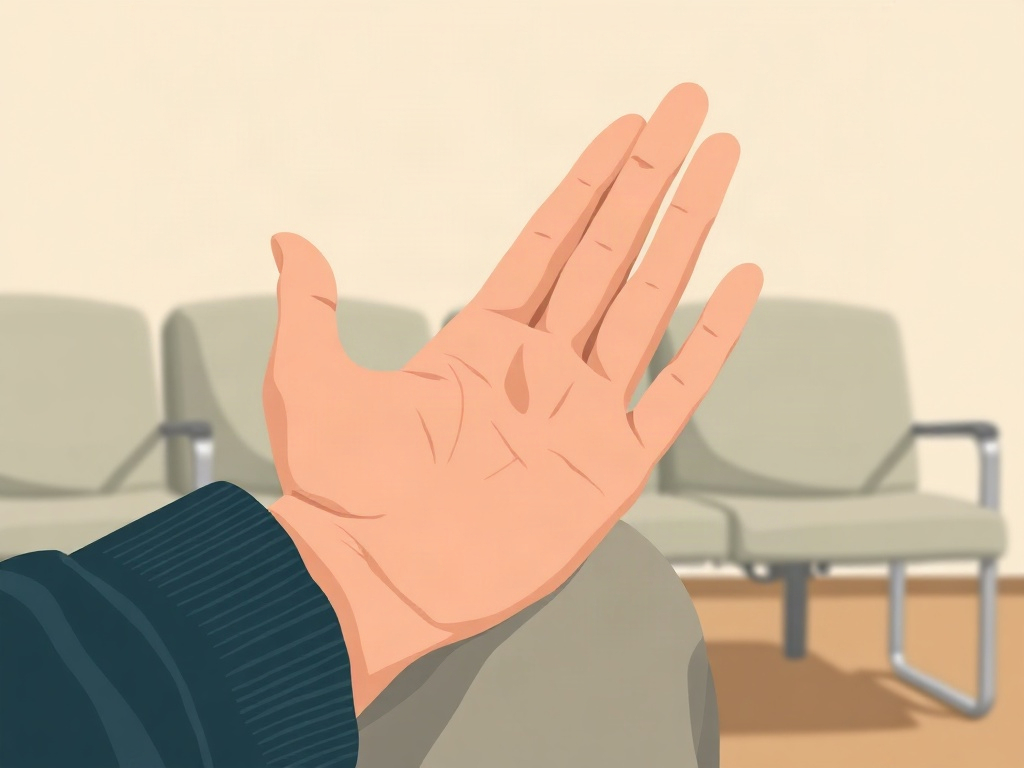
All you need is your hands and a little patience for the first two minutes. It takes 8-10 minutes, suits ages 5-7, and is a lifesaver exactly when the child can no longer bear to sit up straight. Take the child's hand, palm facing up, and with your finger slowly trace a letter or a simple shape on their palm — a circle, a cross, a wavy line, the letter O. They have to guess what you drew without looking. Then it's their turn to draw on your palm. It works for two reasons: it demands complete silence for the child to concentrate, and it gives physical contact that eases the tension before the check-up. For the older ones in the group, move on to short three-letter words. You've succeeded if the child has guessed at least three shapes in a row and has only asked for one more circle. If the child pulls away from touch at this point, stop — sometimes, right before a check-up, they simply don't want to be touched.
Two games for when the first ones stop working
- The one-sentence story: start with "One day a horse walked into a lift" and everyone adds exactly one sentence. The "one sentence" rule matters — otherwise the older child takes over the whole story. If you're in public and don't want to be overheard, tell it in a whisper — that only makes it funnier.
- The forbidden word: pick a word that can't be said for the next ten minutes — "yes", say, or "tooth". Whoever says it loses a point. The game is quiet, demands attention to your own speech, and works surprisingly well with seven-year-olds.
- Counting through the window: if the waiting room has a window onto the street, each child picks a car colour and counts. In January the streets are busy, so grey and white get counted too fast — pick rarer colours so the game doesn't end in two minutes.
- Who blinks first: you stare into each other's eyes without blinking. It lasts thirty seconds but gets a laugh and can be repeated ten times. Use it as filler between the other games, not as the main event.
The most common mistake: the phone as the first move, not the last
It's understandable — you sit down, the child starts fidgeting, you pull out the phone, and silence falls. The trouble is what comes next. After twenty minutes of screen time, the child walks into the surgery with a focus that's hard to interrupt, and the adult has to break it by force, right before a procedure that already makes them uneasy. You take the phone away at the single worst moment of the whole afternoon. The meltdown the other parents in the waiting room hear is almost never about the dentist — it's about the screen being taken away.
If you are going to use a phone, flip the order: games first, while the child still has the resource for it, and screen time only in the last ten minutes, as something that will be set aside naturally the moment your name is called. Even better — put on something you watch together, not alone. It's easier to stop that way.
A second common mistake: promises like "if you're good, I'll buy you something." With two children in a waiting room, this instantly turns into a negotiation — who was better behaved, why did the other one get more. If you want to mark the day, do it in advance and equally for both: "When we're done, we'll stop by the café on the corner and everyone can pick something up to €3." Said before you've even sat down, that's a plan. Said halfway through the wait, it's a bribe, and children can tell the difference.
A child who has been busy with something and stops on their own walks into the surgery calm. A child who's just had something taken away walks in angry — and that has nothing to do with the dentist.
When the two children have different temperaments
The classic setup: the seven-year-old wants rules and points, the five-year-old wants to move. Don't try to fit them into the same game for the whole hour. It works better if you give the older child the role of leader — they pick the object, they keep score, they guard the forbidden word. The responsibility gives them something to do, and the younger one gets a more patient partner than you'd be on your own.
And one more simple thing: if there are two adults, have one take the more restless child out for five minutes into the corridor or by the entrance. Five minutes of walking buys fifteen minutes of sitting. That's not defeat, that's division of labour.
What to pack in your pocket before you leave
- Two small pebbles or buttons for the waiting countdown — two per child.
- A deck of eight to ten cards or photos, if you have one; useful both for putting in order and for a memory game on your lap.
- Water and something very light to eat that doesn't crumble — in a waiting room in the afternoon, hunger arrives faster than boredom.
- Nothing that makes noise. Leave the toys with buttons and sound effects at home; in a waiting room, they work against you.
Planned this way, the hour stops being an ordeal. You come out of it with children who've been occupied rather than children who've endured — and next January, when you say "we're going for a check-up" again, the reaction will be different.