
What to Do With Your Child in the Eye Doctor's Waiting Room Before the First-Grade Health Form
Twenty to forty minutes of waiting outside the eye doctor's office in June, no phone and no meltdowns. Five games you can play with what's already in your bag — games that also get your child ready for the exam itself.
It's June, the hallway smells of disinfectant, and there are still four families ahead of you. Your child has already asked three times when it's your turn, you've already said "soon," and the nurse inside calls out yet another name. The phone is in your bag, and we all know it — it works. The problem is what happens next: your child walks into the exam room with eyes glued to a screen for the last fifteen minutes, and the first thing they're asked to do is look into the distance and pick out tiny shapes.
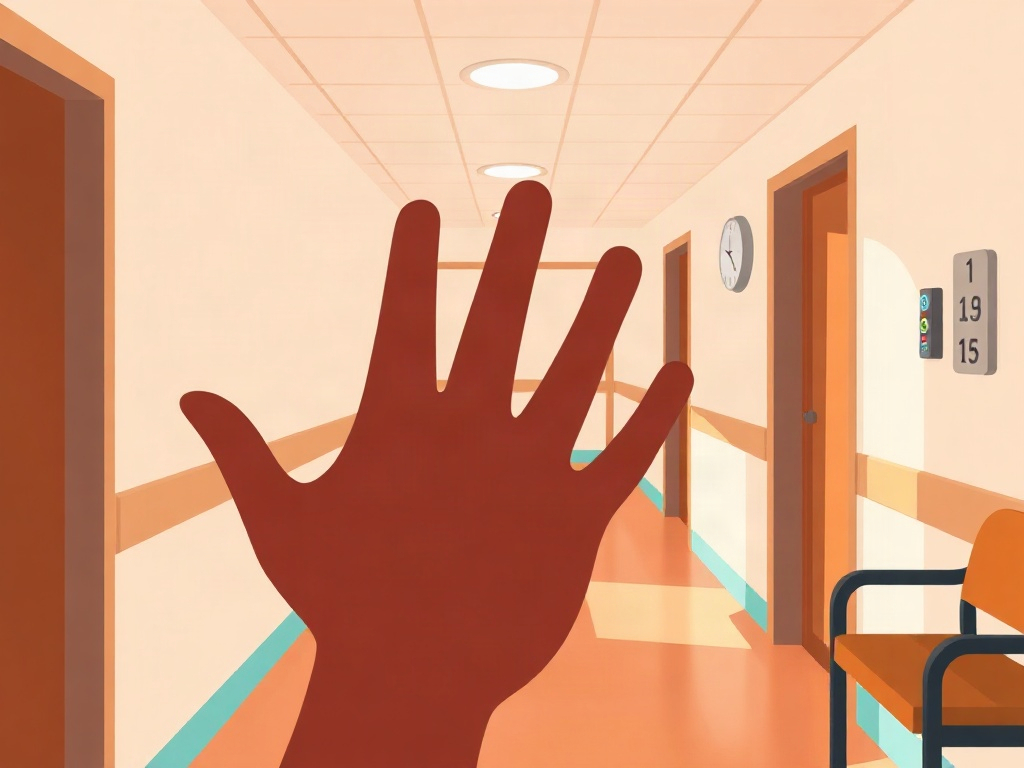
So I'm not going to write "give them a picture book." I'm going to write something more specific: the waiting room is a rehearsal. Everything they do at the eye exam — cover one eye, look far away, say what you see, hold still for the photo — can be turned into a game right there in the hallway. And by the time you walk in, your child already knows the moves.
This is written for children between 5 and 7 — the ones starting first grade this autumn or currently in the pre-school prep group. Younger kids can't handle the rules; older ones find them boring.
Why the phone in the waiting room works against you
It's not about "harmful blue light" — I won't get into that debate. The reason is simpler and more practical. On a screen, a child looks at something roughly thirty centimetres away, holds still, and doesn't talk. The exam asks for the opposite: looking into the distance, shifting focus, answering out loud. The switch is abrupt, and the child responds with silence or "I don't know." The doctor asks "which way is it pointing?" and the child just shrugs — not because they can't see it, but because they haven't said a word in the last twenty minutes.
Second point: taking the phone away right before the door feels like confiscation. The child walks in angry. If instead you're playing something that ends naturally — "we got to ten, that's it" — walking in becomes a continuation, not an interruption.
The game that rehearses the exam itself
Pirate Eye
You barely need anything — just your child's palm and something to look at down the other end of the hallway: a sign, a clock, a door number, a poster. The game takes five to ten minutes and works best with children aged 5-7. Say: "Now you're a pirate. Cover one eye with your hand, but don't press on it — just block the light." Then ask what they can see with the other eye: how many letters are on the sign, what colour the clock's hand is, whether there's a little figure on that poster. Then switch eyes and ask the same questions. If your child says "this one is blurrier," don't make a big deal of it — just remember it and mention it to the doctor inside. That's exactly the sort of thing they ask about. You've succeeded if your child has covered each eye in turn without peeking or giggling, and given one answer for each eye.
This game does double duty. Your child gets used to the sensation of looking with only one eye — for many kids that's the most unpleasant part of the exam, simply because it's unfamiliar. And you walk in with one more useful piece of information.
What if your child can't sit still?
The photo for the health form needs two or three seconds of stillness and a face without a grimace. Sounds easy. With a six-year-old who's been waiting half an hour, it isn't.
Statue on Three
You don't need anything except somewhere to sit facing each other. Two to three minutes is enough, and you can repeat it every ten minutes or so; it works for ages 5-7. Count slowly to three, and on "three" you both freeze — shoulders straight, hands on knees, eyes looking straight ahead, mouth closed, no clenched jaw. Whoever moves first loses. The first round you freeze for three seconds, then five, then seven. Between rounds your child can deliberately wiggle about — that actually helps. You've succeeded if your child can hold still for seven seconds with a straight back and without breaking into laughter. That's exactly what they'll be asked to do in front of the camera.
One small extra: rehearse the "photo face" too. Not an ear-to-ear grin, just a calm expression. Show it yourself first — your child will copy it and find it funny, which is even better, since they'll remember it.
Three games that need nothing in your hands
- Counting in our heads. Agree on a number to spot — say, 4. Then scan the hallway with your eyes, and each of you calls out where you've spotted a 4: on a door, a poster, a calendar, the scales. Whoever finds three first wins. Works just as well with the first letter of your child's name.
- Who's next. Quietly, just between the two of you, guess who'll be called in after you — not commenting on the people, just on the order. "After us it's the lady with the red bag." When it turns out to be right, your child feels like a detective, and the wait stops feeling like a fog with no shape.
- Telling the day backwards. Recount what you've done since morning, but start from the end: "We're sitting in the hallway. Before that we came up the stairs. Before that..." Let your child carry it on. You usually get all the way back to waking up — and by then the nurse has already called your name.
The most common mistake: promising "we'll go in soon"
We all do it. Your child asks when, and you say "soon" or "in five minutes." Fifteen minutes pass. Now your child doesn't believe you anymore, and next time you say "it won't hurt," they won't believe that either — and that's exactly the sentence you'll need inside the exam room.
A trick that actually works is counting people, not minutes. "There are three families ahead of us. Once the third one goes in, we're next." That's something your child can verify and track on their own, and it doesn't depend on you. Hand them the job of counting — that turns the waiting into their task, not yours.
A second common mistake: describing in detail what will happen inside while your child is already on edge. A long explanation sounds like a warning. One sentence is enough: "You'll look at pictures on the wall and say what you see." Play out the rest — don't explain it.
"There are three families ahead of us. You count — once the third one goes in, we're next."
What to bring if you know the wait will be long
In June the hallways are packed, because every health form has to be filled in before the school year ends in mid-June. Realistically, expect anywhere from twenty minutes to an hour of waiting.
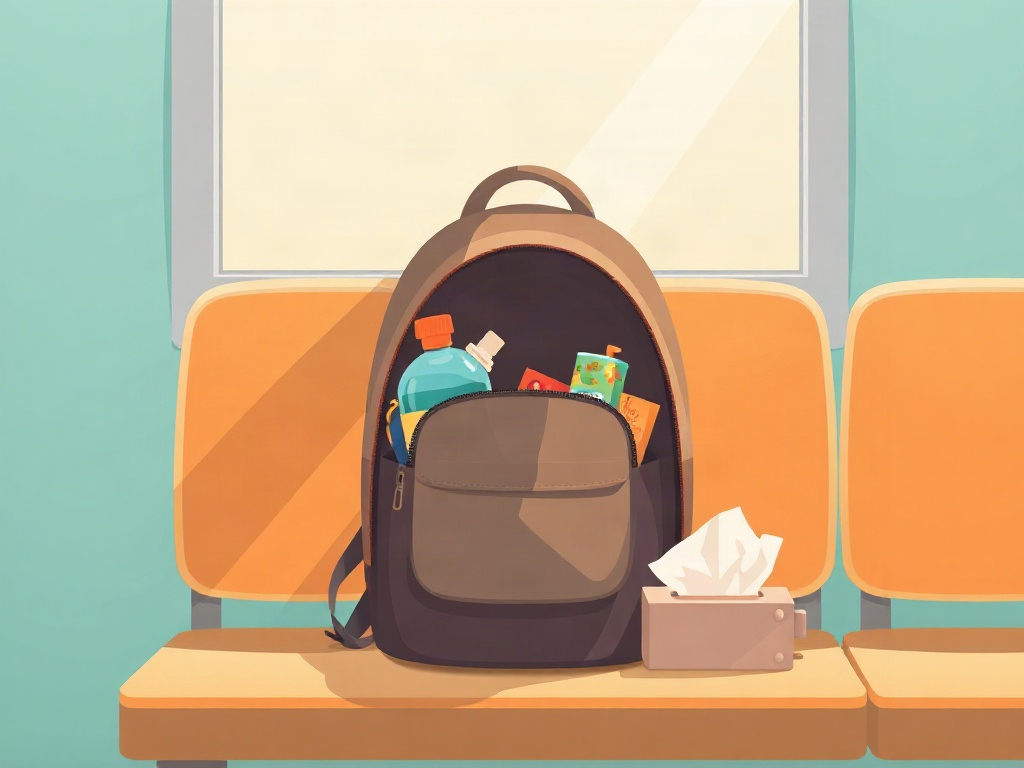
- A water bottle your child can open on their own. Thirst in a warm hallway hits fast and is a common cause of whining.
- Something salty or a piece of fruit, not sweets — biscuit crumbs become a problem right before the photo.
- A deck of cards or a small puzzle of up to 24 pieces, if you have one. A puzzle costing around €2-3 does the same job as pricier toys, as long as it fits on a lap.
- Wet wipes. For hands before the exam, since the nurse will ask your child not to rub their eyes.
- A spare t-shirt, if your child is the type who gets sweaty and irritable. For the photo it helps to be dry and calm.
The last two minutes before the door
The moment you hear your name, stop the game before you even stand up. Get up, say "game's over, it's our turn now," and take their hand. That small pause — three seconds of standing up — is more than enough to reset your child.
One more thing that helps more than it sounds like it would: agree in advance on a word your child can use if something bothers them. Agree on it out in the hallway. "If you don't like something in there, tell me 'wait a second' and I'll stop and ask." Your child walks in knowing there's a brake they can pull. Most of the time they won't use it — but that's exactly why they walk in calmer.
If you've played Pirate Eye and Statue on Three, you leave the hallway with three things: your child already knows what it's like to look with one eye, knows how to hold still for a photo, and has an agreed-upon word ready. That's more preparation than most children get, and it cost you nothing beyond the twenty minutes you were going to spend waiting anyway.