
After the End-of-Year Assembly: Sidewalk Chalk Games to Keep 7-9 Year Olds Busy Until Evening
The hour after the school celebration is the most chaotic of the whole year. Here are two sidewalk chalk games with simple rules that take two minutes to set up and need nothing more than chalk and bottle caps.
The assembly ended at 11:20. The flowers are in the trunk, two flower crowns are already crushed, and the schoolyard is full of thirty kids in their best clothes who don't want to go home. Parents stand around in little groups, chatting. Someone starts playing music from their phone. Seven minutes later, the first kid shouts "I'm bored!", and five minutes after that, two kids are chasing each other between the cars.
This is the moment nobody prepares for. And it's exactly when you hear the sentence that never works: "Go on, go play."

Why "go play" doesn't work right after the assembly
Free play is a wonderful thing — but it requires kids to come up with their own rules and agree on them. Right after an assembly, they're worn out from waiting, from standing in line, from rehearsed poems and from the attention of a hundred adults. The group is mixed: classmates, cousins, babies in strollers, kids from another class nobody knows. With a crowd like that, "go make up a game" means five minutes of arguing over who gets to be what, followed by the loudest kid forcing their version on everyone while three others storm off offended.
The opposite doesn't work either. A parent with a big idea — a relay with fifteen rules, teams, points, a finale — loses the kids before they even finish explaining. Between these two extremes is what actually holds a group's attention: a game with three rules, a round of three to four minutes, and a clear ending after which anyone can step out or stay in.
The two sidewalk chalk games below are exactly that. No prep needed, they don't fall apart if another kid joins halfway through, and nobody waits in line for more than a minute.
The Chalk River
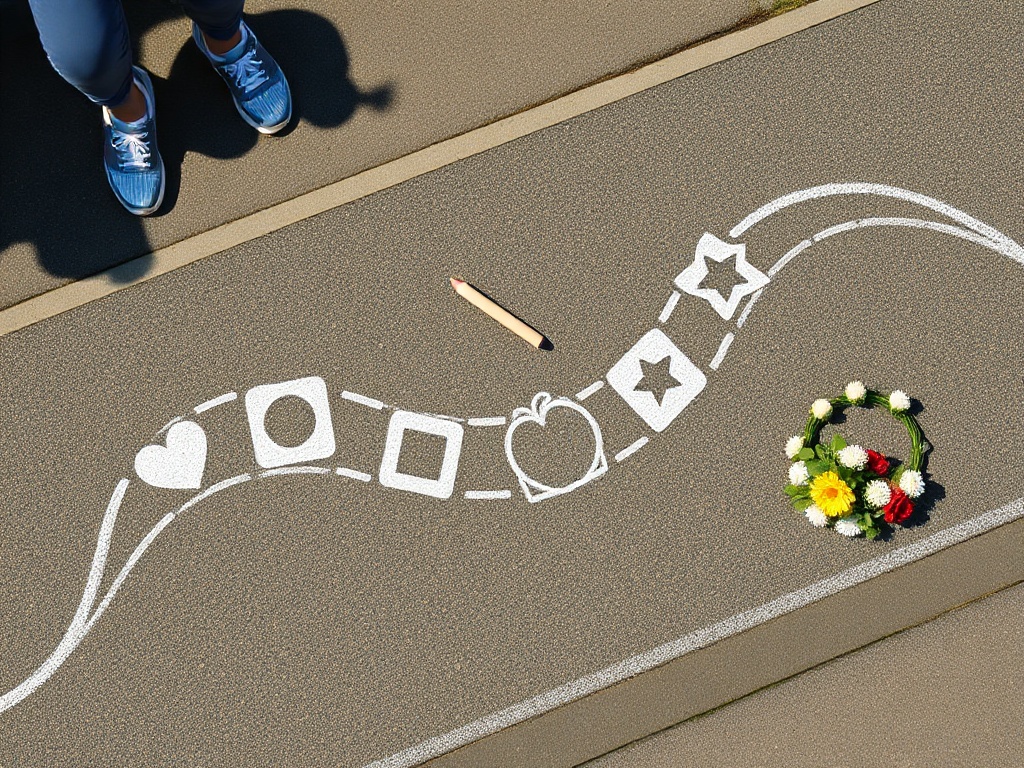
All you need is a box of chalk — some teacher usually has one in their bag, and a box costs about $2. Draw two wavy, roughly parallel lines on the sidewalk about six feet apart — that's the "river." Inside it, draw eight to ten "stones": circles, squares, stars, different sizes. There are three rules, and they take fifteen seconds to explain: you can only cross on the stones, if you step in the water you go back to the start, and you don't rush if there's a kid ahead of you. Then add one twist per round — hopping on one foot, crossing backwards, crossing while holding your flower bouquet, crossing in pairs holding hands. One round takes about 3 minutes, and the whole game can stretch to 20-25 minutes if the kids start drawing new stones themselves. Ages: 6-9, with younger kids using the bigger stones while older ones pick the harder route on their own. You'll know it's working if a child picks up the chalk without being asked and adds their own stone — from that point on, the game keeps going without you.
Bottle Cap Letters
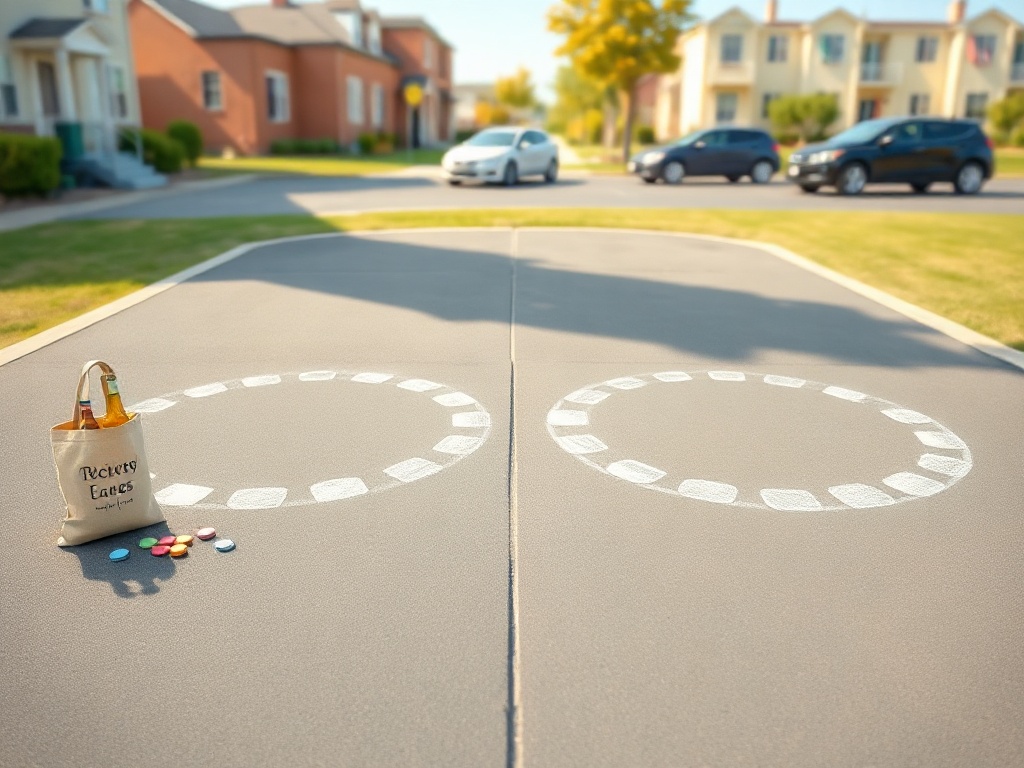
You'll need about twenty plastic bottle caps (six parents can collect that many in two minutes) and chalk again. Draw one large letter on the sidewalk — on the last day of school, it's usually the first letter of the name of whichever kid is throwing. Everyone stands on a line about ten feet away and tries to land three caps inside the letter. A landed cap means you have to say a word starting with that letter — and here's the twist: no repeating words. If the group has mixed ages, younger kids can say any word, while older ones have to give a two-syllable word or the name of a city. One throw takes under a minute, the game runs for 15-20 minutes, and it winds down naturally once you switch letters. Ages: 7-9, since it requires reading and quick word-finding. You'll know it's a hit if the kids start arguing over whether a word was already said — that means they're listening, remembering and following the game, not just waiting for their turn.
What to say to get the game going
Don't ask "Do you want to play something?" — a question aimed at a group of kids almost always gets silence or "no" back. Crouch down and start drawing. The first kid will come over to see what you're doing within about twenty seconds.
- "Look, this is a river. These circles are stones. Try to cross without stepping in the water."
- "You're second. Go once Ethan reaches the other side."
- "This game ends once everyone has crossed three times. Then we start a new one."
- "Who wants to draw the next stone? It can be a really hard one."
- "You stepped in the water — no big deal, back to the start. We're not racing."
Common mistake: turning the game into a competition with a winner
The temptation is strong — a race spikes the energy for a minute and parents see results right away. The problem shows up after the third round. In a mixed-age group, a seven-year-old simply can't out-jump or out-aim a nine-year-old, and kids keep exact count of their losses. What starts as a fun relay ends with two kids sitting on the curb with their backs to everyone else, and the sentence every parent knows by heart: "He's cheating!"
The practical fix isn't to ban competitiveness but to shift the goal: not "who's first" but "did we all make it." Counting does the same job but as a team — "eight crossings without touching the water, let's get to twelve." The group pulls together instead of splitting apart, and nobody walks away from the game feeling like a loser.
Four more things that usually go wrong
- Games that need full-speed running in a yard full of parked cars and strollers. Pick something where the movement happens in place or over short distances.
- Explanations longer than thirty seconds. If the rules don't fit in three sentences, the game is wrong for the moment.
- Long waits for a turn. More than six kids in one round means drawing two rounds side by side, not one long line.
- Elimination games — "whoever messes up is out." The exact kid who most needs to stay in the game is the first one out, and then spends the next hour circling around their parents.
How to tie the game to the end of the school year
The last day of school is both a celebration and almost a finish line — only a few days remain until mid-June. That's why the Chalk River works even better if the stones carry names: first grade, second grade, summer. Kids call them out as they cross. It sounds like a small thing, but on this particular day, they love announcing out loud how far they've come.
As for the bottle caps, leave them in a plastic bag in the car trunk. You'll need them again — at the beach, outside the building, at the first birthday party where you're stuck waiting half an hour with nothing in your hands.
The game after the assembly doesn't need to be more exciting than the assembly itself. It just needs a beginning, rules, and an end.