
A Parent's Guide: How to Cook for Christmas Eve With a 5-8 Year Old, Without Getting in the Way
A parent's guide to Christmas Eve with kids: you don't need to invent "kid jobs" just to keep a child busy in the kitchen. There are real steps on the Christmas Eve menu that a 5-8 year old can do better than an adult - if you give them a real job with a clear finish line, with a parent setting it up and supervising throughout.
The pot of beans is simmering, the oven is full, and the pie dough is waiting. And right then a five-year-old climbs onto the stool by the stove and says, "What can I do?" The answer "not now, go play" lasts about four minutes. Then comes the second visit, the third, and eventually someone loses their temper - usually the adult. If that is how Christmas Eve with kids goes in your kitchen, the fix is not more patience but a better job description for the 5-8 year old at your elbow.
Everything below is written for the parent doing the cooking: you decide what your own child is ready for, you set up the workspace, you supervise the whole time, and you stay in the room. One safety note before anything else: several of these jobs involve small items - walnut halves and shell fragments, rolled paper slips, jar lids - which are a choking risk, so keep them on a surface you can see, never leave a child alone with them, and keep them well out of reach of toddlers and babies.
The usual advice is to give the child "something kid-sized" - a lump of dough to knead off to the side, napkins to fold. It rarely works. The child senses this isn't the real dinner, just busywork, and heads straight back to the pots. At 5-8 years old, kids spot the difference between "a real job" and "a job to keep me occupied" instantly.
Why kitchen games fall flat on Christmas Eve with kids
Because on this day the kitchen runs at full tilt. Many families cook a big meatless spread for Christmas Eve - in some traditions it's a set count of dishes, seven, nine or eleven of them, and even without a fixed number there's usually more on the stove than on any other night of the year. Everything has to be ready before the guests sit down, and there's only one oven. The adult has zero spare bandwidth to explain things. So the child's task has to be one you can explain once, in thirty seconds, and that then runs itself - close enough that you can still keep an eye on it.
Three things make the difference, and all three are purely practical.
- Their own spot. Not right by the stove, but at a table or on a cutting board on the floor - far enough away that you're not saying "move back" every two minutes, and still inside your line of sight.
- A task with a number. Not "sort the nuts," but "sort this bowl of walnuts onto three plates, and set aside twelve whole halves for the dessert." The number is the finish line. Without a number the task never ends, and the child gives up halfway through.
- One tool that's theirs for the evening. A small wooden spoon, a plastic rolling pin, the sieve. Once a tool has an owner, the "I want to stir too" argument disappears.
Which real menu tasks a 5-8 year old can actually take on
This is where adults underestimate kids. A five-year-old picks over walnuts more patiently than you do. A six-year-old arranges dried fruit for the poached-fruit compote more symmetrically. A seven- or eight-year-old can count out fortune notes for the pie without a mistake, as long as the number is fifteen or under. (Fortune notes are a Balkan and Slavic Christmas Eve custom: small slips of paper with a wish or a prediction written on them are baked into the festive pie, and everyone reads out the one hidden in their own slice.)
- Picks the last bits of shell out of freshly cracked walnuts - lifting the fragments out with a teaspoon or a pair of kitchen tongs into a separate bowl, so nothing sharp or small is left loose on the table, with an adult sitting alongside.
- Rinses dried plums and figs for the fruit compote under running water in a colander.
- Rolls up and arranges the little fortune notes in buttered paper.
- Stirs the rice for stuffed peppers or stuffed grape leaves by hand before filling, and brushes the pastry sheets with oil using a pastry brush.
- Shapes soft things without any blade at all: tears cooked pumpkin or banana into pieces by hand, presses shapes out of a slice of cooked beetroot with a plastic cookie cutter, or breaks bread for the stuffing - on a board, sitting down, with an adult at the same table. All the cutting on the Christmas Eve menu is grown-up work: knives, graters and peelers stay with the adults.
- Lays out the grape leaves one by one for the stuffed leaves and counts them out loud.
"I counted them - there are nineteen, so there aren't enough for everyone." A sentence a six-year-old says with complete seriousness, if their job was to count, not just to "help."
The Walnut Factory
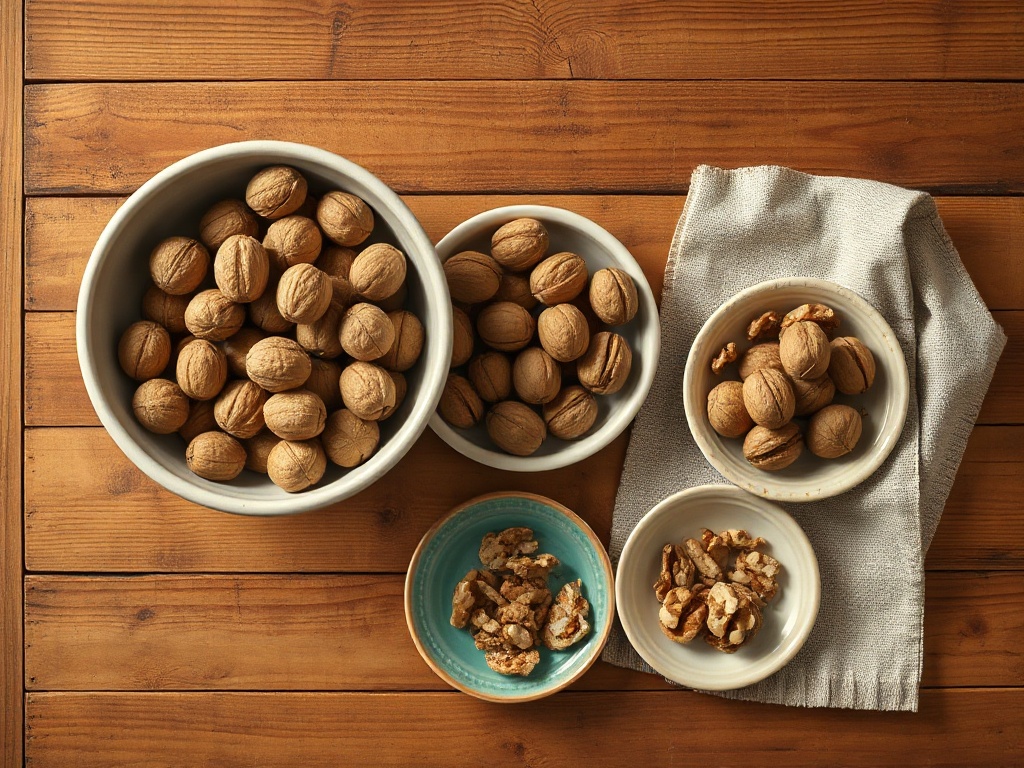
Spread a clean cloth on the table, tip out a bowl of freshly cracked walnuts - kernels with bits of shell still mixed in - and set three small plates beside it - that is the entire setup. Shell fragments and walnut halves are small enough to choke on, so this one stays at the table where you can see it, not carried off around the house. Work like this tends to hold a 5-8 year old's attention far longer than an open-ended request, but how long that lasts differs from child to child, so plan by the bowl rather than by the clock. Sit the child at the table and give them an exact goal: whole halves go on one plate, broken pieces on the second, shell fragments to throw away on the third - the sharp little fragments lifted with a teaspoon rather than pinched up by hand. Tell them how many whole halves you need to decorate the dessert - say twelve - and count them out loud together. The job is done when the bowl is empty and there are twelve whole halves on the decoration plate, and the child can say what went where and why. If they only set aside ten whole ones, that still counts as a win - what matters is finishing the sorting down to the bottom of the bowl.
Keeper of the Fortunes
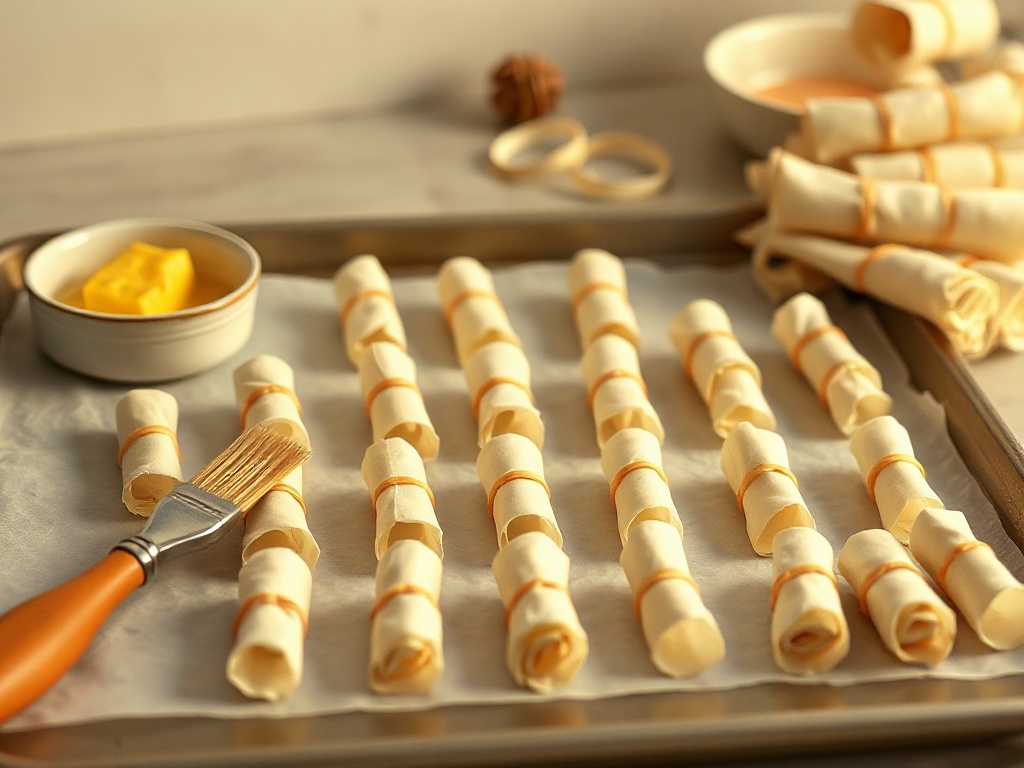
Cut the little slips of paper yourself first, then put out thin baking paper, a pastry brush with a bit of butter and a tray; from there the whole thing is usually a short, self-contained job, done at the table alongside you, since the rolled slips are small enough to end up in a younger sibling's mouth. The adult writes the fortunes - "health," "joy," "new friends," "lots of laughter" - and the child rolls each slip into a tube, wraps it in a scrap of paper, and lines it up on the tray. Say exactly how many are needed: one fortune per guest, plus two spares. If the child can already read, have them read each one aloud before rolling it up - that way they know who gets what, and later at the table they'll guard the secret with enormous delight. You know it's done when the tray holds the exact number of rolled fortunes, each wrapped so the writing doesn't show. If one comes unrolled - they just roll it again, that's part of the fun.
Three mistakes to avoid on the night
"Help me out" and "stir this" sound sweet, but to a five-year-old they're endless. The child doesn't know when it's done, so they don't know when they've succeeded. After three or four minutes they drop the spoon, wander off to a screen, or try to open the oven. The adult reads this as "doesn't want to help." Really, the task just never had a finish line.
The second most common mistake is the opposite extreme - handing over five tasks at once so the child is "occupied through the whole cook." The child starts three of them and finishes none, and the kitchen ends up messier than if they hadn't helped at all. One task, one number, then a break. If afterward they want more - give them a second one.
And the third: redoing their work in front of them. If you rearrange the walnut halves "the right way" right after the child has set them out, next year they won't want to help at all. If something genuinely needs redoing - do it once they've left the room.
Christmas Eve with kids who would rather play than cook
Plenty of 5-8 year olds would rather play than work, and that is still a fine way to spend the evening. In that case, turn the kitchen into a stage set rather than a workstation. Two games work well while your back is turned, and both use what is already out for the Christmas Eve table: "guess the smell" - hold the spices you've just opened for the pie and the compote, cinnamon, orange peel, cumin, dried mint, under their nose and let them guess with their eyes closed; and "round-thing hunter" - the child circles the table and finds ten round things from the dinner spread: an apple, a walnut, a jar lid, a plate. Small finds stay on the table, not in pockets. Even in play, the count is what makes it work. Ten, not "as many as you find."
If you've got a younger second child, give them the sieve and a bit of flour on a tray - and only once they're past the stage of putting everything in their mouth, with you right there beside them and the small items from the older child's job kept up on the table. They'll sift, spill, sift again. Twenty minutes of quiet in exchange for five minutes of sweeping up afterward - on a night like this, that's usually a trade worth making.
What's left after Christmas Eve dinner
When the guests sit down at the table and someone asks, "who picked over these walnuts," the child's hand shoots up. That moment is what the whole evening was building toward. You didn't keep them busy just to get them out of the way - you gave them a real part of the dinner, one with a name and a count of its own. Next year they'll come find you on their own and ask when they get to start on the fortune notes.
One last practical note for the parent doing the planning: there's no need to buy anything special. A kid-sized wooden rolling pin or a set of plastic cookie cutters is cheap enough, but the bowl, sieve and old spoon already at home do the same job just as well. The tool matters only because it's theirs for the evening, not because it's new.